DeFi 3.0: Is the day of lying and winning finally here?

Original author: 0x137, Rhythm BlockBeats
After the DeFi summer last year, the entire DeFi field has entered a period of dormancy, and TVL and Token prices have dropped significantly. But it is gratifying that DeFi has not stopped innovating. In less than half a year, DeFi 2.0 was born in the form of "protocol to control liquidity", trying to solve the problem of unstable liquidity in 1.0. Now, DeFi 2.0 has not even gained a firm foothold, and DeFi 3.0 under the banner of "Farming as a service" has already been killed. So what is the difference between DeFi 3.0 and 2.0? What problem does it solve?
Money Lego for leeks
In the field of DeFi, we often see a word - "money lego". This metaphor vividly captures the characteristics and potential of DeFi, For this field, it is difficult to have a future by fighting alone. Only by joining together like building blocks can a huge empire be built. DeFi 3.0 is built on the basis of DeFi 1.0 and 2.0, and provides efficient and professional farming strategies as a service to ordinary people who are relatively unfamiliar with DeFi or Crypto, that is, "farming as a service".
Multi-Chain Capital (MCC) built on Ethereum is the first project to set off this wave. Users purchase MCC Token to provide funds for the agreement's treasury, and the project then uses these funds to participate in various other DeFi projects, and uses the income obtained from Yield Farming to repurchase MCC to promote the increase in the value of Token. In other words, the value of Token is an indirect mapping of the protocol’s Farming record, and all users need to do is hold Token.
This concept does not sound very new, after all, Yearn Finance already provided Similar services, but after carefully studying some representative DeFi 3.0 projects, you will find that they have indeed brought some new changes to DeFi:
Conform to the multi-span future and find the best choice for users
Guaranteed equal benefit, more sustainable income
Read "Public Chain Explosion vs Ethereum DeFi Weakness, Multicoin Capital Joint Venture Readers of "Tell You the Connection Behind" should know that one of the problems encountered by DeFi 1.0 is that institutions can rely on huge funds and complex algorithms to accurately snipe the liquidity of mining pools, resulting in the continuous loss of retail investors' income. extrusion. In other words, giant whales have become a major obstacle on the way to the popularization of DeFi 1.0. In order to solve this problem, DeFi 2.0 controls the liquidity through the agreement itself to ensure the stability of the liquidity, but it brings another problem, which is the sustainability of the income. The editor of Rhythm previously published "APY 70,000%, DeFi dominated by OHM forks" 2.0》 It is mentioned in the article that many DeFi 2.0 protocols provide high APY that cannot be sustained for a long time in order to quickly expand the treasury. Due to the rapid dilution of Token, the life of some protocols cannot even reach a week.
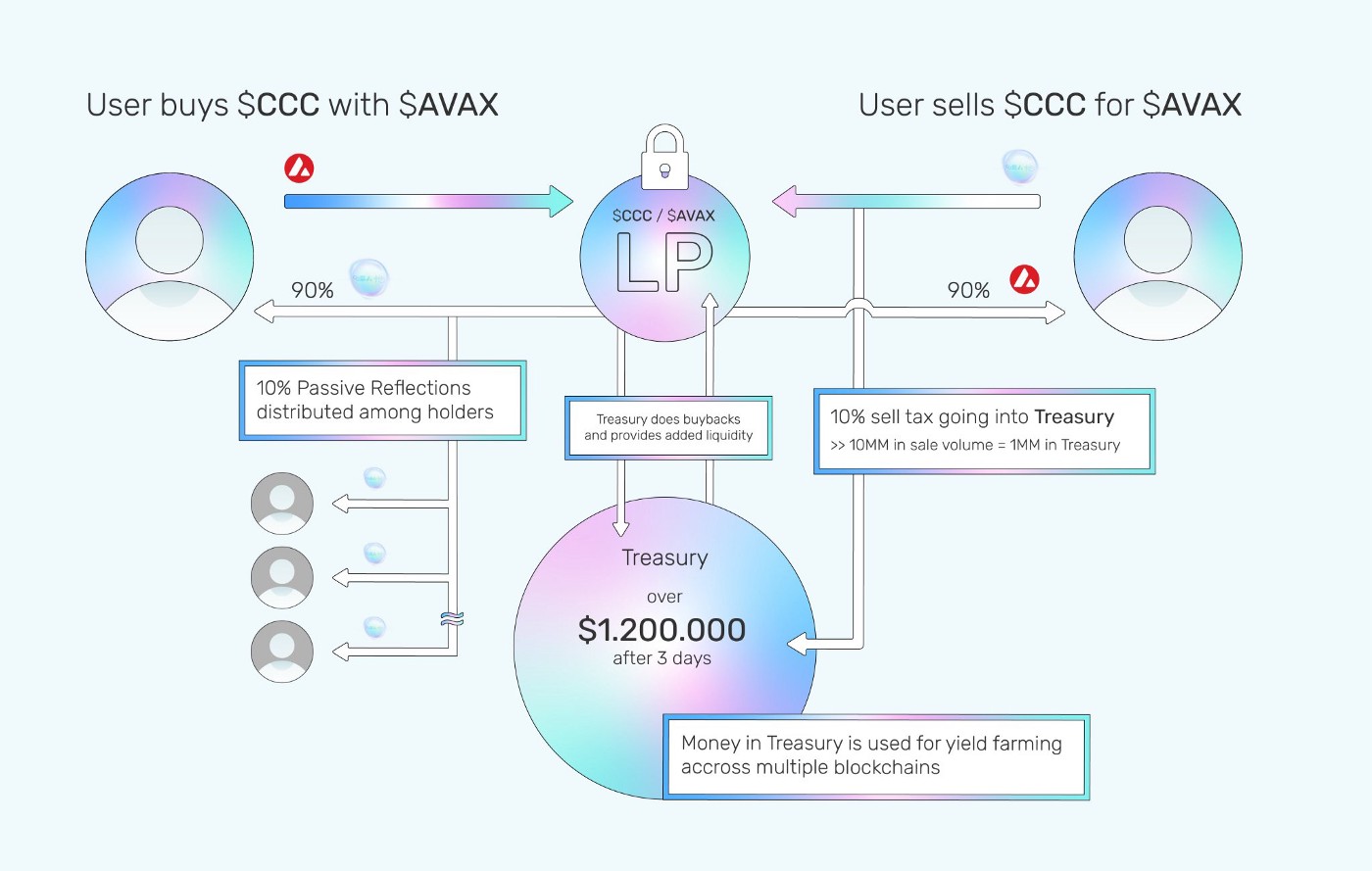
As opposed to DeFi 2.0, DeFi 3.0 adopts a compact Token design. Take Multi-Chain Capital as an example, whether it is buying or selling MCC, each transaction will generate a 10% slippage, of which 5% will be allocated equally to Token holders, and the other 5% will be put into the agreement Treasury to invest in Farming or provide further liquidity. In addition, unlike the 2.0 protocol, the repurchase policy of the DeFi 3.0 protocol is fixed, usually repurchased once a week, and most of the repurchased Tokens are destroyed. Still taking MCC as an example, the Token repurchased by the agreement has now accounted for 35% of the total circulation, providing a relatively strong guarantee for the sustainability of user income. More importantly, there is basically no private placement in DeFi 3.0 projects, and there is no quota for team members, which further reduces the risks brought by Rug and giant whales.
OG and forks
Just like DeFi 2.0, as soon as the concept of "farming as a service" came out, various forks began to bloom everywhere. The editor of Rhythm has sorted out some DeFi 3.0 projects worthy of attention on various public chains.
Multi-Chain Capital (MCC)——ETH
Multi-Chain Capital is the "DeFi 3.0 Pioneer". Its investment strategy focuses on the cross-chain Farming of the DeFi ecosystem. Its latest V3 strategy allocates 90% of the funds Deployed on the Fatom public chain, it consists of three main areas: stablecoins, low IL stable mining, and DeFi 2.0: using mainstream stablecoins with high liquidity (USDC, DAI, USDT) in Curve and other platforms Yield Farming, APY approx. 7 to 20%; mining FTM and FTM-linked TOMB, and then compounding the profits obtained, the APY is about 451%; pledging mainstream DeFi 2.0 protocols, such as Olympus DAO, Wonderland, Hector DAO, etc., the APY can reach 80,000% . In addition to Multi-Chain Capital, Reimagined Finance (ReFi) is also a DeFi 3.0 project worthy of attention on Ethereum.
Cross Chain Capital (CCC)——AVAX
Cross Chain Capital is a fork of MCC on Avalanche. It is more like a "fund DAO", trying to invest in and manage various assets other than DeFi. CCC plans to enter the Metaverse and GameFi fields by accumulating blue-chip NFTs, Metaverse real estate, P2E rentable assets, etc., and hopes to have a lasting impact on marketing, culture, and revenue in these fields. In addition, the CCC treasury will also be used to participate in private placements and IDOs in the encryption field to increase the revenue of the treasury.
In terms of Token use cases, CCC Token will be given the right to govern this "fund DAO" to ensure the security of user funds and the transparency of fund management. The team is also developing Wrapped CCC linked to CCC Token, which is used to create the agreement's own lending service, so that Token holders can obtain more benefits on the basis of "laying and winning". In addition, CCC also intends to establish its own DeFi 2.0 project to expand the source of income for the treasury.
Cross Chain Farming (CCF)——BSC
Cross Chain Farming is the first DeFi 3.0 project on BSC. Taking advantage of the advantages of the BSC ecology, in addition to Farming in the DeFi field, CCF will also expand the business of decentralized Token issuance and listing, on-chain and off-chain security audits, etc. All the proceeds will be used for the return of CCF Token Purchase and dividends to increase the value of Token. At the same time, CCF will also establish a spot investment portfolio and issue airdrops to Token holders.
Scary Chain Capital (SCC) - FTM
Scary Chain Capital is a DeFi 3.0 project on Fantom, aiming to promote the construction of the FTM public chain ecology. SCC hopes to build its own Launchpad and issue airdrops for new projects on Launchpad to Token holders.
Empire Capital Token (ECC) - cross-chain
The DeFi 3.0 project of EmpireDEX, a decentralized cross-chain exchange. ECC intends to bridge the gap between traditional finance (TradFi) and the DeFi world, mainly involving on-chain and off-chain Yield Farming, developing synthetic stocks and packaging them as on-chain NFTs, deploying capital to technology startups in other fields, and participating in IPOs, etc.
Is DeFi 3.0 a blue chip in the future or a pancake to fill your hunger?
In just two months, DeFi 3.0 has developed into a variety of "financial Lego" games, with DeFi as the center radiating to the entire encryption and even traditional finance field, trying to create an active financial ecology. But for now, these beautiful narratives are just visions. Most DeFi 3.0 projects have not passed the test of time and the market, and neither the market value nor the team can compare with the current mainstream DeFi projects.
In addition, the main source of income for these projects is still to rely on cross-chain DeFi Farming, including the immature DeFi 2.0, and the value of the protocol Token is only The indirect mapping of the treasury's income, the value enhancement depends on the agreement's repurchase policy, making it more susceptible to market fluctuations. As investors in the encryption field, we must not be blinded by beautiful narratives and be aware of the huge risks that accompany it. We must think about whether the emergence of DeFi 3.0 is a demonstration of the potential of the industry, or is it driven by market impetuosity?
Welcome to join the official BlockBeats community:
Telegram Subscription Group: https://t.me/theblockbeats
Telegram Discussion Group: https://t.me/BlockBeats_App
Official Twitter Account: https://twitter.com/BlockBeatsAsia
 Related Articles