IOSG: Crypto Market review and outlook
The original title: "IOSG Weekly Brief | Crypto retrospect and prospect the market # 106"
Source: IOSG
Part.1 Insight
Crypto market review and outlook
This article is adapted from Ansem's article Quarter I 2022 (@blknoiz06), edited and translated by Evelyn, AluAyi, Henson, Rex | W3.Hitchhiker, with permission from IOSG.
2021 is clearly going to be a breakthrough year for crypto assets
From institutional acceptance to retail adoption, cryptocurrencies have far outstripped any time in their history. Crypto assets have enjoyed a strong two-year bull market, driven in part by the FED's dovish attitude that has fostered risk appetite among market participants, coupled with rapid innovation in Web3 protocols. Shockingly, in this cycle, we can get from the typical news boast "Look at this token going up 10x!" To appreciate the popularity of cryptocurrencies in society. Visa bought a punk, Adidas bought a boring monkey, many TradFi companies like Jump have acknowledged the long-term legitimacy of cryptocurrencies, Crypto.com bought the naming rights to Staples Center, FTX bought the naming rights to the Miami Heat, Cryptocurrency funds seem to raise billions of dollars every other week. Facebook changed its name to Meta, and the stablecoin legislation is front and center in Congress.Crypto assets have moved quickly to the forefront of public consciousness, and this time they won't be going away anytime soon.
The crypto market will still go through parabolic boom and bust cycles due to the nascent industry, of course, but from my perspective, I see a lot of Fortune 500 companies trying to position themselves to benefit from this new meta-universe, and they can do little more than support these existing decentralized protocols. If this situation continues, the encryption market is likely to be more closely intertwined with the traditional market, along with the progress, encryption assets should be in the transition to a slower growth trajectory, each circuit in different period of performance will be like the stock market, it is in the past few years we have seen already.
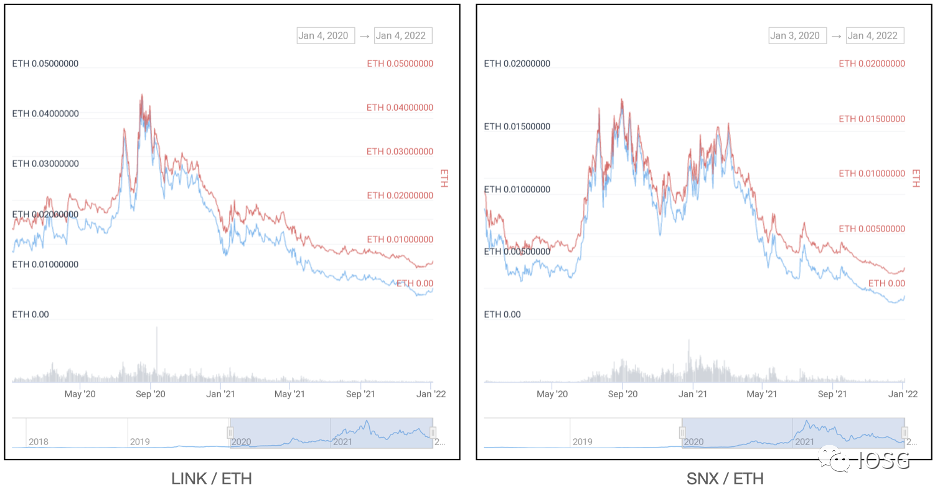
The most expensive lesson for retail investors has been the inability to adapt to new narratives. Whether they are directly exposed to backtracking airdrops, or those who simply understand where markets are going to enable them to make smarter investment decisions, they benefit most from being on the front lines and trying something new. To underscore the shifting trend of cryptocurrency market leaders, we can look at the strength of three separate iterations of the DeFi protocol, LINK and SNX, which originated in early 2019.
Chainlink and Synthetix, two protocols that were some of DeFi's earliest major innovations, The charts for SNX/ETH and LINK/ETH peaked at the first DeFi Summer in August 2020. They have now been in a bear market on ETH for over a year, with SNX/ETH down -92% from its highs. After the first DeFi Summer in 2020, performed well in the second DeFi wave in early 2021, and one of the best-known projects was Sushi, as a fork to Uniswap, Sushi rose 40-fold from a low of $0.50 in November 2020 to a peak of around $22-23 in February 2021.
Other DeFi blue-chip Aave, Comp, and Uni at the time also peaked against ETH around the same time and traded mostly sideways in DOLLAR pairs before the crypto market took a dive in May. After the February peak of DeFi 1.0 and the summer consolidation, we saw the emergence of a third wave of DeFi protocols, led by OHM, DPX, SPELL, TOKE, and others, most notably SPELL and OHM. These deals also quickly gained market attention, each reaping more than 100 times their initial returns and achieving a market cap of several billion dollars at their peak.
All of these agreements are now down sharply from their highs at the time, but it remains to be seen whether they will continue their downward trend against ETH or be able to maintain value better than their DeFi predecessors.
While all of this is happening this year, we also have a thriving multi-chain ecosystem
Over the past year, a number of L1 competitors have directed a large number of new users to DeFi, and the market has directly reflected this user growth in the market value of their projects. During the 92% SNX/ETH decline, Solana vs ETH is up 10-fold since August 2020, or 25-fold if you start from the January 2021 low. So when market participants think we're in for a multi-year bear market just because something has gone up a lot, I think there needs to be a little more nuanced analysis of that argument, because some of the other tokens have been on the run for months.
Looking ahead to 2022, we'll see if certain sectors continue to experience bear market cycles during the macro bull market cycle in cryptocurrencies, or if we have another broad market 90% drop like previous cycles. The challenge for traders is to determine which tokens are mispriced in the current market, how to exploit those misprices, and what new trends are emerging before anyone notices.
The five key trends I envision for 2022 are:
- The trend of good developers joining Web3 from Web2 is accelerating, and the use of development tools and blockchain infrastructure/middleware is increasing.
- The trend of multi-chain DeFi will continue to intensify, with communities formed with existing L1 competing public chain ecosystems, and L0 ecosystems such as Cosmos& IBC eventually became more cohesive.
- Modular blockchain architectures are getting closer to the mainnet going online, with specialization of execution layer/Data Availability layer/Settlement layer.
- The explosion of many different P2E gaming economies as they find creative ways to attract non-cryptocurrency users into the world of digital assets and financial sovereignty.
- Everyone is trying to get in on the metasverse, from big tech companies, to various celebrities, to clothing brands, and in 2022, as users' attention shifts in this direction, we'll see a significant uptick in cryptocurrency partnerships and a race to the top in the Web3 space.
FAANG developers: Shady superprogrammers
One of the most important phenomena of cryptocurrency's recent success is that there are now a lot of smart people working on Web3 and Dapps. I believe we will see more talented developers leaving web2 technology companies for web3 companies, as the industry has become more legalized this year. It is clear that developers can have a direct impact in the crypto market by accelerating their work to fill inefficiencies quickly, and there are many opportunities for innovation. Especially with the growth of platforms that use languages other than Solidity, such as Golang and Rust, these are more appealing to traditional developers who have never worked with crypto assets before.
Blockchain infrastructure is one of the most neglected verticals in the crypto world right now, because users don't use these services directly, so they're not on most people's radar. While a large number of ETH users know what Metamask is, few know that Infura is behind the scenes helping the vast majority of Dapps run on Ethereum. Infura on Ethereum for most traditional developers, comparable to AWS, as we grow in this multi-chain world, there are a lot of other services that are popping up to serve developers on other chains, and that's the track THAT I think will accelerate in 2022.
A New Multi-chain World: L1 competitiveness?
In 2022, I don't believe AVAX, LUNA, and Solana will be the EOS of 2018.
Comparing AltCoins of 2017 to AltCoins of 2021 is a lack of insight, since there was very little users could do on these public chains four years ago. Today, users can connect directly with other users in these decentralized applications to access many cryptofinancial native applications that are different from traditional financial systems.
Back in 2017, I and many other market participants had much lower expectations for these blockchains, and I don't recall using any (literally none) decentralized applications on other L1 competing chains at the time. It was my second month in the crypto world, I read NEO's white paper and thought I had found the best thing since Sliced Bread, only to discover, to my dismay, that Altcoins had fallen more than 90 per cent a few months later.
The actual availability of these AltCoins is now quite different, which is why I don't think this cycle compares at all to previous cycles. So which L1 rival chains will win? And while they've all come a long way, there are still some standouts. Over the past year, a lot of L1 have built frenzied communities, but we have one in 2017 as well, and if you check the hashtag of any of the old projects on Twitter, you'll find that the old stuff still exists to prove it. A frenzied community may spur a price rally in the short term, but the team-building and innovation behind these deals is what builds long-term competitive advantage.
Modular blockchain and ETH 2.0
Modular blockchain design describes a system architecture that separates the different parts of a typical monolithic blockchain by creating dedicated chains for each of the different layers: execution, data Availability and consensus, settlement. Currently, L1's blockchains do all of this at one level, which is why we see some blockchains hit fee bottlenecks as more users join their networks. If we are going to scale up the crypto market to the global population level, it seems that modularity is the ultimate state to make it happen, if for no other reason, all these systems will have to be optimized in the most efficient way.
For much of 2021, Ethereum will be unavailable to users with small wallets because of the high cost of participating in the DeFi protocol at the base layer. The market reflects this sentiment, and the emergence of various other L1 smart contract platforms solves this problem for users. Ethereum's roadmap towards a modular blockchain stack, leveraging ETH as a settlement and data availability layer, and other Rolluop L2 extension solutions such as zkRollups and Optimistic Rollups handling the majority of transactions will all be fully implemented this year. Once this transition is complete, users will be able to use L2's solution while still benefiting from the security of ethereum's base layer.
Play and earn, gamification of digital assets
Axie Infinity achieved something no other crypto project in 2021, creating an in-game ecosystem where millions of users interact with it every day. As the first play-while-earning game to guide large numbers of users to interact with crypto assets in other ways, they've shown how powerful these economies can be when executed at the right scale.
In the Philippines, many people make more money playing Axie Infinity than they do in their real jobs, demonstrating the economic possibilities of user-first monetization. The difficulty for this trend going forward will be to sustain these economic cycles in a way that is sustainable over the long term and keeps attracting new users.
NFT mania is crazy in 2021, and people are paying millions of dollars for Crypto Punks, Bored Apes, and even EtherRocks. While we see a lot more interest around NFTs in 2021, the next iteration will be to provide users with useful digital assets, and we haven't even touched on integrating NFTs directly into blockchain games and other DeFi infrastructures. As the space matures and more money comes in, I think we're going to see a lot of strong teams emerge in 2022 that are delivering products that not only look good, but also provide value to users in many different ways. One of the main attractions of Web3 compared to Web2 is that users are no longer products for sale, but web participants who are rewarded for their positive contributions.
Metadverse mania: Web3-style modern marketing with NFTs
FOMO, or fear-of-missing-out, is now evident in many companies in traditional finance and other industries. In 2019, if you told me Tom Brady was going to star in an AD for a top exchange and Visa was going to buy NFT on Ethereum, I'd think you were crazy. High NW individuals, traditional venture capital firms, gaming companies, sports companies, and more -- all of these companies are trying to catch up with Web3 and determine what role they can play in this new world. NFTs provide a very easy way for companies to connect with these young target markets, and I think we'll see more smart marketing tools put to use this year.
conclusion
I ended my final post for the fourth quarter of 2021 with a few questions that I thought about over the next few years: "What will be the killer app of the 2020s? Amazon in the 2010s, Facebook in the early 2000s, what will it be in the metasverse? How to attract millions of unencrypted users?"
I'm still actively thinking about this question, but I believe the answer may be just around the corner. Only one Dapp has attracted millions of daily active users -- Axie Infinity. Although DFK is still in its very early stages, it's the first decentralized app I've seen that connects DeFi to games in a way that's fun for users. Uniswap is a revolutionary development, but it's not fun to click add ETH/USD LP and then calculate your short term losses and trading gains.
I don't know how many regular Dex users participate in the governance of these platforms, or actually use their tokens for anything other than speculation. Gamification of these original DeFi elements + mobile accessibility is the next step that will really open up a large part of DeFi's target market, because users will want to participate in the ecosystem instead of just guessing. In addition, because users actively participate in the ecosystem, tokens for these games can be more useful than typical governance tokens if properly designed.
"What untapped segments will be more popular in the coming months or next year?"
To answer this question, I think one of the least discussed and most important market segments is the underlying infrastructure that drives these DApps. Expecting non-encrypted users and developers to join without providing them with the right tools to interact seamlessly is a high bar. If we want fully decentralized networks, then we need to make it very easy for users to participate, without having to have the knowledge of a senior engineer or have lived in the crypto world every day for the last decade. In addition, if we want to get more developers into the field, it's critical that all of these systems have the tools and documentation necessary to make new applications easy to deploy, as well as a community willing to help and answer questions.
Here are some bold predictions for this year:
Keplr users will surpass Metamask users
The top 10 would be DeFi Kingdoms
Phantom will have 20 million + users by 2023
DeFi is far superior to Solana in SOL ecology
Daos consisting of encrypted native traders will become more common
There will be at least one P2E guild in the top 25 by market cap
By the end of next year, more people will be using encrypted mobile apps than chrome plug-ins
SoL/Luna/Avax flip Ethereum and hold
Atom is worth more than $100 billion
The DeFi option gets a lot of attention
Important stablecoins Legislation was passed to allow banks to hold stablecoins on their balance sheets
One of the top tech companies is starting to use the AVAX subnet as a development network for blockchain development
I tweeted the other day about my main issues for 2022 and the years ahead, which are modular blockchain architecture and value gains:
In a modular blockchain stack, which layer should capture the most value, or should it be roughly equal between all layers?
I honestly don't have an answer to that question, but as it gets bigger over the next few years, I think it will be one of the most important things for traders to consider and how to position accordingly. My initial thought was that teams focused on building really efficient and dedicated chains would do well, which is why I'm a big fan of zkSync and Celestia (the project to build a modular blockchain architecture) later this year.
Part.2 Investment and financing events
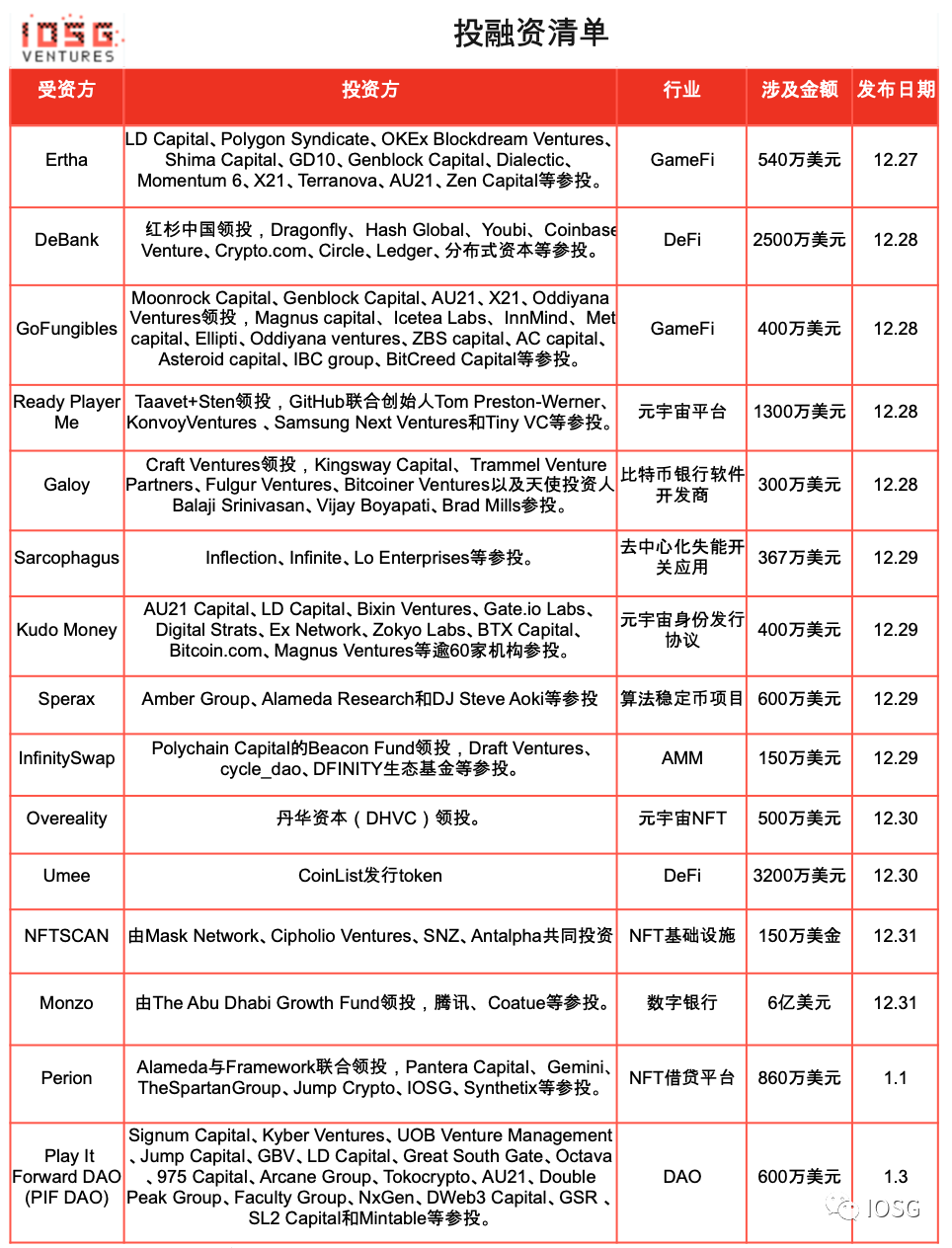
Perion raised $8.6 million, led by Alameda and Framework, with IOSG Ventures
* Game guild
NFT games guild Perion has announced that it has closed an $8.6 million round led by Alameda and Framework, Pantera Capital, Gemini, TheSpartanGroup, Jump Crypto, IOSG Ventures, Synthetix and others participated in the investment. Perion is a decentralized autonomous organization (DAO) that provides services such as purchasing, leasing and managing NFT assets to help players earn revenue in games.
Ertha closes $5.4 million round, with Polygon Syndicate among others
* P2E to swim
On Dec. 27, P2E online game Ertha Metaverse announced a $5.4 million funding round, LD Capital, Polygon Syndicate, OKEx Blockdream Ventures, Shima Capital, GD10, Genblock Capital, Dialectic, Momentum 6. X21, Terranova, AU21, Zen Capital, etc. The new funds raised in this round of financing will be used to promote project construction.
GoFungibles announced the closing of a $4 million private funding round led by Moonrock Capital
* GameFi platform
GoFungibles, the Polygon blockchain-based GameFi platform, announced that it has closed a $4 million private funding round led by Moonrock Capital, Genblock Capital, AU21, X21 and Oddiyana Ventures. Magnus Capital, Icetea Labs, InnMind, Metrix Capital, Ellipti, Oddiyana Ventures, ZBS Capital, AC Capital, Asteroid Capital, IBC Group, BitCreed Capital, etc.
Ready Player Me closes $13 million round, led by Taavet+Sten
* Metaverse platform
Ready Player Me closes $13 million round, led by Taavet+Sten, GitHub co-founder Tom Preston-Werner, Konvoy Ventures, Samsung Next Ventures, and Tiny VC were among the investors.
Sarcophagus raised $3.67 million in funding from Inflection, Infinite, Lo Enterprises, and others
* Decentralized disable switch applications
Decentralized incapacitation switch Sarcophagus was used to complete $3.67 million of on-chain financing, including Inflection, Infinite, Lo Enterprises. Sarcophagus was incubated by Web3-focused Decent Labs. Sarcophagus is a decentralized disable switch application based on Ethereum and Arweave. Users can upload files to Sarcophagus and specify private key recipients. If a future user fails to perform an action or the set time expires, the recipient will receive a private key to open the user's file stored in Arweave. Usage scenarios include wills and trusts, password recovery, voucher storage, etc.
Kudo Money completed $4 million series A financing at A valuation of $40 million, with the participation of AU21 Capital and others
* Meta-cosmic identity publishing agreement
Kudo Money announced the completion of A $4 million Series A funding round at A valuation of $40 million, Including AU21 Capital, LD Capital, Bixin Ventures, Gate. IO Labs, Digital Strats, Ex Network, Zokyo Labs, BTX Capital, Bitcoin.com, Magnus Ventures and more than 60 other institutions participated.
Galoy closes $3 million seed round to replicate El Salvador project
* Bitcoin banking software development
Bitcoin banking software developer Galoy has raised $3 million in seed funding, led by Craft Ventures, Kingsway Capital, Trammel Venture Partners, Fulgur Ventures, Bitcoiner Ventures, and angel investors Balaji Srinivasan and Vijay Contributed by Boyapati and Brad Mills. Galoy is also the founder of Bitcoin Beach Wallet in El Salvador, whose suite of solutions enables any community, company or government to provide banking services using Bitcoin and the Lightning network.
Sperax raised $6 million at a $200 million valuation, with Alameda Research and other investors
* Algorithm stabilizers
Sperax, an algorithmic stablecoin project on Arbitrum, has announced the completion of a $6 million funding round from Amber Group, Alameda Research and DJ Steve Aoki, which will be used to expand the Solidity development team.
InfinitySwap closed a $1.5 million seed round led by Beacon Fund
* DFINITY ecological AMM
DFINITY Ecological AMM InfinitySwap completed a $1.5 million seed round of financing, led by Beacon Fund of Polychain Capital, and participated by Draft Ventures, Cycle_DAO and DFINITY Ecological Fund.
Overeality closes $5 million in funding led by Danhwal Capital
* Metacosmic infrastructure projects
Overeality, a meta-cosmic NFT project, has closed a $5 million funding round led by DHVC, according to official sources. The new funding will be used for Overeality mainnet deployment and phase I product launch to build a fan economy in the metasomes.
Umee announced the closing of a $32 million funding round
*DeFi
DeFi startup Umee has announced the closing of a $32 million funding round. In June, it raised a $6.3 million seed round from Polychain, Coinbase and others. Umee CEO Brent Xu said the team plans to use the newly raised funds to expand its engineering team, expand its legal compliance resources through marketing, expand the underlying infrastructure and grow the global community. Umee is building a "cross-chain DeFi Center" that will house the initial tools Umee built and train developers based on the initial products to focus on creating tools for cross-chain rates, cross-chain leverage, and multi-chain mortgages. The team plans to launch the mainnet in mid-February 2022.
NFTSCAN completed $1.5 million angel round equity financing, and Mask Network participated in the investment
*NFT infrastructure
NFT Infrastructure NFTSCAN completed a $1.5 million angel round of equity financing by Mask Network, Cipholio Ventures, SNZ and Antalpha. According to the NFTSCAN team, this round of funding will be mainly used for technical team building to further improve development efficiency, promote multi-chain NFT data development, and serve more blockchain network developers and NFT ecosystem communities. NFTSCAN is a professional NFT browser and data analysis platform. NFTSCAN raised a seed round led by Y2Z Ventures in April and officially launched the Ethereum NFT browser in September.
Monzo raised $600 million at a valuation of $4.5 billion, with Tencent and other investors participating
* Digital banking
British digital bank Monzo has raised $600 million at a valuation of $4.5 billion, led by The Abu Dhabi Growth Fund, with Tencent, Coatue and other investors participating. TS Anil, chief executive of Monzo, said: "The fact that we have received investor interest in this round is testament to our performance and the great opportunities ahead." Monzo has more than 5 million users and will nearly double its revenue in 2021. The company also plans to move into new product areas, recently launching a buy now, Pay later (BNPL) tool.
Play It Forward DAO (PIF DAO) announced the completion of $6 million private financing, with Signum Capital, LD Capital and others participating in the investment
*DAO
Play It Forward DAO (PIF DAO) announced the closing of a $6 million private placement, Signum Capital, Kyber Ventures, UOB Venture Management, Jump Capital, GBV, LD Capital, Great South Gate, Octava, 975 Capital, Arcane Group, Tokocrypto, AU21, Double Peak Group, Faculty Group, NxGen, DWeb3 Capital, GSR, SL2 Capital, and Mintable Such as ginseng. Co-founder Cholo Maputol said the money will be used to expand DAO's scholarship program, expand its P2E panel platform, and fund some early investments in P2E gaming and infrastructure projects.
Part.3 Project progress after IOSG investment
Web 3.0 Subscription to NFT Social network ShowMe The Sandbox co-founder: Plans to move to Polygon and launch DAO in 2022; Polygon became the fastest growing blockchain with the number of addresses on the chain in 2021
* capacity
The Web 3.0 subscription NFT network ShowMe is officially on Polygon today and plans to support Ethereum, BSC, Avalanche, MoonRiver, Harmony, PlatON and more in the near future.
In 2022, ethereum-based metauniverse game The Sandbox will start an Alpha season-like playtesting period every few months to get more feedback from LAND owners, Sebastien Borget, co-founder and COO, said in an interview. The Sandbox will also be moved to Polygon to reduce transaction costs and network congestion when interacting with The game.
According to Coin98 Analytics, Polygon became the fastest growing blockchain in 2021. The total number of addresses on the chain was only 180 at the beginning of the year, but as of December 30, 2021, the total number of Polygon addresses has reached 129,44,295. The growth rate reached 71913397 percent.
NFT music platform Pianity has created a new moderator position
*SocialFi
Pianity, an NFT music platform, has announced the creation of a new position at PianityDAO, called Moderators, aimed at reporting and identifying offending works. Pianity is also known to set a leaderboard for the position. In addition, becoming a moderator can receive PIA tokens in return.
Alethea AI has received funding from the BSC Growth Fund to collaborate in the metasectics, NFT ecosystems and other areas
* yuan universe
Alethea AI has announced that Binance Smart Chain (BSC) has invested in the company through BSC's recently launched $1 billion growth fund. BSC will help Alethea AI drive the development and evolution of the Noah "S Ark ecosystem, the first intelligent meta-universe. BSC will work with Alethea AI on meta-cosmic partnerships, NFT ecosystem strategy support, joint marketing and education between ARTIFICIAL intelligence (AI) and NFT. As part of the new initiative, Binance Smart Chain has purchased an unspecified number of ALI tokens.
InsurAce online Balanced Insurance products
*DeFi
DeFi Insurance protocol InsurAce has launched Balanced, a DeFi platform based on ICON. Users can purchase Balanced smart contract insurance products.
Coin98 Labs announced the launch of Saros Finance, a Solana-based DeFi platform
*DeFi
Coin98 Labs announced the launch of Saros Finance, a Solana-based DeFi platform, and the launch of SarosSwap, a decentralized automatic liquidity protocol.
Part.4 Industry pulse
The Bholdus main network is live, with Launchpad and NFT markets to follow
* Cross-chain heterogeneous infrastructure
Blockchain platform Bholdus has launched the first version of its mainnet smart contract. Therefore, Bholdus is ready to introduce a variety of DApps. According to the official announcement, the mainnet version will be available on December 30, 2021. This release marks the full release of the Bholdus cross-chain heterogeneous infrastructure. In addition, with the activation of the main network, BHO tokens officially became its core utility and governance assets. The BHO becomes the only token that can be used to pledge, pay Gas bills, etc., and vote on all important governance referendums. Bholdus will evolve into a multi-product hub for the metasverse age. Over the next few months, Bholdus will launch a number of products including token Launchpad, NFT Marketplace, multi-platform DEX, and more.
Terra founder unveils crypto Industry forecast for 2022: The Cognitive shift to Web 3 has Begun
*DeFi
The most exciting thing about crypto is to facilitate a great migration of human activity from the physical world to the Internet, and to create a world that is not constrained by the laws of physics, such as gender and location, but only by human intelligence, Terra founder Do Kwon said as he released a forecast for the industry in 2022. Do Kwon believes that Web 3 will definitely not just be Minecraft with tokens, and DeFi will also be transformed. Today, the most popular DeFi apps are still those from the Web 2 world, such as trading platforms, insurance, etc. But now, The cognitive shift to Web 3 has already begun.
Genesis announced a $6 million NFT loan to Meta4 Capital
*NFT
Genesis announced a $6 million NFT backed loan to Meta4 Capital, which featured NFT only as collateral. Meta4 Capital is a Miami-based NFT venture Capital firm backed by Andreessen Horowitz that specializes in acquiring rare and historic NFT.
Report: Nearly 50% of blockchain industry usage comes from gaming Dapps
*GameFi
According to DappRadar's recently released BGA Blockchain Gaming Report 2021, more than 1.4 million unique active wallets (UAW) are connected to blockchain games every day, and they leapfrog DeFi to become the industry's leading category this year. While gaming DApps account for 49% of the blockchain industry's total usage, gaming NFT transactions exceeded $4.5 billion, accounting for 20% of total NFT sales this year.
South Korea's Com2uS may become the world's first "meta-universe office" company
* yuan universe
Com2uS Group, a South Korean game company, is expected to become the first company in the world. Com2uS has announced that it will move all of its approximately 2,500 employees into the space in the second half of 2022, officially ushering in the era of working and living in the space. In addition, they are also signing contracts with large enterprises in various industries to build a meta-cosmic ecosystem. In the future, by settling in a large number of enterprises, they will create a meta-cosmic city integrating leisure, entertainment and economy.
The original link
Welcome to join the official BlockBeats community:
Telegram Subscription Group: https://t.me/theblockbeats
Telegram Discussion Group: https://t.me/BlockBeats_App
Official Twitter Account: https://twitter.com/BlockBeatsAsia