V god recites what has been said and done in the past 10 years, involving the latest thinking of bitcoin, sharding, BCH and so on

原文作者:Vitalik Buterin,以太坊创始人
Link to people
Editor's note:
Just today, God V shared some of the things he said and did over the last 10 years on Twitter, and gave his latest thoughts on them, covering Bitcoin, BCH, POW, POS, sharding, Copycoin, Stabocoin, and much more.
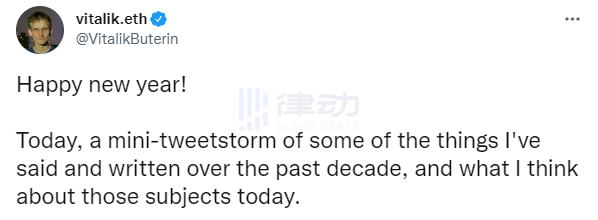
For learning purposes, the author compiled the content of twitter at the first time. In view of the short time, some contents may be inconsistent, welcome to correct:
1. In 2013, I wrote about how Bitcoin could really help Iranians and Argentines. Core point: Bitcoin's main benefits are international and anti-censorship, not a "21 million cap." I predict that stable currencies will flourish.
Last week, I went to Argentina. My conclusion: roughly right. The adoption rate of cryptocurrencies is high, but the adoption rate of stabecoins is also high; Many businesses already operate in the USDT. Of course, that could change if the dollar itself starts to have more problems.
2. In 2013, I published an article on the consequences of bitcoin service "being regulated". The core point is that bitcoin is resistant to censorship not because it belongs to a new legal category, but through technology.
My point for today: Sure, bitcoin's decentralization could allow it to "survive" in a hyper-hostile regulatory environment, but it can't "thrive." Successful censorship resistance strategies require a combination of technical robustness and public legitimacy.
3. I predicted in 2015 when PoS and sharding would be implemented. To be honest, these are all very wrong and worth laughing at; Share a screenshot of a speech I gave in 2015 so you can laugh more easily:
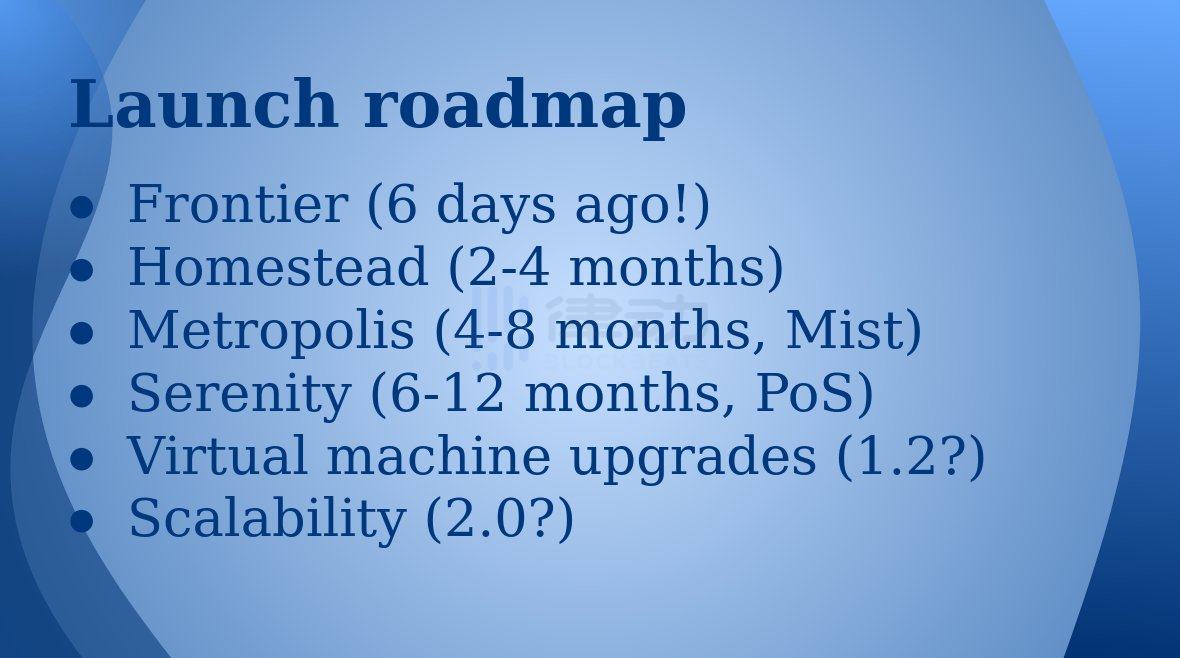
What is the core mistake? In my opinion, I seriously underestimated the complexity of software development. Today, the Ethereum research team values simplicity -- both in the final design and the path to implementation -- in favor of pragmatic compromises. Dankrad's latest sharding design fits this spirit.
4. "Money Internet should not cost more than 5 cents per transaction." That was the goal for 2017, it's still the goal, and I'm still 100% committed to it, which is why we spent so much time working on scalability.
5. I should also add that the core concept of sharding survives intact.
Blockchain 1.0: Nodes download everything, with consensus
BitTorrent: Only a few things are downloaded per node, but there is no consensus
Ideal: BitTorrent efficiency but blockchain-like consensus
Core support technologies come from the community, ZK-SNARK, and data availability sampling.
6. I was a supporter of POW in 2012. Fortunately, by 2013, I was excited about POS. In 2014, I changed my mind again.
This reflects a broader evolution of my thinking: from "X is what I have to defend, so whatever is good for X must be right" to "I like X, but X has flaws and it looks like Y fixed them, I now support X+Y".
Soldier mentality -- > Scout mentality.
7. Published an article on automatic contract execution in 2014. Basically, it's trying to prove that making the whole society more like a formal system is good and we should be excited about it.
Through thorough research, I've seen the limits of this way of thinking: The problem with pushing everything into a formal system is that almost any formal system with more than two actors is hackable.
I liked shanzhai coins before they became popular. See my article in September 2013 (2 months before Ethereum was born). Three core arguments:
(I) Differential chain optimization for differential targets
(ii) Lower cost of having multiple chains
(iii) In case the core development team goes wrong and needs outside help
Do I still agree with that?
The above parameters are less important today because (I) chains are more versatile, (ii) applications are more complex and therefore more dangerous to bridge, and (iii) experiments are feasible in L2.
Even so, I think there are some things you can't do in L2, and there's room in a different L1.
9. I was particularly optimistic about Bitcoin Cash because in this war of scale, I agree with the big block supporters more than the block supporters.
Today, I think BCH is a loser. My main point is this: Communities that form around rebellions, even if they have a good cause, often have a long hard time because they value courage over competence and rally around resistance rather than a coherent path forward.
10. The posts in 2016-2017 were all about building Uniswap.
"Do something simple and stupid, even suboptimal" is the current philosophy, but it took me a long time to find the rationale for POS and sharding design.
11. Applications envisioned in ethereum white Paper:
*ERC 20 standard token
* Algorithm stabilizers
* Domain name System (e.g. ENS)
* Decentralized file storage and computation
*DAO
* A wallet with withdrawal limits
* predicted machine
* Forecast market
Although incentive file storage + computation is not yet implemented, many of the above assumptions are correct (basically predicted DeFi). Of course, I completely ignored NFT.
I would say that the biggest issue missing from the details is the issue of collusion in DAO governance.
12. Published an article on stablecoin in 2014. A large part of the article tried to use blockchain data as a price reference rather than a predictor.
I'm a little pessimistic right now, especially because of PoS switches, we need a predictor. If we want stable currencies to collapse against the dollar to be robust (by switching to their own local CPI if that happens), we need more aggressive governance.
Conclusion:
* I was naive about politics and large-scale human organization, too focused on simple and complete formal models... I know now.
* I did have good instincts early on to avoid the craziest parts of bitcoin maximization thinking. There were a few early mistakes that I quickly corrected.
* Just because X is wrong doesn't mean that any resistance against X will go smoothly. This presents another form of organisation with difficulties.
* Technically, I'm more accurate with abstract ideas than with software development. The latter must be understood over time.
* I now realize more deeply that what we need is simpler than I thought.
The original link
Welcome to join the official BlockBeats community:
Telegram Subscription Group: https://t.me/theblockbeats
Telegram Discussion Group: https://t.me/BlockBeats_App
Official Twitter Account: https://twitter.com/BlockBeatsAsia
 Related Articles