Vincent Niu, Partner, Sky9 Capital: Web3 reinventing the value of data
On Web3 reinventing the Value of Data
Vincent Niu, Cloud 9 Capital
Some time ago, I posted some opinions about the data on the chain on Twitter, and some friends sent me a private letter asking me to expand on it. Therefore, this article is also a sort of arrangement of my thoughts. Since the last article, it has been a full half year, I hope the following update frequency can be higher.
tl; dr
· in Web2.0, your data has value, but it doesn't belong to you, and the value isn't given to you.
· On-chain data is a gold mine, the more applications, the more data, the bigger the gold mine.
· in Web3.0, your value behavior will eventually be rewarded, the carrier of value is your data, but also belongs to you.
In the world of Web2.0, if you are zhao Yun in King of Glory, all the skin collected, you go to eternal Eternal or Harry Potter magic awakening, can only start from a blank sheet of paper, no one knows you are a king master. If you're a little-known up host on Site B, you might go to Youtube and find someone already carrying videos under your name. If you have 5,000 yuan on wechat and want to transfer it to Alipay, you can only withdraw cash to your bank card and recharge it to Alipay. Every time you use a new product on a mobile web site, you have to go through the phone number/email/user/password/verification code process, and then click the password back the second time you use the product you don't use much.
In the world of Web2.0,Every app does everything it can to lock in users, increase engagement and retention, and build a moat of users and data to squeeze the most value out of them. As a user, you get the experience of using the product, but you have nothing. All your data can be wiped out overnight.Once the largest Chinese Blog community BlogCN, once the school network, not to mention the number of offline online games. In essence, users' behavior and data work for the company,When you check the Service Agreement and Privacy Policy when you sign up, you have entered into an unequal contract,That is, your data belongs to a company and can be used and monetized at will. If we stop operation one day, I'm sorry, I have the right to explain, your number is gone, your data is gone.
So, in Web2.0, your data has value, but it doesn't belong to you, and the value isn't given to you.
Under the underlying Web3.0 framework based on blockchain technology, it seems to be a step forward. A blockchain is a public database on which all applications read and write data. Due to current performance limitations and high interaction costs,Apps tend to put only "high-value behavior" interactions on the chain, and that behavioral data is a gold mine.
Four years ago, it was still the era of IC0 and pie drawing competition of various public chains. The transaction types on the chain were very single, and most of them were Token transfers. In the space of four years, the application layer has seen several tracks explode, from DeFi to NFT to GameFi, with thousands of applications recording various forms of data on the chain.The filtering/analysis/processing of this data can create a myriad of scenarios, from capturing trading opportunities, to identifying specific user address groups, to forming on-chain identities and social relationships, each of which is worth over $10 billion.
One is full
In my last article,Brief introduction to MY understanding of NFT and MetaverseThe interoperability brought about by blockchain has been mentioned many times. From a data point of view, interoperability is a big change that was unimaginable in Web2.0. An address account can native land thousands of applications at the same time, the application of high value are recorded in an account, for each address on the chain of interaction, you can know whether this address () the people behind the liquidity of a DeFi early mining user, is a collector of NFT, Is it a DEX trading user, is it a GameFi player, etc.
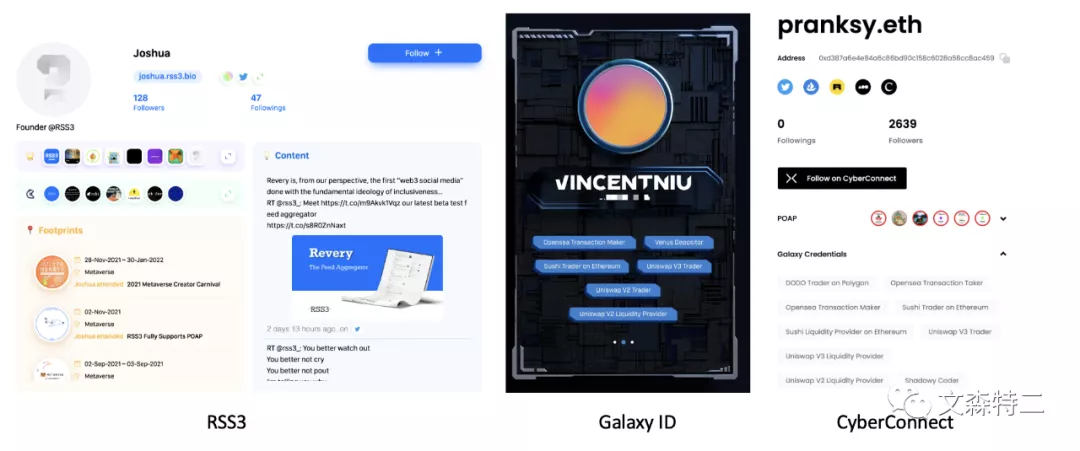
Portraits an address of the user can use behavior completely describe these chain, in the world of the web, you on the Internet every footprint is in the hands of different companies, each company is only a fragment of mastered all your behavior, the more the more companies involved in the business to master the more pieces, but not piece together a full picture.On a blockchain, the full picture of an address is hidden in every interaction you make on the chain. Any person or organization can piece together your image without permission. RSS3/Project Galaxy/CyberConnect all organize and present users' on-chain image and behavior in different ways.
What is the value
Value actions are rewarded
In Web2.0, if you make a game and want to attract king of honor users as seed users, is it possible? Even if you are inside Tencent, you may not get the resources and permissions you want. If you build a social product and want to attract weibo users in bulk, is it possible?
On the chain, which address played which game, how much money spent, at a glance. Which address has participated in YFI mining, Curve pre-mining, NFT transaction, can easily obtain the address list.You can use a set of filters to find a list of seed users that meet your requirements, airdrop them, give them perks, and entice them to use your product.
The value of a product comes from every on-chain interaction of its users, whether it is an NFT transaction or the addition of liquidity.If the value generated by these interactions is not recognized by this project, it does not matter, other project parties will pay attention to the value brought by these behaviors.It was interesting to see OpenDao airdrop SOS tokens to OpenSea users a few days ago. My focus is not on whether OpenDao can make an NFT trading platform better than OpenSea through this operation (I think it's hard). It's your high-value activity on OpenSea, and even if you don't get the expected return (OpenSea is likely to go IPO route), someone else can give it. SOS is not the first or the last, as Rarible says. Most people also got NFT early on through OpenSea deals), there will be LooksRare and more to come.
In the Token economy model of every new project, people think more or less. 1. How do I find the first seed users and airdrop them; 2. How do I give back to users who provide value to my product?So just do what you need to do on the chain, and sooner or later your "high-value behavior" will give you "value."
For those of you who have experienced DeFi Summer 2020 and who have been airdropped for various projects in the past year, this is what your data value gives you back.If you think that you withdraw all the balance in an address, this account is worthless, this cognition is wrong, your chain footprint is the most precious, please cherish your every wallet address, do not lose easily.
Traceable identity value without proof
If you are a veteran player of Legend 1, it is very difficult to prove that you have ever played or played a god suit, because the stats are gone when the server is disabled. But if Cryptokitties goes down in a few years, you can still use your Ethereum address to tell everyone that you bought a Christmas Cat in late 2017. On Linkedin you can wrap "made a few powerpoint slides" into "led a $500 million merger and acquisition case." On blockchain you boast that you are a big DeFi player/early adopter.
Last week I received a resume:
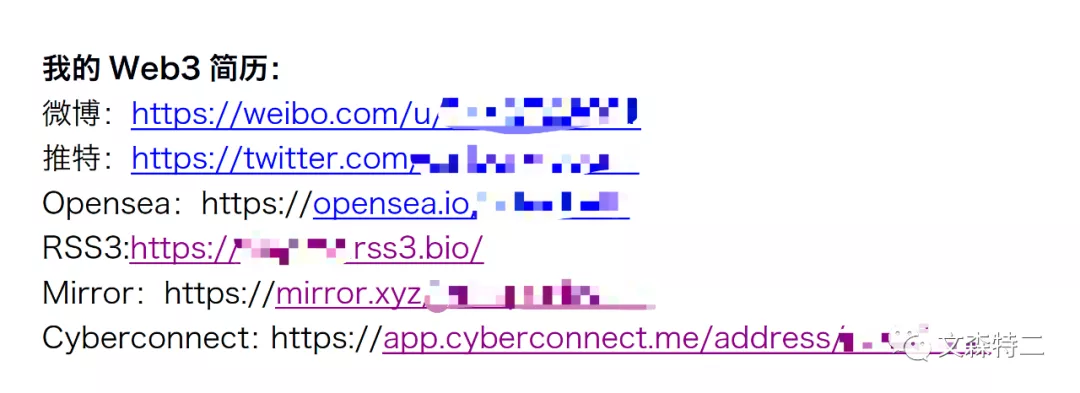
Without too much text, we can see from OpenSea, RSS3, Mirror and Cyberconnect which DApps this brother has used in the past two years, which NFT he has bought, and whether he is a Crypto native.The data on the chain is worth a thousand words. When it comes to hiring in this industry, I think Linkedin is done.
This data can not only truly reflect a person's history and identity on the chain, but also establish social and group relationships natively.We now have groups that are still built on Web2.0 apps like wechat, Discord, telegram, DeFi fan groups, NFT discussion groups, XX project groups. In fact, many of the users in the group may have nothing to do with the theme, may have never played DeFi, have not bought a Token for a project, but blindly follow the rhythm of the group."
If it is a community tool based on wallet address login, naturally groups can be established according to certain filtering conditions, such as THE NFT community that can only be joined with Punks or BAYC address, for example, the DeFi community that can only be joined with certain DeFi tokens and the number reaches certain conditions. For example, you can only join the DAO community if you have participated in more than 3 projects of Snapshot voting governance. These entry thresholds can be automatically determined natively by reading the asset information and behavior history of the address on the chain without proof. If the conditions are no longer met, automatically kick out users who do not meet the threshold. Permission management can also be based on the data on the chain to automatically increase and decrease rights, rather than manually set by the administrator. For example, if you have 100 tokens for a certain project, you can enter the general group, and if you have more than 100,000 tokens, you can automatically enter the VIP group and automatically get the rainbow-colored ID identification. Several projects, such as ShowMe and Metalink, are exploring this direction.
This creates a more transparent and efficient community, where everyone meets the group's membership threshold and the process is native, real, dynamically updated and trust-free.
Data-driven Alpha
There are billions of dollars of Token transactions and hundreds of millions of DOLLARS of NFT transactions on the chain every day, and all this information is public, it is not difficult to imagine how much Alpha can be mined. Nansen. Ai has taken this to the extreme, iterating a product with tens of millions of dollars in revenue and a valuation of nearly a billion dollars in just one and a half years. Whale marks on the chain, Smart Money tracking, chip flow and distribution in Token God mode, deep mining of NFT project... Giving this information to an analytical user is like putting an ATM machine in front of him.
Above, I have just listed a few ongoing and rapidly iterating scenarios, just the tip of the iceberg. The value of the gold mine of on-chain data has been fully demonstrated. In the future, we will also see the extensive application of Credit Score based on on-chain data and decentralized identity in the metasomes. And data products like Nansen that focus on one Angle to bring value to users.
In Web3.0, on-chain data is personal and readable to each person or organization, and can be captured for value. The way value is distributed is being reshaped. For the foreseeable future, when you use any application in Web3.0, you will not start from scratch, but walk through each application with your address portrait and tags. The carrier of value is your data, and it belongs to you.
Give yourself AMA
Q: What about multiple addresses?
A: A lot of people change addresses every time they play DeFi. One possible solution is to label/analyze/calculate your identity by signing bundle multiple wallet addresses in a DID framework. Spectral uses this approach to its on-chain credits.
Q: these Web3.0 app experiences are still not good, I use a wool?
A: Exactly. At present, the infrastructure is still not perfect. When we read the data on the chain, if we read the data directly through the blockchain every time, and read the files directly through the decentralized storage, we cannot solve the problem of high concurrency. The number of CyberConnect users in the past few days has ruined Ceramics. If you recognize the value of blockchain data I've written about in this article, it's only a matter of time.
Q: the moat of big Web2.0 companies -- users and data -- is no longer the moat, so what is the moat of big Web3.0 companies? Is there a business problem?
A: This is A question I've been thinking about A lot over the past few years, and it deserves A separate article. But to make a long story short, if Web3.0 ultimately leads to better value distribution and a better user experience, then all of this is worthwhile and in the right direction. The business model pioneered in Web2.0 is the logic of acquiring users for free or even subsidizing them, rounding them up and monetizing them. In Web3.0, there will be another way to capture value and a business moat.
Q: Should I study these projects you mentioned above?
A: This article does not constitute any investment advice. Which of the projects mentioned above will be successful is hard to judge at this point. For example, in 2018, Jihoz, the co-founder of Axie, was excited to tell me that Axie had reached 160 DAU. At that time, I believe both of us could not imagine that three years later, Axie now has a million daily life and ten billion DOLLARS FDV. At this point, we can only bet on the right direction, a solid, long-term team, and continue to explore together for years to come.
Personally, I and my organization are very bullish on the whole data-driven track, which is a big investment theme for us in Web3.0, with multiple eco-projects. Welcome to start a business in this track friends to exchange.
The original link
Welcome to join the official BlockBeats community:
Telegram Subscription Group: https://t.me/theblockbeats
Telegram Discussion Group: https://t.me/BlockBeats_App
Official Twitter Account: https://twitter.com/BlockBeatsAsia
 Related Articles