AMM pioneer Bancor after V3 upgrade
First Class Research Paper: Bancor, pioneer of AMM DEX
Original source: First-class Blockchain Research Institute
Bancor The core mechanism of V2.1 version is BNT elastic supply, which compensates for the volatile losses of liquidity providers. Basically, 100% coverage can be achieved, and the economic model is sustainable in the long run. V3 will be an improvement and feature upgrade over V2.1, intended to further improve the user experience and increase revenue.
The profile
Bancor was a pioneer in AMMDEX, but its market share declined after AMMDEX such as Uniswap and Sushiswap emerged. Bancor then chose "solving the problem of volatile losses" as the focus to improve the agreement. In v2.1, LP providers are largely immune to impermanence losses.
The core of v2.1 is BNT elastic provisioning and has two features:
1) Support single currency to provide liquidity and reduce risk exposure;
2) Support liquidity protection. The protocol adopts two ways of protection. First, the protocol transaction fee is used to compensate the fickle loss of the liquidity provider, and BNT is forged for compensation in the case of insufficient transaction fee. Liquidity protection requires a 100-day lock-up period to achieve close to 100% coverage, and there is a ceiling on the size of the liquidity pool.
After v2.1 is deployed, the following features are displayed:
1) The liquidity in the Bancor agreement increased significantly, but the market share of trading volume did not expand;
2) There are few trading pools with sufficient liquidity, and some liquidity pools have poor liquidity;
3) The liquidity of some transaction pairs is better than that of Uniswap and other DEX, which enables Bancor to capture a certain market share;
4) The liquidity pool of Stablecoin and some long-tail currencies is limited to the limit of the liquidity pool and cannot be expanded.
In order to better establish a foothold in DEX field and expand market share, Bancor will release V3 version based on v2.1 version to optimize the solution of volatile loss (increase liquidity pool ceiling, etc.) and improve other performance of the protocol. The main improvements include:
1) Lift the ceiling of liquidity protection. In v2.1, there is a cap on the BNT provided by the protocol, and users must provide BNT to expand the pool. After the lifting of the liquidity cap, the liquidity in the agreement is likely to grow again, which is conducive to the formation of a positive cycle of high liquidity, low slip point, higher trading volume and higher fees attracting more liquidity, especially for the Stablecoin pool and some long-tail currencies currently subject to liquidity limits. It should be noted that after lifting the upper limit of liquidity protection, the amount of BNT forged in the agreement increases, but the effect on the actual flux is very small.
2) To achieve instantaneous liquidity protection, users can withdraw as they deposit, no longer need to wait 100 days to achieve 100% volatile loss protection, improve the flexibility of the use of funds. V3 volatile loss calculation may use the predictor quotation, so there may be a arbitrage, the agreement of volatile loss compensation pressure increases, may increase the possibility of using forged BNT compensation;
3) Release the BNT summary pool, so that Token transactions no longer need to be translatable through BNT, which can reduce the slip point and Gas cost;
4) Allow the BancorDAO to guide liquidity distribution. The agreement will introduce the concept of trading liquidity, which can be used for market making, and superfluid liquidity, which can also be used for other charging strategies. The amount of trading liquidity will still be determined by DAO. Any Token that exceeds transaction liquidity can be used in a hyperliquid strategy that accumulates additional value for the protocol participants.
In addition, the agreement also added automatic compound interest for liquidity mining rewards, bilateral rewards, support for third parties to share volatile losses, and realize the composability of LP tokens, aiming to improve user income and the utilization rate of underlying funds.
At present, competition in DEX sector is fierce and head effect is obvious. It can be seen from the example of Curve that differentiated product strategy has the opportunity to compete for more market share. Therefore, Bancor focuses on the solution of volatile loss, supplemented with the function of improving capital utilization rate and user experience. Is good for Bancor to compete for more DEX market share.
1. Basic Overview & NBSP;
1.1 & have spent Project Introduction & NBSP;
Bancor is a decentralized trading platform based on Ethereum. The development direction is volatile loss solution. The current protocol version is V2.1, and the core mechanism is BNT elastic provisioning. Bancor is about to release version V3, which further refines the volatile loss solution and improves underlying capital utilization to further balance the equity of traders, liquidity providers and BNT holders.
2. Project details & NBSP;
2.1 & have spent Founder and contributor & NBSP;

2.2 & have spent money
Bancor IC0 raised 390,000 ETH, a total amount of $152.3 million at ETH prices at the time. The price of IC0 was 1BNT=0.01 ETH, at that time 79,323,978 BNT were generated, half of the total tokens were sold to IC0 participants, the remaining 20% were allocated to ecological rewards, and 20% were allocated to the Bancor Foundation, 10% is allocated to Bancor contributors.
ETH fund purpose: & NBSP;
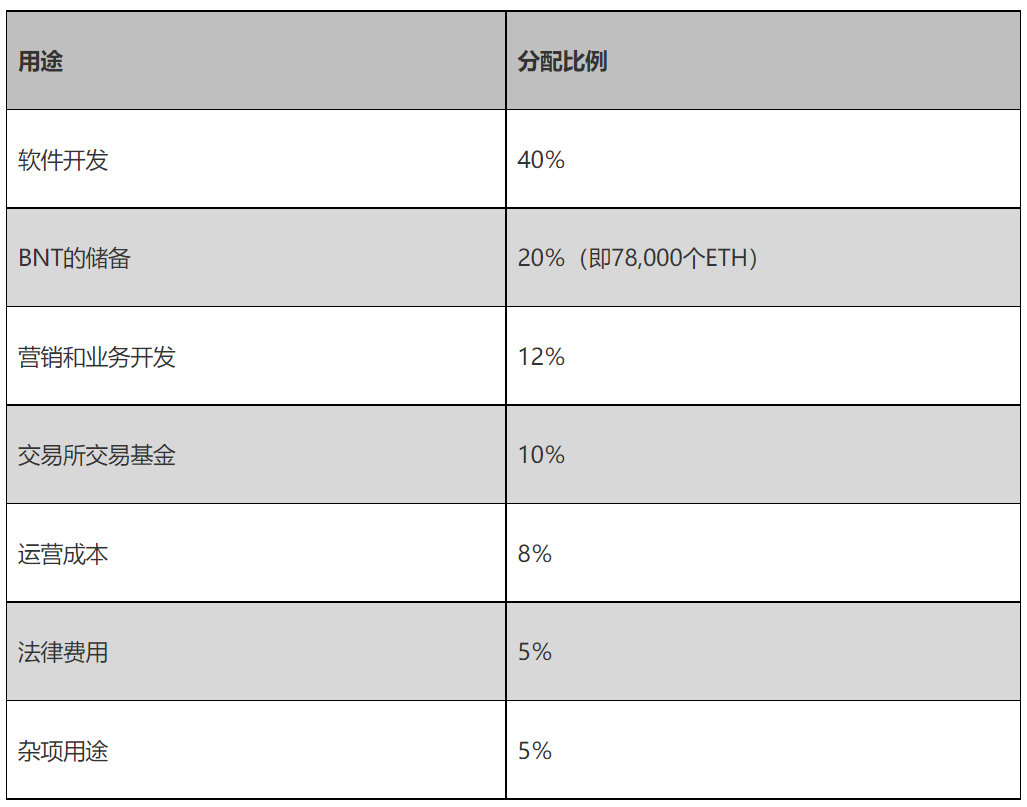
The team did not provide further updates on the subsequent use of its funds.
2.3 & have spent product
In terms of time, Bancor is the earliest AMM DEX on the market, currently v2.1, with an upcoming V3 upgrade.
AMM (Automated Market Maker) uses algorithms to replace the manual quotation of traditional Market makers and takes a Token pool as the transaction object of users. The Token pool consists of two or more trading pairs that have an algorithm of their own that provides users with real-time Token exchange rates. Traditional market makers can still participate by adding a lot of their tokens to the Token pool. This Token pool is also called a LiquidityPool (LP) because it pools the liquidity of market makers.
At present, most AMM DEX algorithms in the market are basically X*Y=V algorithms after simplification, and the difference in algorithm design only has a slight impact on price conversion. The most important factor affecting prices is liquidity.
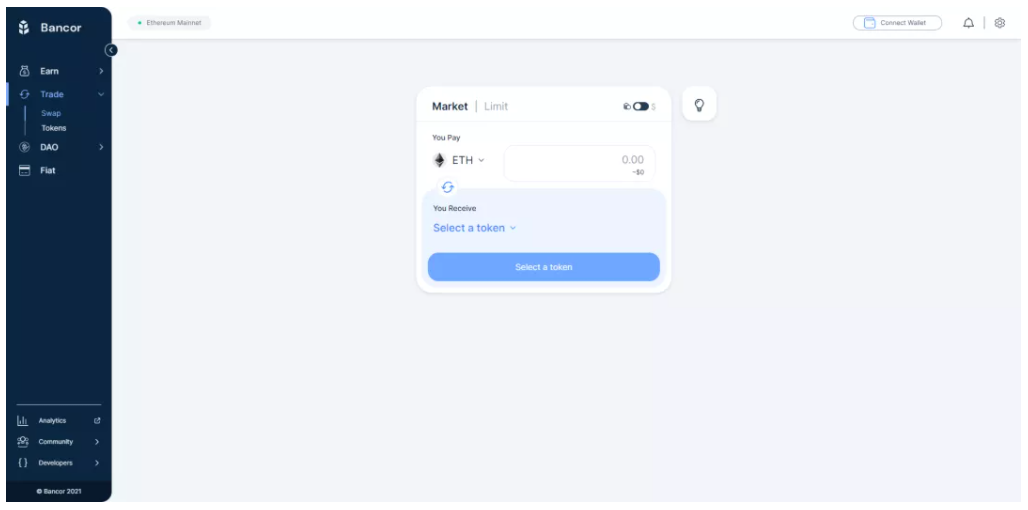
Figure 2-1 Bancor transaction interface
Figure 2-2 Liquidity pool page
2.3.1 & have spent V2.1 version
V2.1 is the current version and has two main features:
1) Market making in a single currency to reduce risk exposure;
2) Liquidity protection. V2.1 uses BNT elastic supply (elasticBNT supply) to achieve the above two features of the mechanism.
Bancor scheme: & NBSP;
A. When a user adds TKN to the TKN (example) Token whitelist pool, the agreement automatically mints new BNT whose value is equal to the value of TKN, resulting in an increase in the total supply of BNT.
B. When users use the pool for transactions, part of the procedure fee shall be paid by TNK and part by BNT.
C. At this point, if another user provides 100 BNT to the pool, the original 100 BNT of the pool will be destroyed, and the transaction cost corresponding to the 100 BNT will also be destroyed.
D. When the whitelisted pool expires and the user is about to remove liquidity, the agreement calculates the impermanence loss.
E. The agreement will use transaction fees to compensate for volatile losses and determine whether new forged BNT is needed to compensate for losses.
F. After compensating for losses, the remaining TKN pool-related BNT tokens will be destroyed. In order to protect the entire network from the influence of new BNT, the following restrictions are made: 1) The total amount of adding a single currency and the number of BNT minted by adding a single Token are capped throughout the network; 2) Liquidity protection rate is limited (liquidity needs to be withdrawn after the end of the 100 day cycle to cover 100% volatile losses).
Bancor's income from a pool is divided into two parts:
1) The cost of forging protocol-owned BNT (BNT). The cost of forging BNT is used to compensate the liquidity provider for the loss of transiency, if there is still any charge after the compensation, it will be destroyed. If the agreement cost is not enough to compensate for the volatile loss, the agreement forging BNT is used for subsidy;
2) Fees generated by TKN (example) tokens are allocated to liquidity providers.
The liquidity protection mechanism is that the longer a user stays in the pool, the more it is protected by the mechanism. It takes about three months (100 days) to cover 100 percent of the volatile losses.
Under the Bancor single-currency market-making scheme, assuming that there are no volatile losses and no BNT providers, the pool obtains transaction fees paid partly by TKN and partly by BNT. When the end user draws all the TKN liquidity, the value of TKN will be greater than the initial value, so the protocol will automatically destroy more BNT than was previously cast. So eventually, the total supply of BNT will decrease, which will increase the scarcity of BNT. But the assumption of this conclusion is almost impossible to hold, and volatile losses can be mitigated but cannot be avoided. Under Bancor's impermanence loss insurance mechanism, it is possible that the system will need to mint new BNT to compensate the liquidity provider, in which case the total supply of BNT will increase. How much more or less will depend on Bancor's trading volume and market volatility. BNT elastic supply strategy can be effective for a long time only when the cost generated by the agreement and the amount of volatile loss reach a dynamic balance.
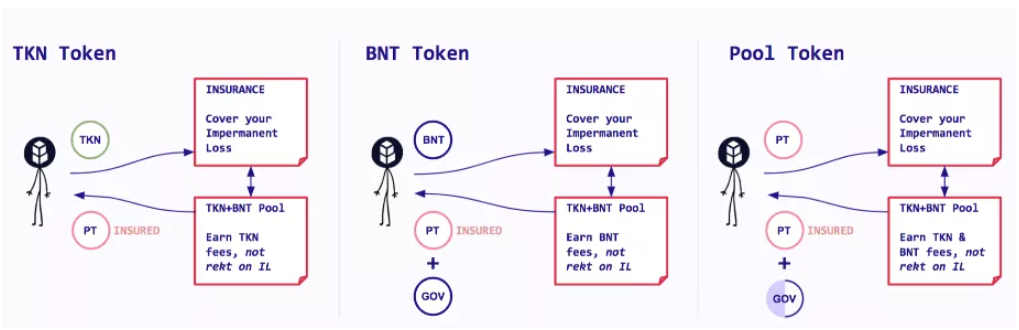
Figure 2-3 Operation process
As shown in the figure above, the Token provided by the TKN provider generates a proof Token that provides liquidity (Pool Token (PT)). Users who provide BNT to a whitelisted Pool will receive vBNT, which represents the BNT liquidity they protect, and which is used for community voting.
Bancor VortexBanco
Vortex is actually selling BNT liquidity to provide proof of vBNT functionality, thereby increasing BNT leverage. Bancor collects 5% of the transaction fee to buy back and destroy vBNT so that there is a buyer for vBNT.
Votex was a last resort solution in V2.1, vBNT stands for deposit liquidity and transaction fees, while mining revenue and vBNT are separate. VBNT under V3 binds liquidity, fees and mining earnings so that all earnings can be compounded.
Points for improvement:
· In Bancor 2.1, transactions still need BNT as an intermediate Token. For example, when ETH purchases ENJ, it needs ETH-BNT-ENJ conversion, which increases transaction costs and sliding points. Relatively complex contract processing also increases Gas costs;
· The premise of 100% coverage of volatile losses is that liquidity must be provided for 100 days. Users cannot withdraw as they deposit, which reduces the utilization rate of funds.
· Liquidity expansion of some currencies is capped.
2.3.2 & have spent V3 version & have spent
V3 is an improved version of V2.1, with three phases: Dawn (expected in January 2022), Sunrise (the most core feature), and Daylight.
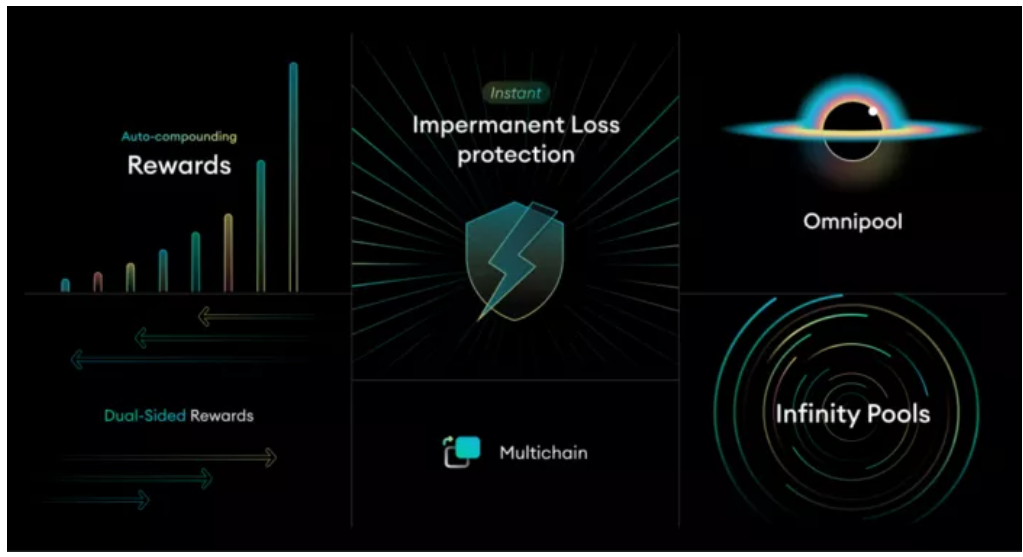
图 2-4 v3 宣传图
The dawn phase updates five major features:
1) Transient protection loss: no need to wait for the end of the 100 day cycle like v2.1. Liquidity providers receive liquidity protection even if they withdraw as they deposit. However, in the case of instantaneous protection against impermanent losses, there may be a arbitrage spread, which increases the pressure on the system to cover impermanent losses and raises the possibility that the system will issue additional BNT tokens to compensate liquidity providers. New mechanisms have been deployed to make more efficient use of the existing liquidity of the protocol and the flexibility to use pool fees to cover non-permanent losses of liquidity pools in the network.
2) Publish the BNT summary pool: in V3, the BNT pool is a centralized pool. In Bancorv2.1, each transaction pair pool requires a BNT pool (such as ETH/BNT, DAI/BNT). Contributors indicate that when BNT becomes a summary pool, Token transactions no longer need to hop through BNT, thereby reducing Gas and slip points for users.
3) Automatic compound interest: When users provide liquidity, the revenue usually comes from transaction fees and liquidity mining rewards. Liquidity mining and transaction fees are automatically compounded. In V2.1, transaction fees can automatically compound, but users must manually compound mining rewards. In addition, in V3, both the project party and Bancor can offer tokens as liquidity incentives (both bilateral incentives allow automatic compound interest).
4) Remove the deposit limit. It is beneficial to improve the total liquidity of DEX, thus providing better liquidity depth and price. As the liquidity of protection increases, only increased trading volume and income (including transaction fees and other strategy income) can sustain the viability of economic models in the long run. The agreement will introduce the concepts of trading liquidity, which is used for market making, and superfluid liquidity, which is used for trading liquidity and other fee-based strategies. The size of the transaction liquidity is still determined by the DAO, and tokens exceeding the transaction liquidity can be used for hyperliquidity strategies that can accumulate additional value for the agreement participants. It is essentially a matter of prioritizing underlying liquidity to achieve more returns through flexible strategies while meeting the liquidity needs of transactions.
5)BancorDAO 不仅有权利决定协议锻造出的 BNT 通过何种方式帮助协议获取额外费用,还可以投票表决白名单中锻造出的 BNT 量是否减少,或者是将锻造的 BNT 流动性转移到别的池子中,从而优化 Bancor 协议、BNT 持有者和 LP 获取的费用。
Additional features:
1) Reduce Gas fees & NBSP;
2) L2 deployment. At present, DEX basically adopts the multi-chain deployment scheme. After the improvement of Bancor contract, it is more convenient to migrate.
3) One-click liquidity migration, you can migrate v2 liquidity to V3, or migrate liquidity from Uniswap, Sushiswap and other DEX to Bancor V3.
4) Combinable pool tokens: Bancor V2.1's pool tokens are bound to positions and are not combinable. Bancor V3 will introduce a new LP Token model, hoping to improve the utilization of users' funds, or the Bancor protocol will help users achieve portfolio gains with LP tokens. According to the team AMA, in version v3, if the LP Token holder sells the LP Token (e.g. VBNT), then the user no longer enjoys the liquidity mining benefits. At present, both the mainstream lending products and DEX LP tokens in the market can be traded freely, but only a few LP tokens are fully utilized in practical applications. At present, the LP Token of Curve has a high utilization rate, and a series of ecology based on Curve has emerged, including aggregation revenue protocol and so on. After Bancor's LP Token is composable, the possibility of compound returns is improved, but the specific situation still needs to be combined with market acceptance and cooperation with relevant project parties.
5) Third-party liquidity protection: in V2.1, impermanent losses are compensated by transaction fees and additional issuance of BNT, which basically keeps BNT in a microinflationary state (not considering liquidity mining). As long as the volatility loss is greater than the transaction fee gain, BNT will remain inflationary. V3 cancelled the liquidity protection ceiling and adopted instantaneous liquidity protection, which may further increase the pressure of compensation for volatile losses. The Token project side can provide Token as compensation for volatile losses and share the pressure for Bancor.
6) Front-end improvement.
Conclusion:
Many details of V3 are still being worked out. The current V3 dawn phase emphasizes performance to compensate for volatile losses and improve returns. The improvement points of impermanent loss compensation include:
1) Instantaneous compensation;
2) Compensation by a third party (project party);
3) Remove the liquidity protection cap.
Improvement points include:
1) Liquidity allocation through DAO to improve the capital utilization rate of underlying assets;
2) Support LP Token composability;
3) Automatic compound interest. If the protection of volatile loss and additional income can be achieved, it can indeed improve the attractiveness of liquidity providers, and it is possible to realize a positive cycle of liquidity growth, low slip point, higher trading volume, and higher commission fee attracting more liquidity.
3. Development & have spent
3.1 & have spent History & have spent
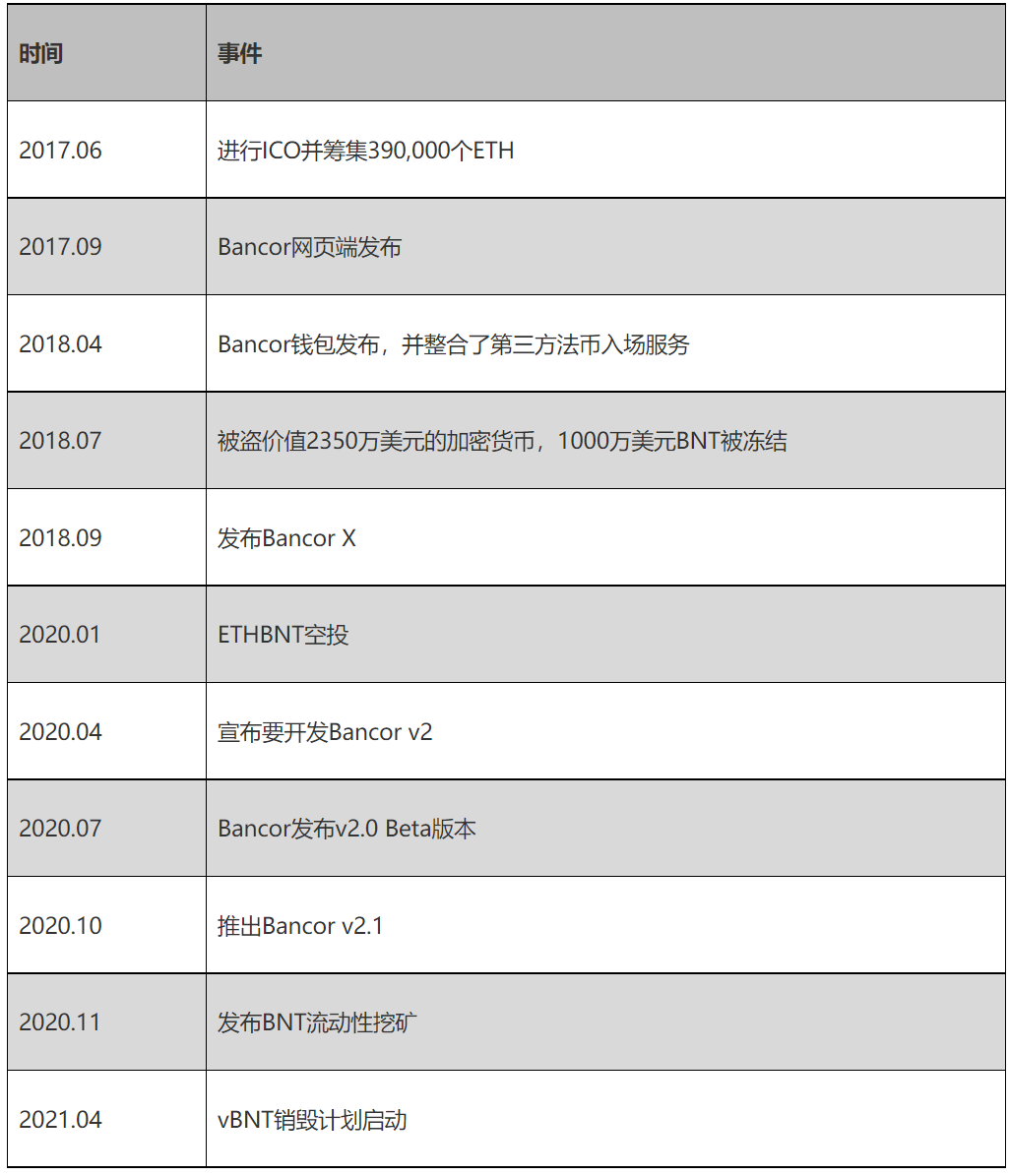
Table 3-1 Bancor events
The Bancor team has been working on the Appcoin chain trading platform since 2012. The IC0 it conducted in 2017 was also the largest of its kind at the time, far exceeding the actual size of the team's funding plan. Bancor is the earliest AMM DEX. The original vision is to provide a trading market for long-tail tokens. The core is to create a liquidity pool bound with BNT for long-tail tokens and provide market quotes with algorithms. Bancor is committed to the ecosystem of Ethereum. In 2018, cross-chain EOS was developed, but the effect was not good, mainly due to the poor development of EOS ecosystem.
Because Bancor 1.0's algorithm required BNT to be used as the conversion Token for Token transactions, which resulted in a higher fee charge and a larger slip point, Bancor's transaction volume lagged behind that of comparable DEXs, and the share of transactions on the Ethereum chain was largely concentrated in Uniswap. Bancor V1's small liquidity pool and large sliding point lead to small trading volume, and low transaction fee income leads to liquidity participants' reluctance to provide liquidity, which also forms a vicious circle.
At the same time, it is also pointed out in the market that liquidity providers are suffering from impermanent losses (non-permanent losses) in AMM DEX, and the AMM DEX usually does not support the provision of single currency liquidity when providing liquidity, which also results in liquidity providers having to bear a variety of Token price risks.
由此,Bancor 希望改进自己的 AMM 模型,使转换Token更有效率,提高交易量,同时为流动性提供者避免多币暴露风险和非永久性损失。Bancor 在同年 4 月宣布要推出 v2.0,v2.0 最初是采用预言机报价方案,但市场上已用预言机进行报价的 AMM DEX 方案证明该方案存在漏洞。Bancor 出了 v2.0 Beta 版本后遇到了一些问题,随后暂停升级,重新研发,直接进入 v2.1 阶段。v2.1 版本实现了非永久性损失补偿和单币提供流动性功能。
3.2 & have spent The status quo
Bancor V2.1 has been running for 1 year. The following is Bancor transaction data and relevant data since the operation of Bancorv2.
At present, there is no perfect single index to measure DEX in the market, and trading volume is only one of them. Although in AMM DEX, higher revenue will attract more LP's, and better depth means better price, higher transaction volume will increase agreement revenue. However, the largest trading volume does not mean that the LP yield of the agreement is the highest among all the agreements, because factors such as capital utilization rate and volatile loss will affect the LP income rate.
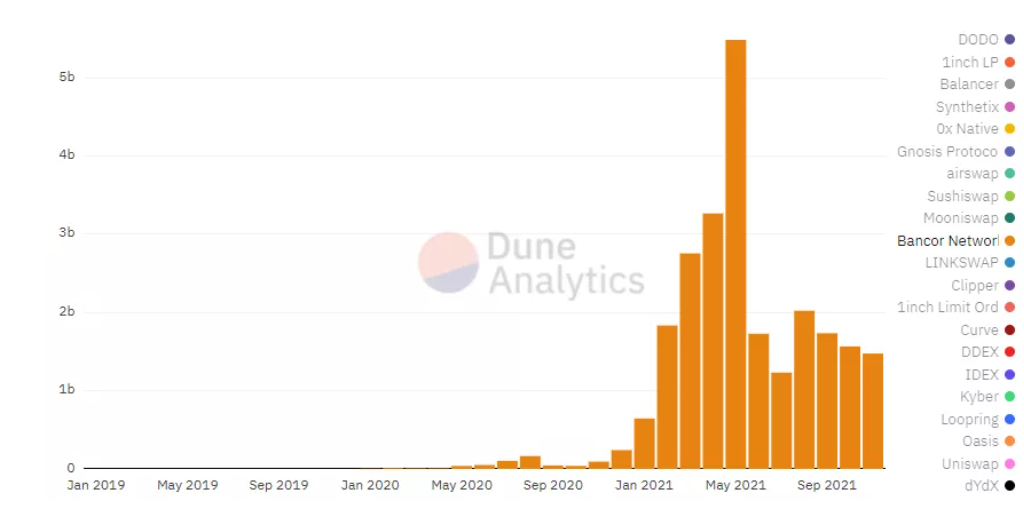
Figure 3-1 Trading volume of Bancor (January 2019 -- November 2021.11)
根据图 3-1,在 2020 年 5 月之前,Bancor 每月的交易量基本上不超过 1,000 万美元(作为参考,Uniswap 当时月交易量约为 1 亿美元)。随着 2020 年 DeFi 热潮,Bancor 交易量随着市场活跃度增加,在 2020 年 8 月达到了一个小高峰,月交易量为 1.6 亿美元。2020 年 10 月,Bancor v2.1 发布,但适逢市场活跃度降低,因此 Bancor 交易量并没有明显增加。随后,2021 年市场再次转暖,Bancor 的交易量和市场总体交易量都迅速上涨,v2.1 发布对 Bancor 交易量增长影响可能相对比较小。
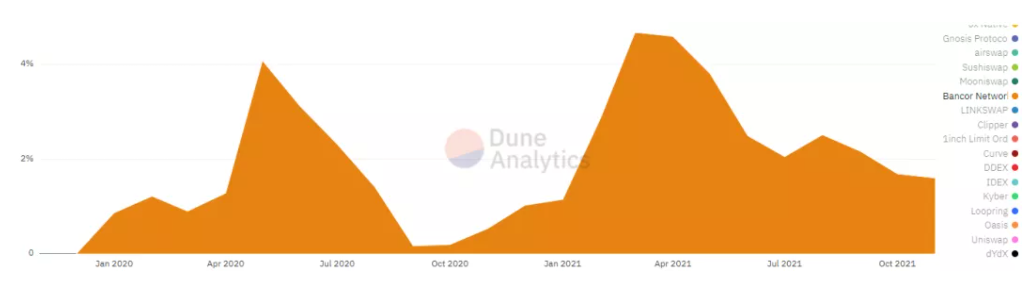
Figure 3-2 Bancor Volume market share (2020.01-2021.11)
根据图 3-2,v2.1 发布前,Bancor 市场占有率最高达到约 4%,v2.1 发布后,随着 Bancor 池子中流动性增加,Bancor 的市场占有率在 2021 年 4 月达到约 5%,随后又下降到 2% 左右。尽管 Bancor 的流动性增加,但实际上对市场份额占比没有太大影响。原因可能是 Bancor 只有核心几个池子保持相对稳定的交易量,当市场上出现热点Token时,Bancor 实际上没有优势,因此市场份额会在市场有热点Token时间段而减少,例如 2021 年 Q3 和 Q4 阶段游戏和元宇宙领域Token。
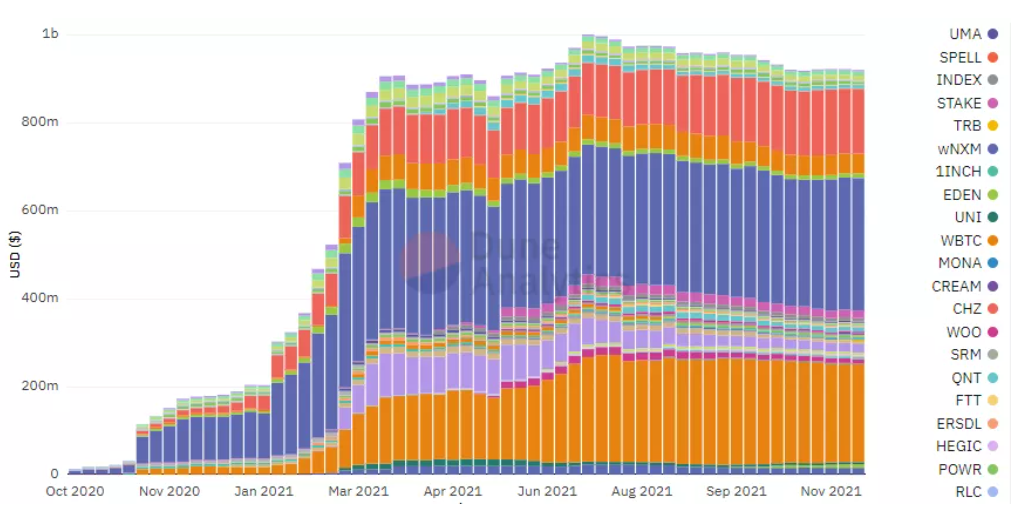
Figure 3-3 Total amount of liquidity protection and Token types
根据图 3-3,目前 Bancor 支持流动性保护的Token种类约 80 种。截至 2021 年 11 月,流动性保护总量达到将近 10 亿美元,其中流动性最高的Token为:BNT(蓝色)、WBTC(橙色(下))、MATIC(紫色)、LINK(玫红色)、ENJ(橙色(上)),这 5 种Token的流动性总量达到将近 7 亿美元。
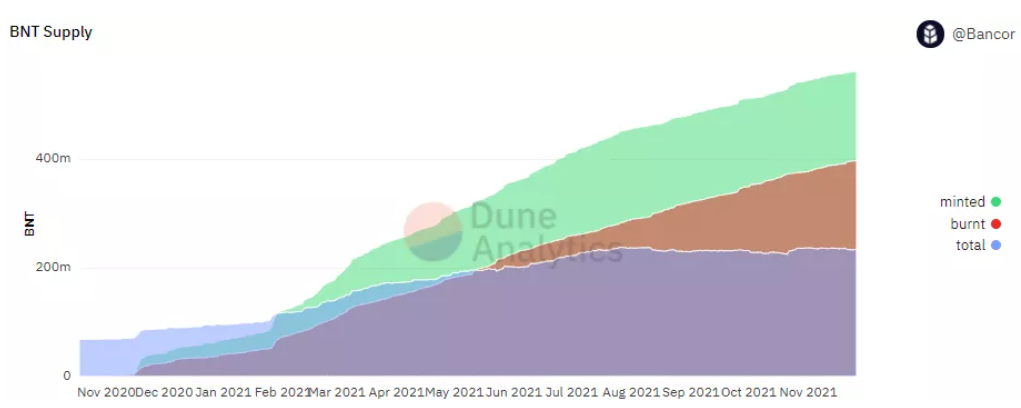
图 3-4 BNT Token总量
根据图 3-4,BNT 锻造总量随着池子开放增加。流动性移除后,系统额外锻造的 BNT 会销毁。因此当 Bancor 内添加的流动性增加到一定程度后,系统内的 BNT 总量会达到相对平稳的状态。
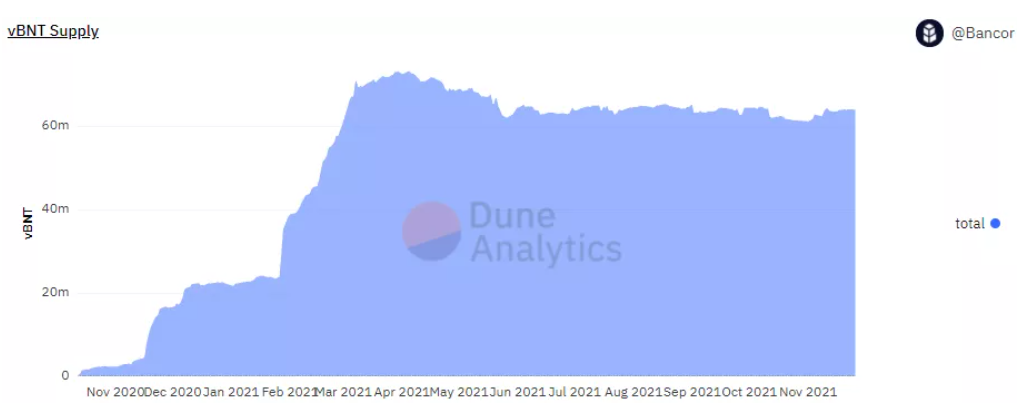
Figure 3-5 Total amount of vBNT
vBNT 约等于质押 BNT 总量,从 2021 年 6 月开始,BNT 存入总量进入相对平稳阶段。截至 2021 年 11 月 26 日,vBNT 已销毁总量的约 2%,由于 vBNT/BNT 交易量较少,因此手续费收入并不多,vBNT 销毁率并不高。结合图 3-4,可以推测,当 Bancor v3 发布后,如果解除流动性保护上限设置,同时实现随存随取获得流动性保护后,BNT 总量可能会在一段时间内迅速上涨,但在 Bancor 池子内流动性总量达到相对平稳后,BNT 总量也会进入稳定期。
3.3 & have spent In the future
According to the team's disclosure, Bancor will focus on v3 development and marketing activities for the next six months. The current disclosure is the first phase of Bancor V3, and the second phase of V3 will be released later. Bancor V3 Phase 1 is expected to be released in January 2022. The team will announce v3 Phase 2 information in February and complete phase 2 development in March or April.
Conclusion: Bancor started a series of explorations since it proposed to solve the problem of volatile loss. The current version of V2.1 protects liquidity and increases liquidity within the protocol rapidly through this feature, but still fails to expand market share. As a result, the team will continue to focus on addressing volatile losses and further expand liquidity to better position Bancor protocol in the DEX space, with v3 deployment being an important stage in expanding its market share.
4. Economic Model & NBSP;
4.1 & have spent supply
The total supply of BNT was 79,323,978 units at the initial IC0 and remained in dynamic supply for two years until the ETHBNT airdrop switched to a fixed supply and the total supply became 69,148,642 units, a decrease of nearly 10 million units. After deploying version V2 and liquidity mining, BNT is an inflation-type Token. As of November 24, 2021, the maximum supply of BNT was 234,106,568, of which 83.11% was pledged in the agreement, and the actual amount of tokens in circulation was about 40 million BNT.
Flow mining
· The team started liquidity mining in November 2020 for 72 weeks (up to March 2022).
· Bancor provides WEEKLY BNT incentives to liquidity providers in the whitelisted pool, with 100,000-200,000 BNT per week for large pools and 10,000-20,000 BNT per week for medium-sized pools.
· Every two weeks, two new tokens can be added to the liquidity mining program. Once activated, the Token pool continues to earn BNT Token rewards for 12 weeks;
· Once activated, the Token pool continues to earn BNT Token rewards for 12 weeks.
· 70% of the BNT liquidity mining award will be allocated to the BNT end of the liquidity pool and the remaining 30% will be allocated to the base ERC20 (example TKN) end.
· 6 large capital pools and 2 medium capital pools were initially set up.
4.2 & have spent demand
In V2.1, there is an upper limit for the whitelist pool of liquidity protection, that is, there is an upper limit for the BNT forged by protocols in a single pool and in the whole network. If users need to deposit other types of tokens, they need to increase the amount of BNT that users deposit. Users who store BNT get vBNT, which can be used for governance and for protocol transaction fees. In Bancor V3, although it is still a simple deposit of BNT for LP, V3 actually automates the search for the optimal scheme of BNT income within the protocol to some extent, so it may increase the demand for BNT. 4.3 & have spent Since there is no BNT data added through liquidity mining so far, the following content is only a rough judgment based on existing data.
BNT inflation mainly comes from three parts:
1) Liquidity mining;
2) BNT forged by the agreement is not circulated in the market. This portion of BNT is destroyed as the user adds BNT to the pool or withdraws liquidity.
3) When the accumulated transaction cost of the agreement cannot cover the volatile loss, the agreement will forge new BNT to compensate the liquidity provider when the user withdraws the liquidity.
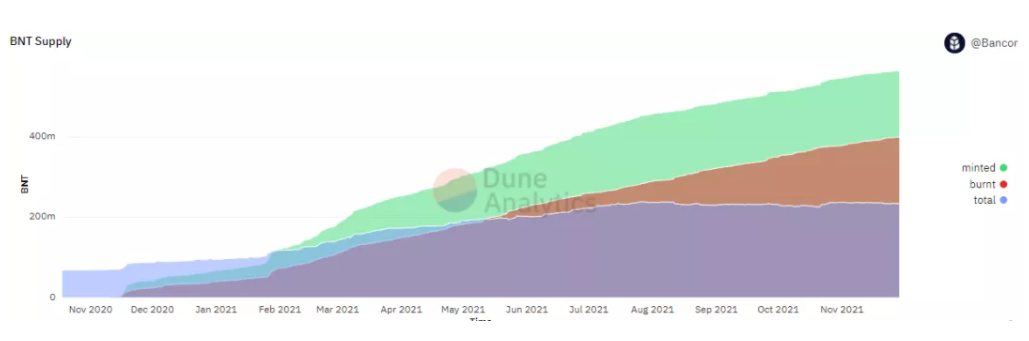
Figure 4-1 BNT Token supply
结合图 3-3,Bancor 协议内保护的流动性从 2021 年 5 月就基本维持在 10 亿美元左右,因此在池子中添加流动性导致系统锻造 BNT 增加量可以忽略不计。而图 4-1 中,BNT 总量从 2021 年 5 月至今的 6 个月时间内,BNT 总量从约 2 亿枚增加到 2.3 亿枚Token,增加了 3,000 万枚Token。
From May to May (24 months), about 14.88 million to 29.36 million BNT will be issued, assuming that six large pools (WBTC, ETH, LINK, DAI, USDT and other mainstream trading pairs) and two medium-sized pools will continue liquidity mining. At the same time, combined with the v2.1 summary released by the team, the agreement fees generated by the transaction can basically cover the compensation for volatile losses. Therefore, it can be concluded that the main cause of BNT inflation at present is liquidity mining, rather than contractual forging of BNT to compensate for volatile losses.
After V3, the number of BNT forged by the protocol may increase as the total amount of liquidity protection may increase, so the total number of tokens may increase as a result, but the actual amount of tokens in circulation is mainly due to liquidity mining and impermanent loss compensation forged BNT (in cases where the fee cannot cover impermanent losses).
And in V2.1 version, the calculation of impermanence loss is settled after the end of the cycle, the time cycle is longer, which can accurately calculate the impermanence loss. However, in V3 version, the function of instantaneous loss compensation is added, and it is expected to use the predictor to make the quotation. This feature may make the protocol produce arbitrage space, and increase the pressure of protocol loss coverage.
总结:1)v2.1 版本中,BNT 总量通胀主要是因为流动性挖矿和协议锻造 BNT 增加,弹性 BNT 经济模式是可行的。2)无限制流动性导致协议内的流动性增加,从而 BNT 总量增长,但协议内随着流动性增加而锻造的 BNT 会在流动性移除时减少,因此无限制流动性对实际流通的Token量基本上没有影响。3)瞬时流动性保护可能会存在套利空间,从而增加协议无常损失补偿的压力,提高了增发 BNT 用于补偿的可能性。Token总量可能会继续增加。
5. Competition & have spent
5.1 & have spent Industry Overview & NBSP;
Bancor belongs to the subdivision track: DEX.
5.1.1 & have spent DEX status quo
We can intuitively feel the current situation of DEX field from business data.
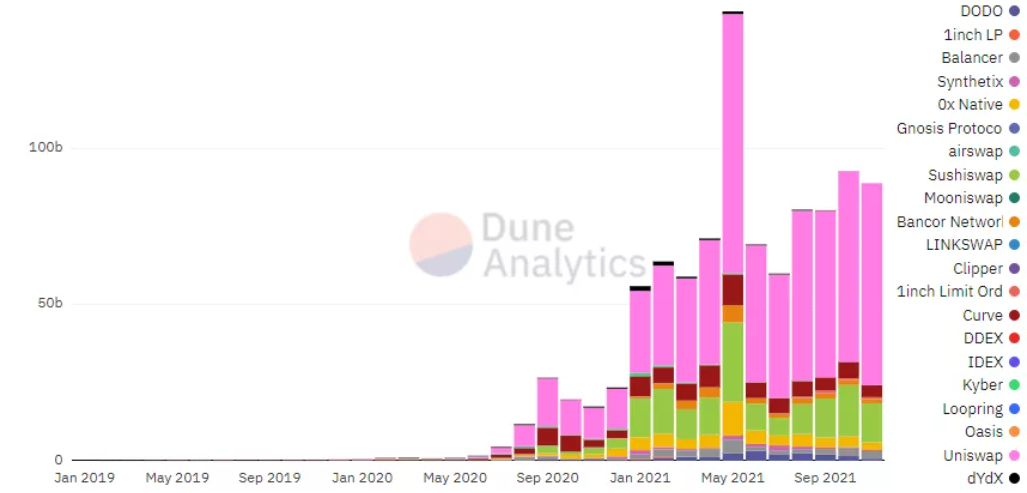
图 5-1 DEX 月交易量(2019.01-2021.10)
从图 5-1 可看出,DEX 赛道在 2020 年 6 月前都还处于沉寂状态。从 2020 年 6 月开始,DEX 赛道进入交易量启动阶段,随后在 2021 年 1 月正式爆发,主要是因为交易平台成熟、DeFi 生态发展和行情等多重刺激使链上生态整体进入大繁荣。
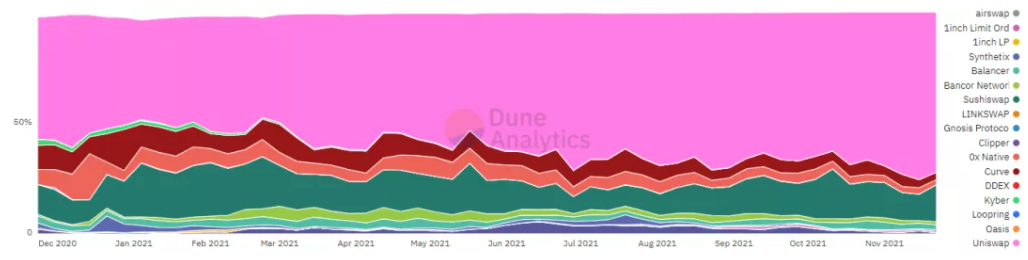
Figure 5-2 DEX market share ratio (2020.12-2021.11)
As you can see from the chart, most of the trading is concentrated in Uniswap (pink), Sushiswap (green) and Curve (bright red). The remaining DEX players with significant market share include 0X Native (rose), Balancer (blue) and Bancor (cyan). Bancor's transaction volume share began to increase from March 2021 and peaked in May 2021. After June, Bancor's transaction volume and market share decreased accordingly. When the volume data of nearly a year is enlarged to the weekly dimension level, it can be seen that there is an obvious and stable echelon stratification:
Tier 1: Uniswap. In the vast majority of the time to maintain more than half of the volume of the market share, even up to 75% of the market share.
Second tier: SushiSwap, Curve and 0X. Sushiswap has a market share of between 10% and 20%, although at one point its market share exceeded 20%, but Uniswap was squeezed. Curve belongs to the anchored asset exchange agreement and maintains a market share of 6%-10%. 0X is the leader of order book protocol. At present, most order book DEX base uses 0X.
Third tier: Bancor, Balancer, DoDo. The market share has remained between 1% and 5% for a long time.
Fourth tier: trading volume market share for a long time less than 1%.
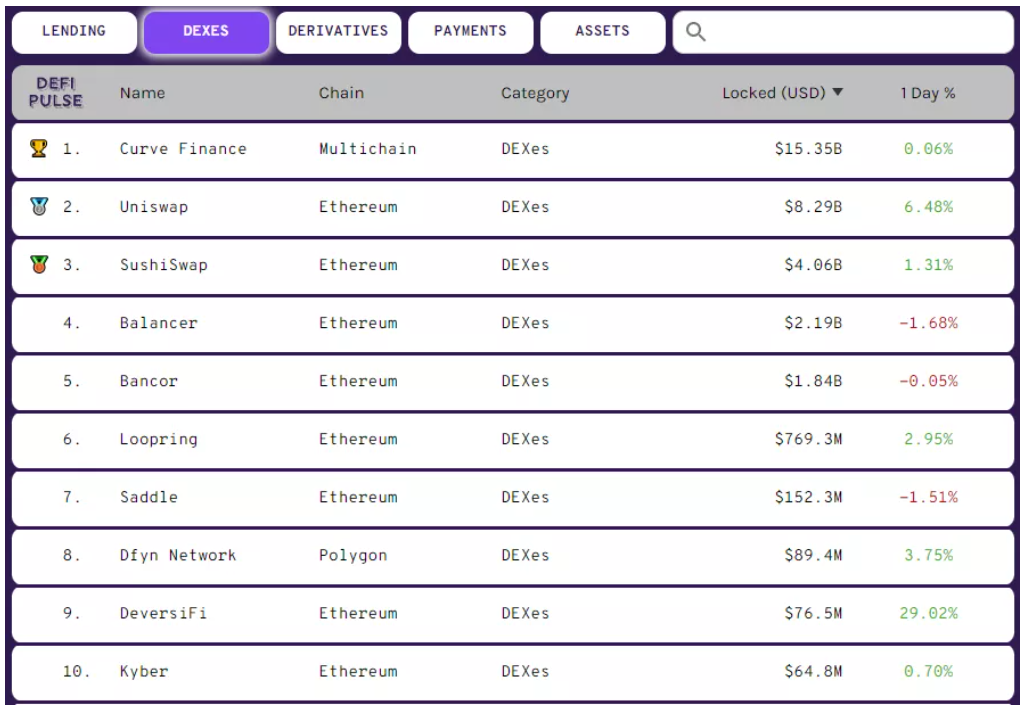
Figure 5-3 Top10 DEX mobility
在 AMM DEX 中,流动性大通常意味着更好的交易价格。因此 LP(流动性提供者)是 AMM DEX 的重要参与方。除了安全性等因素外,DEX 对流动性提供者最大吸引力来自收益,通常包括交易手续费分成和挖矿补贴。从图 5-3 可看出,Curve、Uniswap 和 Sushiswap 处于第一梯队,TVL 在 40 亿美元以上。(Curve 统计了多链汇总数据,而 Uniswap 和 SushiSwap 仅统计以太坊链上数据,因此差距较大。)第二梯队为 Bancor 和 Balancer,流动性在 20 亿美元左右。
5.1.2 & have spent Circuit partitioning
As can be seen from 5.1.1, Uniswap holds the leading position in DEX, while other DEX compete for the remaining market share. The competition of DEX mainly comes from the supply side and the demand side. DEX has a large track and many types of participants (traders, arbitraggers, LP (divided into individuals and market makers), project parties and other DeFi projects) with different demands. Therefore, DEX has room for product differentiation strategies.
DEX is divided into AMM paradigm and non-AMM paradigm.
(1) & AMM paradigm have spent
AMM is the mainstream paradigm of DEX at present. Currently, there are several significant driving points as follows:
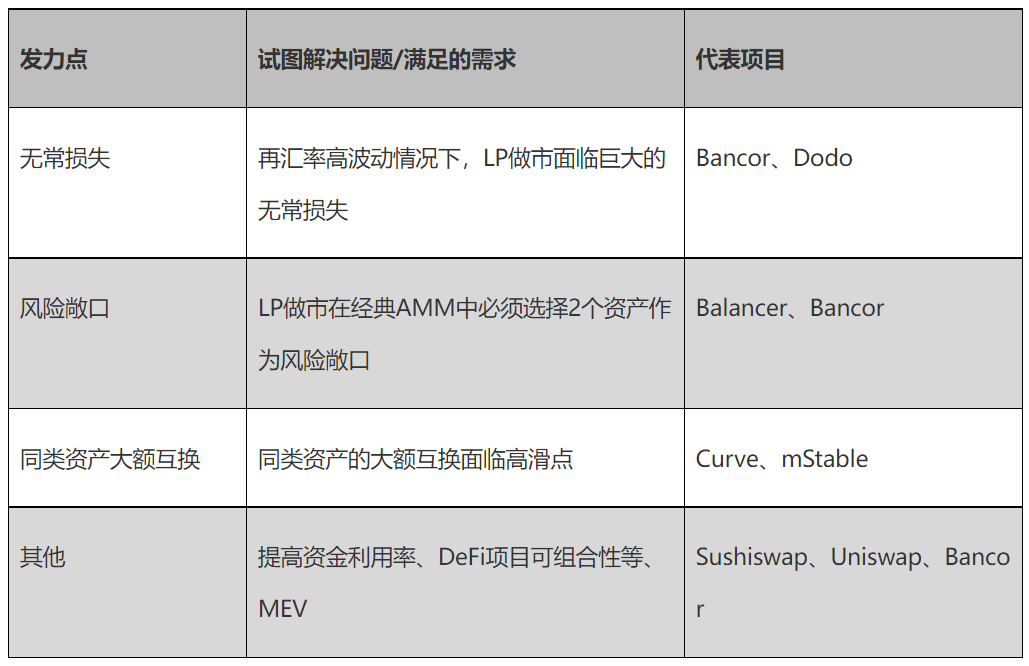
表 5-1 AMM 发力点
Note: The above categories are divided according to the power points of the project business logic and are not perfect in form.
(2) outside the AMM paradigm
In the very long term, the order book is formally the ultimate model. The parties to the order book are very free to express their willingness to trade (price, quantity), but AMM can only choose one or the other. In mainstream finance, the order book is the most widely used paradigm. At present, blockchain and Defi are still in the early stage. The lack of basic performance leads to the high cost of orders, and the lack of liquidity leads to the low efficiency of order book matching. AMM takes advantage of the trend and occupies the majority of the market. However, with the development of tier 2 or even tier 1 technology and the increasing abundance of liquidity, it is highly likely that the paradigm shift of DEX will be promoted.
5.2 竞争分析
The main task of Bancor is still to compete with the head DEX for market share. Therefore, the following contents focus on the development status of Bancor and the improvement of V3, and compare with the head DEX (Uniswap, Sushiswap and Curve).
It should be noted that at present, it is difficult to find a single indicator to measure the pattern of the whole market, while trading volume and TVL are important indicators. The calculation of impermanence loss is complicated, so the following data do not consider the problem of impermanence loss of the agreement.
5.2.1 & have spent Transaction volume, users and revenue
Trading volume
The core purpose of a decentralized trading platform is to promote Token exchange among traders. Trading volume is an important indicator to measure the success of a decentralized trading platform and also reflects the actual value of DEX. In addition, the growth of trading volume is also conducive to increasing the fee income of the agreement, thus attracting more liquidity providers and increasing the liquidity of DEX.
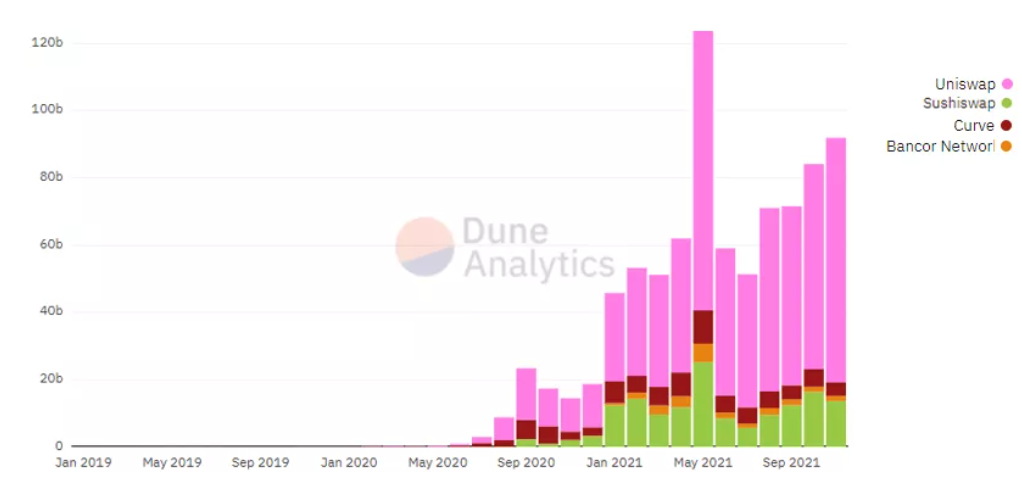
图 5-4 交易量对比
According to Figure 5-4, the trading volume of Bancor lags behind that of DEX, and the increase or decrease of trading volume is mainly affected by the market.
用户
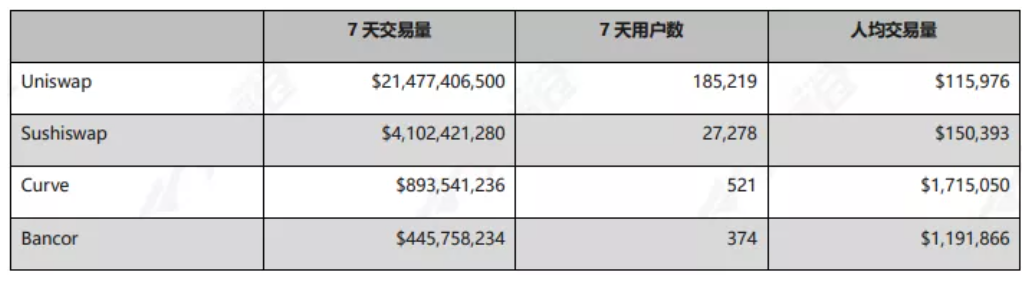
Table 5-2 Comparison of transaction data in the past 7 days
Based on Figure 5-4 and Table 5-2, it can be seen that the trading volume and number of transactions of Bancor are much lower than that of Uniswap and Sushiswap, but the per capita trading volume is much higher than that of Uniswap and Sushiswap, just like Curve.
Reasons may include:
1) Uniswap and Sushiswap have the head effect, so they become the preferred coins on the project decentralized trading platform. Long-tail tokens have low liquidity and a large slip point, so the trading volume is small, dragging down the average trading volume. At the same time, when the popularity of long-tail Token is high, it can bring huge transaction volume to the agreement, so it has a positive effect on the increase of transaction volume of the agreement.
2) Curve refers to the transaction of benchmarked assets. Mainstream assets have good liquidity, but the contract is complex, so Gas is expensive and not suitable for small-amount capital transaction.
3) Bancor's most liquid WETH, wBTC, BNT, LINK and MATIC pools have higher prices than Uniswap and Sushiswap in some cases. Bancor's trading formula is complicated and needs to jump, so Gas charges are higher. Not suitable for small transactions. Things will improve when Bancor V3 is deployed.
income
The following data do not take into account the fickle loss of liquidity providers. The actual income of users should be the total income minus the fickle loss.
DEX typically charges a transaction fee of 0.3% of the value of a transaction, and higher revenue means more transactions. DEX with higher income is more attractive to liquidity providers, thus achieving a positive cycle. However, Bancor's transaction pairs usually charge a fee of 0.1%~0.2%, and some transaction pairs will change the fee through DAO voting.
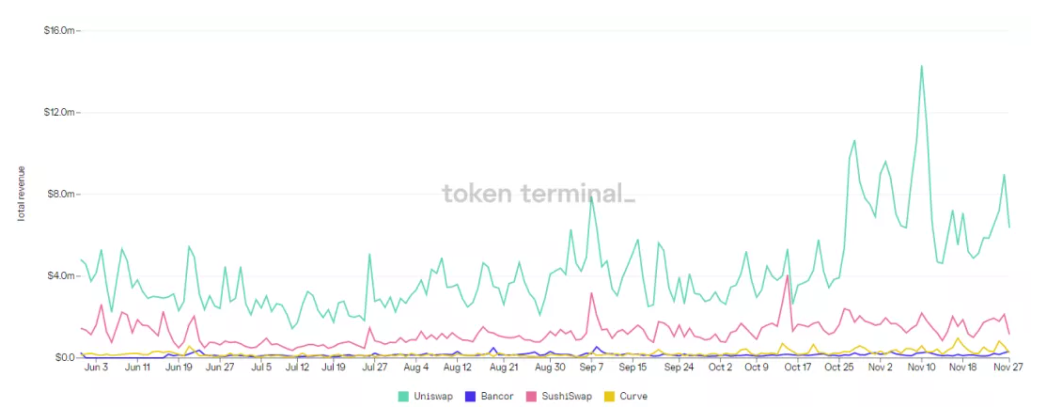
Figure 5-5 Revenue comparison between protocols (2021.06-2021.11)
According to Figure 5-5, Uniswap far outstrips the other DEX with over $4 million per day in revenue, while Bancor and Curve are around $100,000 per day.
5.2.2 & have spent liquidity
锁仓量可以评估 DeFi 协议的增长,也可以评估 DEX 可供利用的流动性的情况。锁仓量越高,说明 DEX 可供利用的流动性越大,更高的流动性可以带来更低的滑点和更好的交易体验,吸引更多的用户进行交易,在 1inch 这类的聚合协议将撮合交易时也会优先路由至提供最佳价格的 DEX。
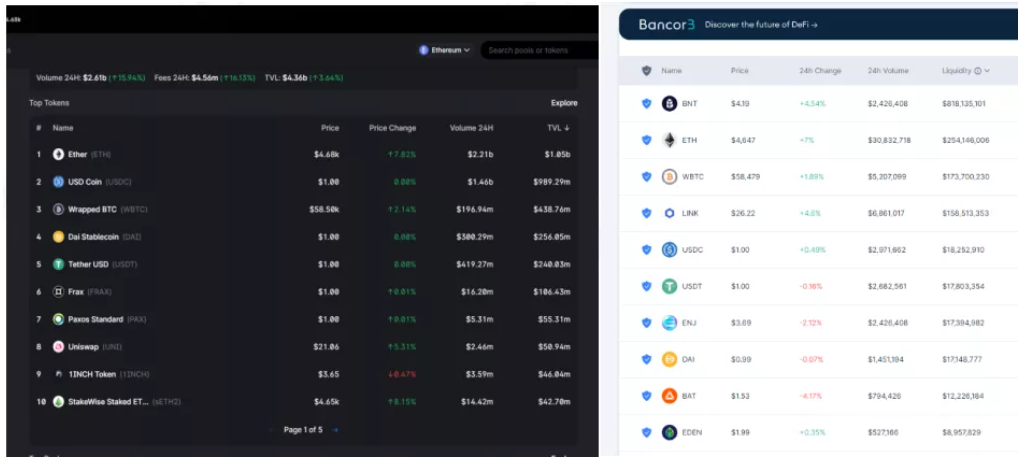
Figure 5-6 Comparison of Top 10 liquidity (2021.11.30)
根据图 5-6 可以看出,Uniswap 的 ETH、WBTC 和Stablecoin等主流Token池子的流动性都高于 Bancor。Bancor 目前只有前 9 个Token流动性是超过 1,000 万美元的,大部分池子的流动性都比较小,因此很难提供比较好的价格。
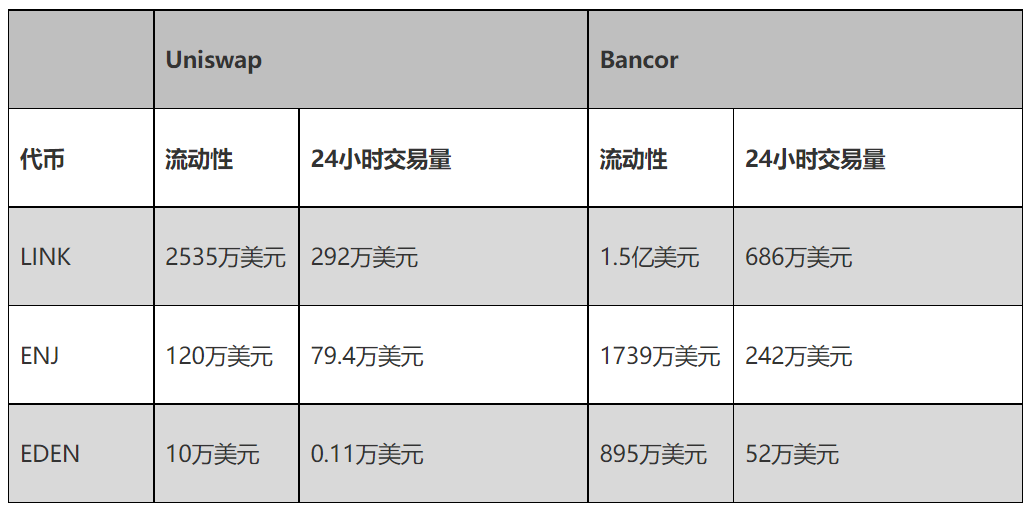
Table 5-3 Comparison of liquidity of some Token types (2021.11.30)
从表 5-2 可看出,Bancor 的某些流动性池子是具有竞争力的,BNT 交易量小的原因,也在于它的「健康」池子数量较少,可正常交易的Token种类较少。因为流动性保护的存在,最大的问题是限制了小币种的单币添加,因此当流动性上限解除后,Bancor 的小币种有机会扩大流动性,从而争夺一定市场交易份额。
5.2.3 requires & have spent Variable loss scheme
Currently, Bancor and DoDo are the main DEX solutions for volatile losses in the market. Based on the practice of the past year, Bancor's scheme subsidises liquidity providers suffering from volatile losses through transaction fees, forging BNT if necessary and thus achieving 100% volatile loss coverage. However, the Dodo scheme will suffer more volatile losses except Stablecoin because of the difference between the predictor quotation and the real-time price in the market due to the introduction of predictor quotation. Stablecoin is currently the source of Dodo's biggest deal.
In other words, Bancor is currently the only DEX in the market that has successfully "solved" the problem of volatile losses, and its economic model is sustainable.
Conclusion: From the current data, Bancor's operation is better than v1 version, but still lags behind the head DEX, and it is difficult to compete for more market share from the head.
Bancor v3 版本有机会再次扩大协议内的流动性,并且有机会改善Stablecoin和山寨Token(例上述 ENJ、LINK、EDEN 等Token)的流动性,从而改变当前局面。优化无常损失补偿、提高流动性提供者收益是一个比较好的发展方向,是有机会提高 Bancor 竞争优势的。
6. 风险
Paradigm shift
The order book is the preferred trading model, and one that has been proven for decades, if not centuries, in mainstream asset and finance. The transition to the order book takes a long time due to infrastructure performance and poor liquidity. In the long run, the future is likely to be dominated by order books and dedicated AMMs. So it requires constant attention.
Competition in the market
目前 DEX 领域头部效应明显,Uniswap、Sushiswap、Curve 长期占据大部分市场份额,形成了自己的生态,无论是对项目方还是对用户来说,已经形成了头部效应。
The original link
Welcome to join the official BlockBeats community:
Telegram Subscription Group: https://t.me/theblockbeats
Telegram Discussion Group: https://t.me/BlockBeats_App
Official Twitter Account: https://twitter.com/BlockBeatsAsia

 Related Articles