Bloomberg's 2022 Crypto outlook, Bitcoin, Ethereum, and crypto dollars
Bloomberg Crypto Outlook
原文作者:Mike McGlone,BI 高级商品分析师
原文编译:Moni,Odaily 星球日报
Spurred by the proliferation of revolutionary technologies such as the crypto dollar and non-homogeneous tokens (NFT), we expect the US to fully embrace cryptocurrencies and introduce appropriate regulation in 2022, all of which will have some impact on price gains. To be clear, cryptocurrency prices, especially bitcoin and Ethereum, which are in limited supply, should continue to rally as a result of the massive increase in the dollar money supply caused by quantitative easing. So what exactly might trip up the advancing "three Musketeers" -- bitcoin, Ethereum and the crypto dollar? This may be an issue that needs to be discussed more deeply in 2022, but we expect bitcoin and Ethereum to gain wider market adoption and overcome most of the market volatility issues (such as the near 50% crypto market correction seen in 2021). In addition, the normalization of equity returns and the continued decline in Treasury yields could also affect bitcoin and Ethereum.
The term staboins can be misleading, as most staboins are actually pegged to the U.S. dollar, so we thought it might be more appropriate to call them crypto dollars.
Bitcoin, bonds and the Federal Reserve
Bitcoin, Ethereum, cryptocurrencies, the Fed and the deflationary forces of 2022. The Fed is likely to reassess its quantitative easing strategy, and lower bond yields could signal a favorable macroeconomic environment in 2022 for the two leading cryptocurrencies bitcoin and Ethereum. Crypto assets showed different strengths than equities at the end of 2021, which could portend continued outperformance for digital assets in 2022.
Is Bitcoin expecting the Fed to end the money game? Some argue that the Fed will still hold off on monetary tightening in 2022 because of fears that stocks will fall, a scenario that could be a positive for bitcoin. Bitcoin is becoming a digital store of value as the cryptocurrency industry's benchmark, but it's important to note that bitcoin is still in price discovery mode, so it's still a risky asset. Bitcoin is bound to face headwinds to growth if stocks fall, but cryptocurrencies could be the main beneficiaries as falling stock prices put pressure on bond yields and encourage more central bank liquidity.
Our chart charts the future pricing of one-year federal funds in 2022, which are expected to have higher rates. The fact that the Fed's attempts to sustain the tightening cycle have failed, particularly since raising rates in 2015, suggests that the US is set to follow Japan and Europe into negative yields.

Could Fed tapering be a dream? Bitcoin may tell you
Bond yields defy the lower consensus. Despite the consensus view that long-term Treasury yields are higher, the metric still can't realistically hold above 2%, a figure that could help bitcoin become a major asset in a deflationary environment in 2022. Yields on long-term US bonds fell below the 2% threshold for the first time in February 2020, largely because of the COVID-19 outbreak in the US, which led to a subsequent plunge in most risky assets in March. Our chart charts that US yields are likely to follow Japan and Europe into negative territory, meaning that the forthcoming digital reserve asset is likely to be the most prominent beneficiary.
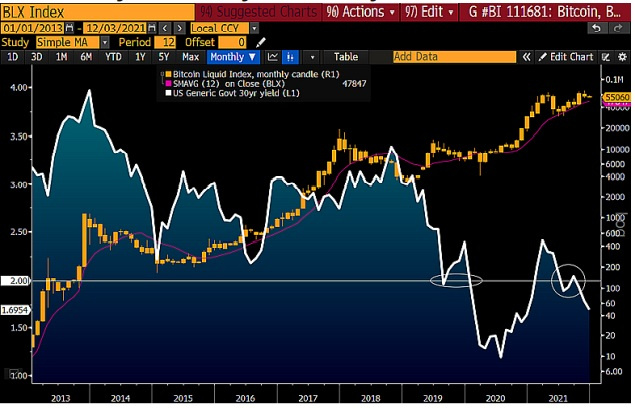
Bitcoin is likely to be the main beneficiary as Treasury yields fall
Money has shifted from gold to Bitcoin and Ethereum, and for 2022 the question centers on a liquidity reversal or acceleration. As bond yields fall, we tend to favor cryptocurrencies for greater liquidity.
Do cryptocurrencies have an advantage over the stock market? The different strengths from the stock market and the basis for a sharp decline in 2021 could set the stage for further appreciation in cryptocurrency asset prices in 2022. The market could have a comparative advantage in 2022. Our chart depicts the Bloomberg Galaxy Crypto Index rising despite the S&P 500's decline at the end of November. It's important to note that crypto is still a risky asset, but the major assets -- Bitcoin and Ethereum -- may be shifting to stores of value.
Reduced supply is a key attribute shared by the two leading cryptocurrencies, Bitcoin and Ethereum. Both early adopters of the two cryptocurrencies and those who have recently migrated to their portfolios need to be aware that while digital assets may have advantages over expanding stock markets, there are risks of volatility, especially as the Federal Reserve reduces liquidity.
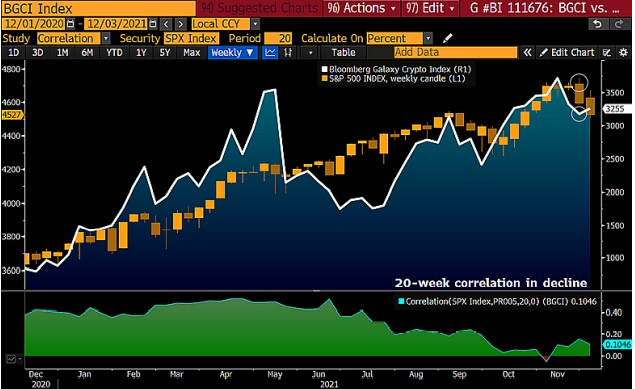
Crypto assets differ in strength from the stock market
Crypto dollar, Bitcoin, Ethereum
Who are the "Three Musketeers" of 2022? Answer: Crypto dollars, Ethereum, and Bitcoin. The crypto dollar represents a better way to transact, a stronger ecosystem, and an asset class that is here to stay. It is the most important advance in the digital currency revolution and the third leg of the crypto stool. The other two musketeers -- Bitcoin and Ethereum -- look as durable in the bull market as the stabocoin, which tracks the dollar.
Bitcoin, Ethereum, and crypto dollars in 2022. Past performance is no predictor of future results, but when a new asset class outperforms an existing one, there doesn't seem to be much reason to argue against it, and there seems to be only one option left for you to follow. In our view, this scenario is expected to play a major role in 2022, as money managers may instead be exposed to greater risk if they continue to own crypto assets, as they are not allocated crypto assets in their portfolios. According to our chart data, the Bloomberg Galaxy Crypto Index (BGCI) is up about 1,200% since the end of 2019, while the S&P 500 is up nearly 90%. Such outperformance is often accompanied by volatility, notably that the BGCI was down nearly 60% in 2021, but that could set the stage for further appreciation in 2022.
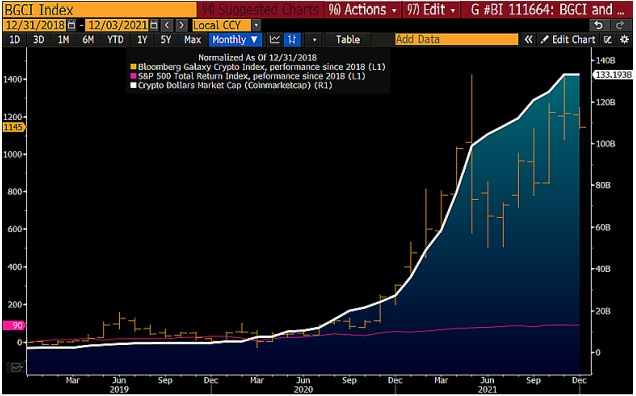
Crypto dollar proliferation and rising BGCI index
80% of the BGCI index's asset allocation is in Bitcoin and Ethereum, so we expect further consolidation and possibly a surge in cryptocurrency market trends in 2022, with our follow-up chart showing the crypto dollar market cap rising to over $130 billion.
The U.S. dollar has always been the dominant cryptocurrency. Bitcoin and Ethereum are expected to continue to lead the crypto ecosystem, compared with some 15,000 cryptocurrencies vying for speculative leadership. BNB, SOL and ADA have replaced XRP, BCH and LINK near the head from a year ago. Our chart charts the continued upward trajectory of the crypto dollar market cap versus bitcoin and Ethereum. In our view, there is still a lot of speculation about crypto changes, as indicated by Shiba And Dogecoin, but there should not be much movement in the top three positions.
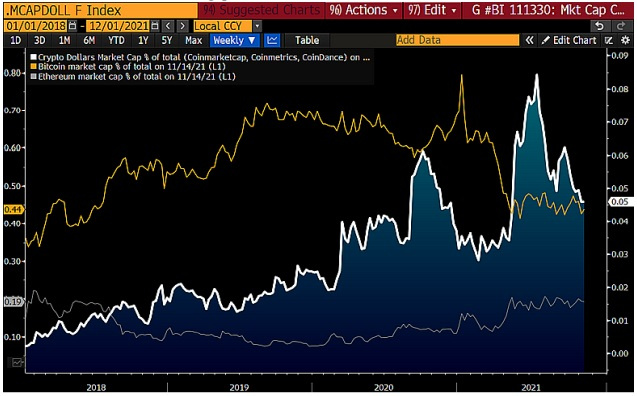
The crypto dollar will remain bullish
Ethereum's market cap as a percentage of crypto's market cap has been rising to around 20%, up from around 10% a year ago, because most crypto dollars run on the Ethereum platform.
Head of the digital asset bull market: crypto dollar. Crypto dollar attributes include instant settlement of round-the-clock trading, transmission of dollars, and earning much higher interest rates than euro/dollar. In this regard, crypto dollars have a huge impact on digital assets such as Ethereum, thus boosting the DOLLAR and most other financial assets. In a world that is rapidly going digital, trading through digital tokens may be the trend. Our chart compares the market capitalization of the top five crypto dollars (Tether is no. 1) to bitcoin and Ethereum. Tether typically trades more than bitcoin and Ethereum combined, according to Coinmarketcap, and let's not forget that Tether is also an Ethereum token.
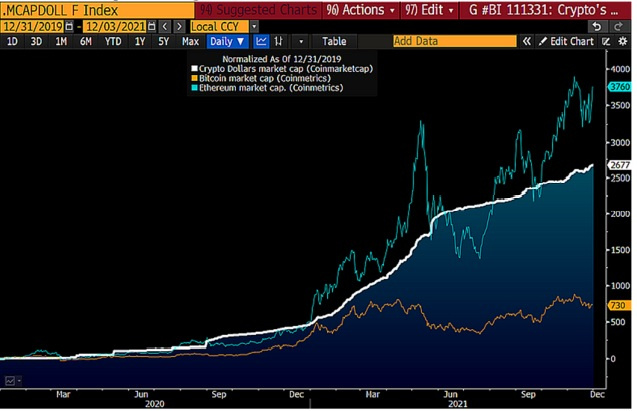
Crypto cap trends since the end of 2019
Volatility in the crypto market is to be expected, given that the emergence of central bank digital currencies has already occurred organically, but the data suggest a shift in the crypto market towards the US dollar.
Bitcoin bull Market
Has Bitcoin started a new bull market in 2021? An update trend. As we head into 2022, the key question for bitcoin now is whether it has peaked or is just a consolidated bull market. We believe it is the latter, and in this market environment, Bitcoin is well on its way to becoming a global digital collateral. In 2022, key support for bitcoin is likely around $50,000, with resistance around $100,000.
The price range for bitcoin in 2022 could be between $40,000 and $70,000. As we've seen, bitcoin has pulled back by about 50% in 2021, but the fundamentals remain positive and are likely to rise again in 2022. China has banned cryptocurrencies altogether, but energy consumption issues have improved bitcoin's fundamentals, as evidenced by its rapid recovery after bottoming out in July. Now that most mining operations have moved to places like the United States and Canada, the energy use of the world's largest decentralized network shows bitcoin's continued power. Our chart charts the new bull market seen since the July lows around $30,000.
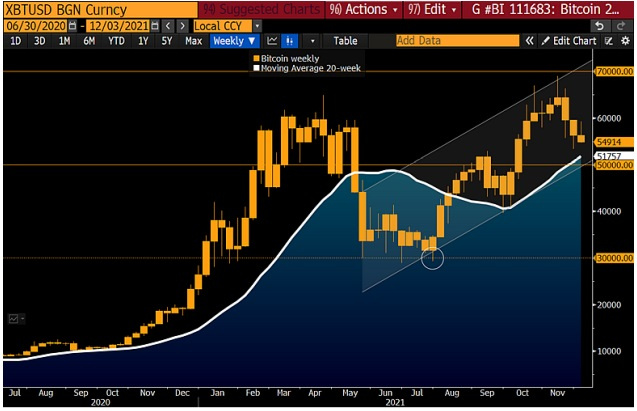
Bitcoin's speculative excesses in 2021 have been cleared
Support for Bitcoin should be around $40,000 -- just below the 20-week moving average, and at the top of the trend channel we find initial resistance around $70,000.
Will Bitcoin hit $100,000 by 2022? Bitcoin seems to be on a $100,000 trajectory. We think it should only be a matter of time, because there is an economic basis for this, one is increased market demand, and two is the supply of Bitcoin. There are plenty of examples of bitcoin moving forward in 2022 in the process of mainstream adoption. The launch of bitcoin exchange-traded funds and futures in the US, Canada and Europe, and the designation of bitcoin as legal tender in El Salvador, all point to increased global adoption. Our chart charts the decline in bitcoin supply versus the rise in price and volatility, and the overall picture looks subdued.

Bitcoin remains bullish as adoption rises and supply falls
If an asset is maturing, it's normal to see a decline in volatility, and that's how we look at Bitcoin. Bitcoin's current annualized volatility is just under 80%, which is about the same as in 2018, but the price is now much higher than it was in 2018, suggesting that the mainstream is starting to embrace bitcoin.
Bitcoin may be more than just a digital version of gold. If assessed according to traditional models, the potential path for the price of bitcoin is likely to stabilize at about 100 times that of gold per ounce, with lower and lower volatility. According to our chart data, bitcoin prices have continued to rise relative to gold, with the 260-day volatility of bitcoin reaching its lowest level since early 2021. Bitcoin's 260-day volatility, a measure of relative risk, bottomed out at the end of 2016 before a bull market in 2017, while 2020 and 2016 are similar in that the supply of bitcoin halved, hitting a new all-time high in 2021.
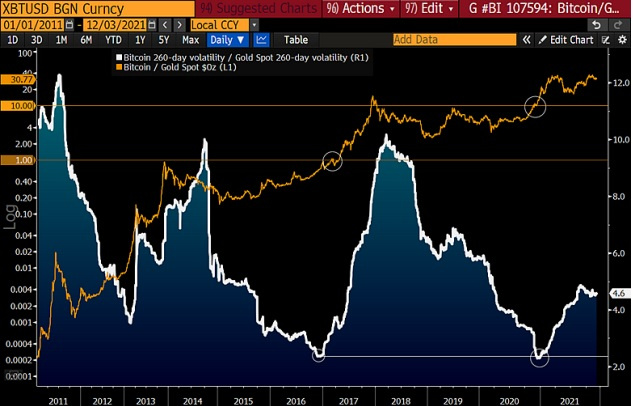
Bitcoin is likely to stabilize at around 100 times the price of gold per ounce
We believe bitcoin's fundamental support remains on an appreciation path compared to gold.
A consolidated, mature bitcoin bull market. As 2022 approaches, we see a pause, correction and update of the Bitcoin bull market is how we see Bitcoin approaching 2022. As depth and adoption increases, bitcoin's volatility will decline and its price will rise over the long term. In early 2021, Bitcoin hit a milestone: Its 260-day volatility fell to its lowest level ever compared to most major asset classes, particularly the S&P 500. In 2021, bitcoin prices rose by about 100%, and the average price this year was just under $50,000 or so.
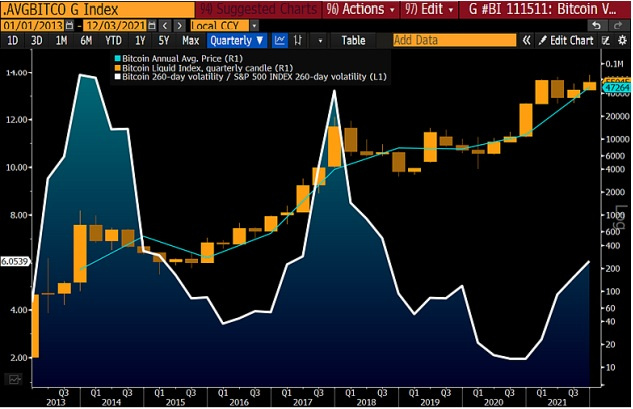
Bitcoin in q4 2021 was unchanged from Q1
Bitcoin fell about 50% in the second quarter of this year, but this actually helps solidify the fundamentals, and we think bitcoin has more potential to break $100,000 in 2022 than to stay below $50,000.
Ethereum bull Market
What might stop the Ethereum bull market in 2022? The answer may be unexpected: higher prices. At a time when demand is increasing and supply is falling, ethereum's centrality to the digital world of finance and money is the foundation for further appreciation. Ethereum has been the best-performing major crypto asset in 2021, with ETH turning positive in the second half after falling about 60% in the first half.
The bullish price range for Ethereum is likely to be between $4000- $5000. Going into 2022, Ethereum is likely to see two trends: rising adoption and declining supply. Ethereum survived a major correction in 2021, and the key question now is how far it might take for ethereum prices to pull back. According to our analysis, ethereum could see a new bull market, of course, in the context of ethereum's July lows, which ultimately established that $4,000 should serve as key resistance and $2,000 as key support.
You'll find the resistance going forward is support now and $4,000 could be a key fulcrum in 2022.
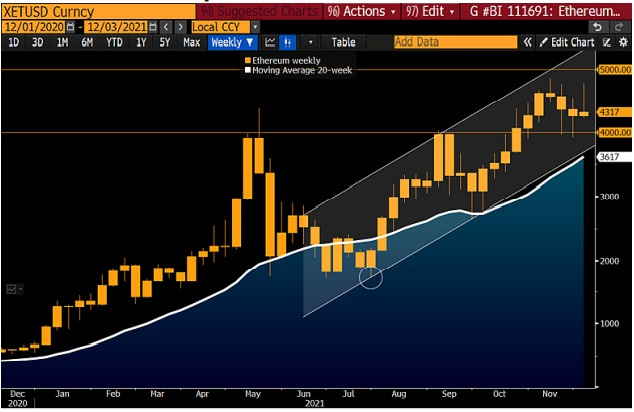
There is no reason to complicate the bull market
Ethereum remains the platform of choice for NFT and crypto dollars, and this has already emerged and played out in 2021, which we expect to build on and successfully foster greater market competition in 2022. Of course, we've all seen a number of crypto "ethereum killers," but in the end, ethereum has failed to take its place.
Who are the biggest beneficiaries of bitcoin ETFs? Answer: Ethereum. The fact that ethereum has been doing better and better since the US launched the first exchange-traded fund to track bitcoin may indicate that the bull market is more durable. October 19th. The Proshares Bitcoin Strategy ETF (BITO) officially launched, and ethereum is up about 20% on the day, while Bitcoin is down about 8%. Ethereum appears to be in the early stages of becoming collateral for the Internet, and is also becoming a hub for DeFi, fintech, and NFT building platforms.
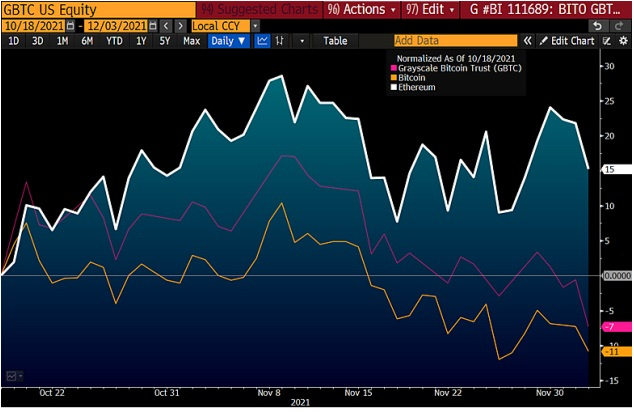
Ethereum's performance since the LAUNCH of a BITCOIN ETF in the US
In 2021, ethereum protocol changes (EIP-1559), in this context, ETH supply began to decrease. Since then, trading volume and open interest in Zizhong's Ethereum futures contract have increased, and if this is any indicator, it should only be a matter of time before regulators approve futics-based Ethereum ETFs.
The rise of encryption, DeFi and Ethereum. Ethereum has always been in the lead in leading the wave of digitization, tokenization, DeFi, fintech and NFT. According to our chart analysis, the price of Ethereum remains roughly parallel to the total market value of crypto assets from Coinmarketcap. Most NFT is denominated in Ethereum, which means that as the NFT ecosystem expands, so will the demand for ETH. Bitcoin is becoming a global digital reserve asset, while Ethereum is being used as collateral for the Internet. Currently the most widely traded crypto assets (Tether) are crypto dollars and Ethereum tokens, and Axie Infinity, the most popular play-for-play game, also runs on the Ethereum network.
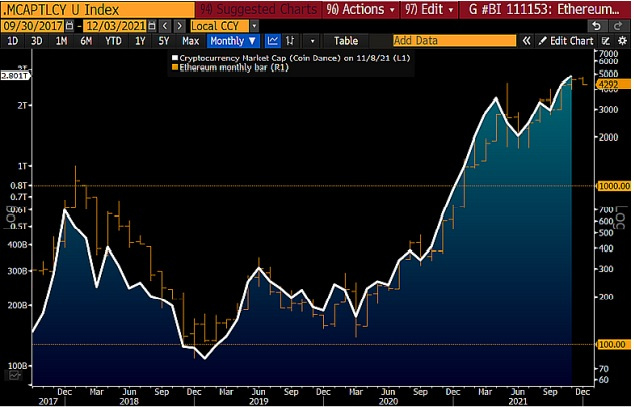
Ethereum -- crypto platform, Internet collateral
Ethereum has gained depth and dominance. Ethereum's success will spur competition and more potential Ethereum killers, but we have seen that Ethereum has been able to cope well with market corrections and continues to maintain its market leadership.
The Ethereum supply could be in free fall. There are a lot of things that could go wrong with an ethereum upgrade, but the incremental supply of Ethereum has started to decline steadily, meaning that ethereum will become more mature -- if the rules of economics apply -- which is clearly good for ethereum prices. The chart below depicts how the supply of Ethereum has been decreasing since early August after the implementation of EIP-1559, and ETH destruction is getting faster and faster, with the 52-week rate of change between the number of new Ethereum tokens and the total number outstanding expected to drop below 4% for the first time. While demand for Ethereum isn't as direct, it could end up being less in supply than Bitcoin.
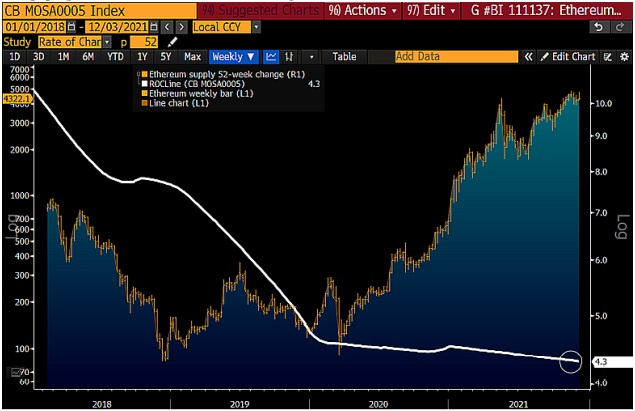
Supply trends favor higher ethereum prices
The original link
Welcome to join the official BlockBeats community:
Telegram Subscription Group: https://t.me/theblockbeats
Telegram Discussion Group: https://t.me/BlockBeats_App
Official Twitter Account: https://twitter.com/BlockBeatsAsia

 Related Articles