Nansen: How is Celo bringing blockchain to mainstream adoption
Celo: Toward Blockchain Mainstream Adoption
原文作者:Yasmine Karimi,Nansen
Mim, Deep Tide Tech Flow
In the history of Web1.0 and Web2.0, hundreds of companies competed for dominance in the information revolution, and only those who successfully turned complex technologies into user-friendly products were winners.
While this is all about the information Internet, we find ourselves at a similar turnabout in cryptography today. Blockchain technology is able to seamlessly transfer assets in seconds without a trusted third party, but lacks the user experience that has made it mainstream. In the eyes of many, its mutability makes it a store of value, not a medium of exchange.
On the other hand, currently, other payment systems like Apple Pay, PayPal or Venmo are user-friendly and can ensure the stability of value, but they involve middlemen, which not only prolong the transaction time, but also incur fees. In some other parts of the world, the self-employed can even be left out of the global economy, either because they don't have bank accounts or because local financial institutions are weak.
If we combine the benefits of blockchain technology with the user-friendliness of traditional payment systems, we can finally unlock the problem: an Internet of immediate and profound value. This is the goal of Celo blockchain.
What is Celo?
Celo is a 1-tier blockchain founded in 2017 and supported by A16Z. Like other blockchains, it is an EVM compatible chain that supports transactions and decentralized applications. Decentralized applications can provide financial services while leveraging blockchain technology. On Celo, for example, dApps include Ubeswap (a mobile-first decentralized trading platform), PoolTogether (a crypto savings protocol based on premium bonds), Moola (a lending asset platform), and SushiSwap.
Confirmatory transactions rely on the proof-of-interest consensus mechanism. Unlike the proof of work model, proof of equity selects validators based on the number of local tokens in the blockchain. Since the validator is selected on this basis, no significant amount of computing power is required. There is no competition among miners to drive Gas prices sky-high.
Transaction verification also takes much less time, as individual nodes do not have to invest as much processing power as pos-based blockchains Solana (50,000 TPS) and Polkadot (1,000 TPS). In contrast, Ethereum only had 16 test assemblies to handle.
To understand the differences between Layer 1 and Layer 2 blockchains and the current blockchain landscape, you can refer to our published article.
Transaction speed and Gas charges
As mentioned above, proof-of-interest consensus enables relatively high transaction speeds and low Gas charges, 5 seconds and $0.00004 on Celo, respectively. Over time, Celo has also consistently spent less per day on gas than Ethereum, as shown below.
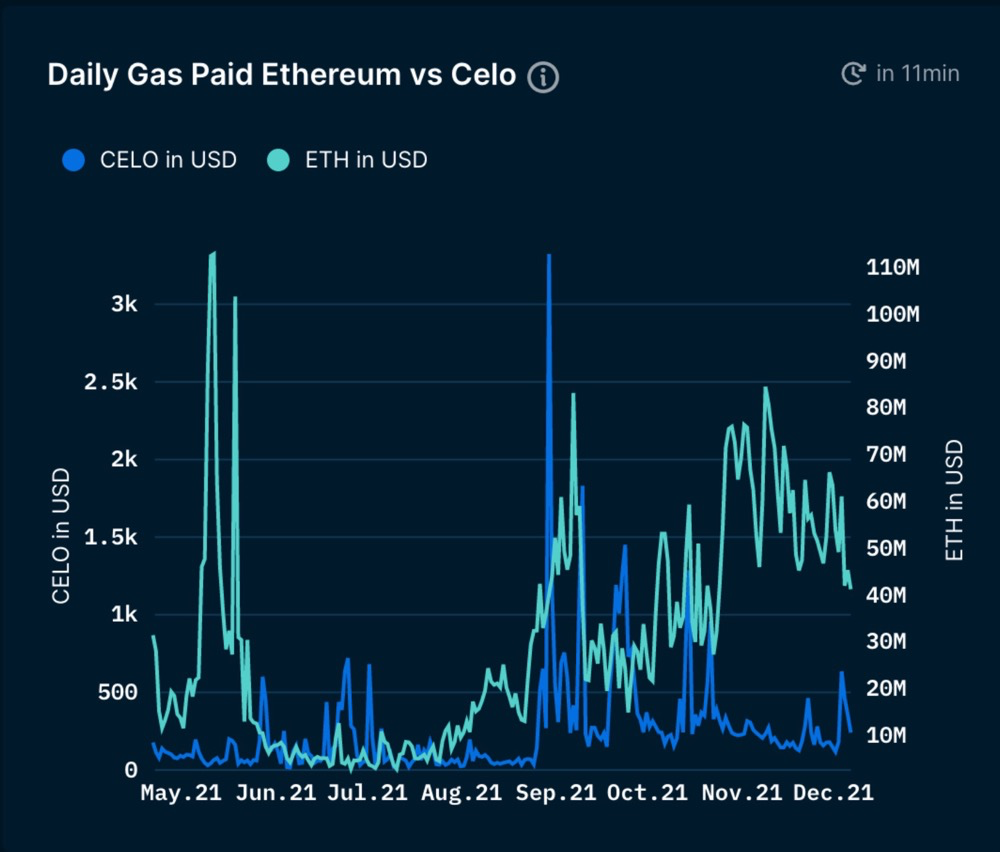
Total daily Gas paid on Celo vs ETH over time
Celo achieved a throughput of 200TPS while keeping Gas bills low, which is higher than the 16TPS on ethereum, but still relatively low compared to blockchains like Solana. Co-founder Marek Olszewski says the team is still working to increase throughput, which will make it possible for Celo to become the fastest EVM chain by the end of 2022.
In addition, its network of nodes is limited to 163, making its network connections more centralized than blockchains such as Ethereum. Since its inception, it also has fewer total transactions and fewer unique addresses. In fact, it has processed 70.6 million transactions, out of a total of 44 billion on Solana.
However, a look at Celo's trading since its inception suggests organic growth, particularly since late July. Celo has increased from processing 10% of all Ethereum transactions to 45% of all Ethereum transactions, indicating an increasing adoption rate.
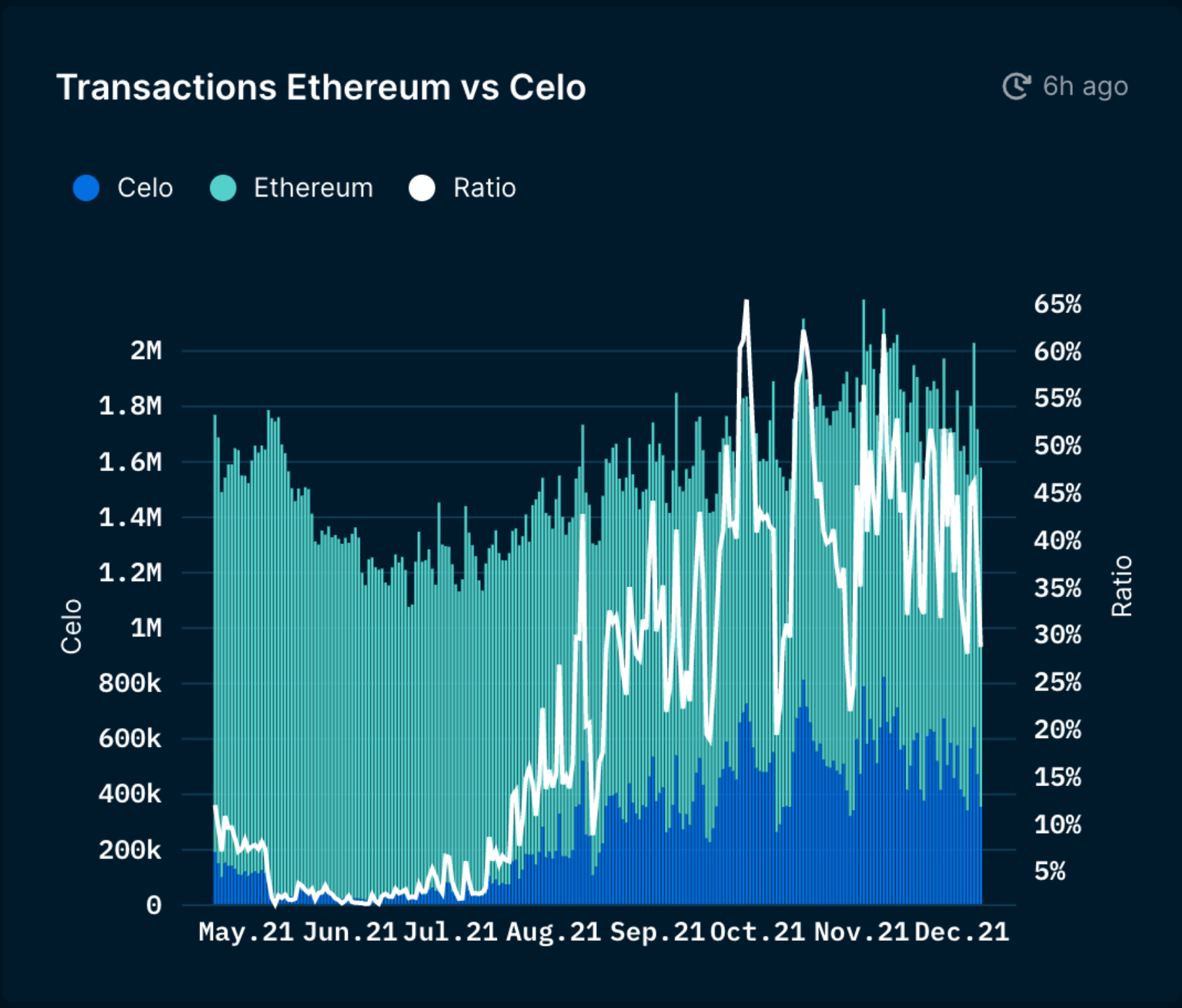
Total daily volume of Celo vs ETH over time
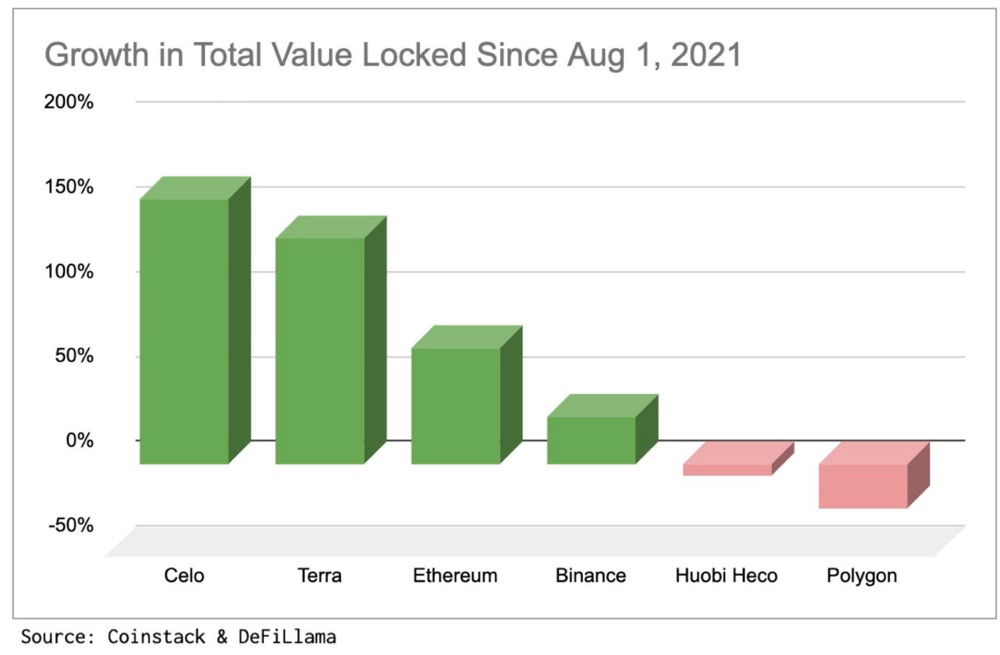
In addition, Celo is currently the fourth fastest growing blockchain in DeFi, according to Coinstack and DeFiLama. Since August 1, its Total Value Locked has increased 157% from $339 million to $870 million, Surpassing major blockchains such as Terra, Ethereum, BSC, HECO, and Polygon, which have a total lock value (TVL) of at least $800 million. Let's take a look at why Celo is getting more attention.
Celo 的独特之处在于:1)它是一个全球支付平台,任何拥有手机的人都可以使用;2)它使用与法定货币挂钩的稳定价值 Token ,以最大限度地减少波动。我们尝试在下文简化这两种机制的工作原理。
Mobile wallets are universal
Today, about 2 billion people don't have bank accounts, most have never heard of a cryptocurrency wallet, but almost everyone has a phone. Celo allows mobile phone users to use their phone number as a public key instead of a traditional long string address. Phone numbers become visible public addresses for contacts, and you can link your phone number to your wallet before receiving a TEXT verification code.
This approach does not compromise user privacy because only the hash of the phone number (plus a pseudo-random source code) is stored in the shared database, not the phone number itself.
In addition, Celo uses an algorithm called EigenTrust to calculate a reputation score for a phone number. It is determined by the total number of other calls that trust it and weighted by their respective reputation scores, and is particularly useful when dealing with people outside the contact list.
Stable value
有两种主要的加密资产:CELO 和 Celo Dollars。CELO 是该协议的原生资产,它是一种实用程序 Token ,用户能够参与网络共识(通过其权益证明系统)、支付区块链上的交易费用以及对治理决策进行投票。Celo Dollar(cUSD)是一种与美元挂钩的稳定资产。
The stability of Celo depends on two different types of mechanisms. The first mechanism is represented by flexible supply stablecoins linked to fiat currencies such as the Celo Dollar (cUSD) and the Celo Euro (cEUR). To provide additional stability, Celo also gets a diversified basket of cryptocurrencies as reserves to support the peg.
The second mechanism is Mento, which is a stable algorithm for catching arbitrage opportunities. When the price of cUSD is above $1, arbitrageurs will buy CELO and convert it into cUSD, then sell cUSD for a profit. Selling cUSD lowers its market price to $1.
同样,如果 cUSD 的价格低于 1 美元,套利者将购买 Token ,然后将其兑换成 CELO,以从差价中获利,买入 cUSD 会将其价格推高到 1 美元。
Navigate Celo with Nansen
Dapp panoramic
There are currently about 90 decentralized applications on Celo, and these Dapps are either fully deployed or about to be configured, especially in the context of Celo Camp (a virtual accelerator) and related competitions organized by Celo.
We can categorize these decentralized applications into three broad categories: wallets for managing Celo assets, dApps for decentralized finance, and DApps for social dimension "impact."
As the Nansen chart below shows, decentralized software is more mature than others in each category, with Moola and Ubeswap accounting for 40% of the total logging incidence on Celo, which refers to the time the entities' respective smart contracts successfully run their code.
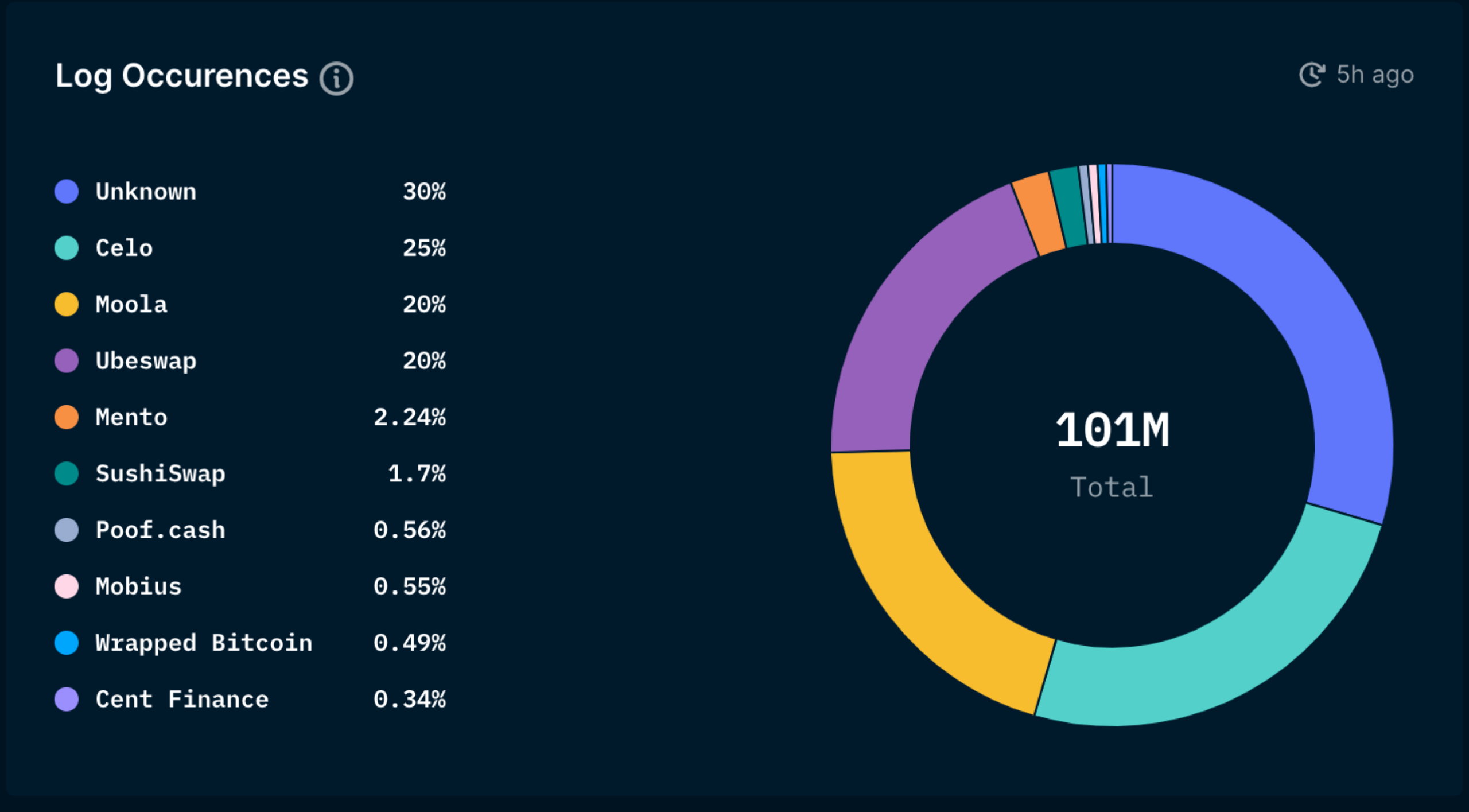
Top Applications for Celo (in order of log occurrences)
Moola is Celo's previous mobile-first asset lending platform and a mobile-compatible spin-off of Uniswap, Ubeswap's decentralized trading platform. Other interesting examples of decentralized financial software on Celo are: Mento, an automated market maker (AMM) -style decentralized trading platform that is native to Celo; Poof. Cash, a private agreement that allows you to deposit, earn and withdraw money without anyone knowing the balance of your account.
It is particularly interesting that large decentralized financial protocols like SushiSwap outpace smaller mobile native decentralized software on Celo (Moola, Ubeswap, etc.) in log incidence, indicating a strong focus on mobile-first cryptocurrency services. In fact, SushiSwap accounted for only 1.7% of the total log incidence.
Some of these decentralized financial apps are designed to help specific situations. For example, programs like Doni allow you to give money to the community and make small loans.
The funds used on these decentralized apps are managed by wallets, mainly Valora, Celo Wallet, Terminal, Metamask, Abra and Opera. It's important to note that while some of these apps are native, like Valora, others are metamask-like browser extension wallets (like Inflibridge).
Contract activities
We've also seen some entities that generate contracts on Ethereum and Polygon appear on Celo (PoolTogether, SushiSwap, etc.).
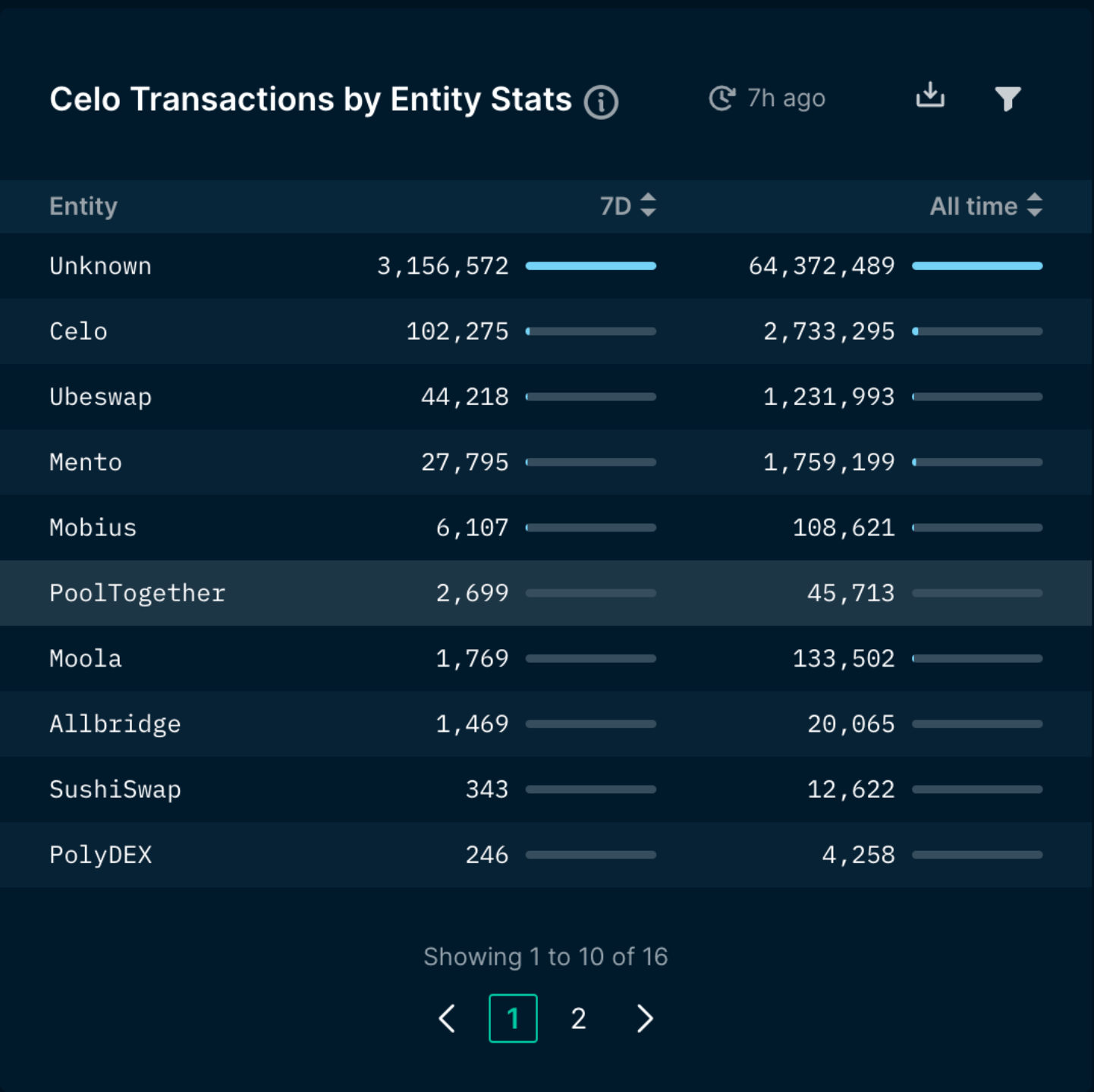
App transactions on Celo
为了保持领先地位,追踪在 Celo 上创建的最新和最热的智能合约,包括新的趋势性 Token 销售、Staking 和流动池以及 NFT 收集,这种做法具有特殊的意义。
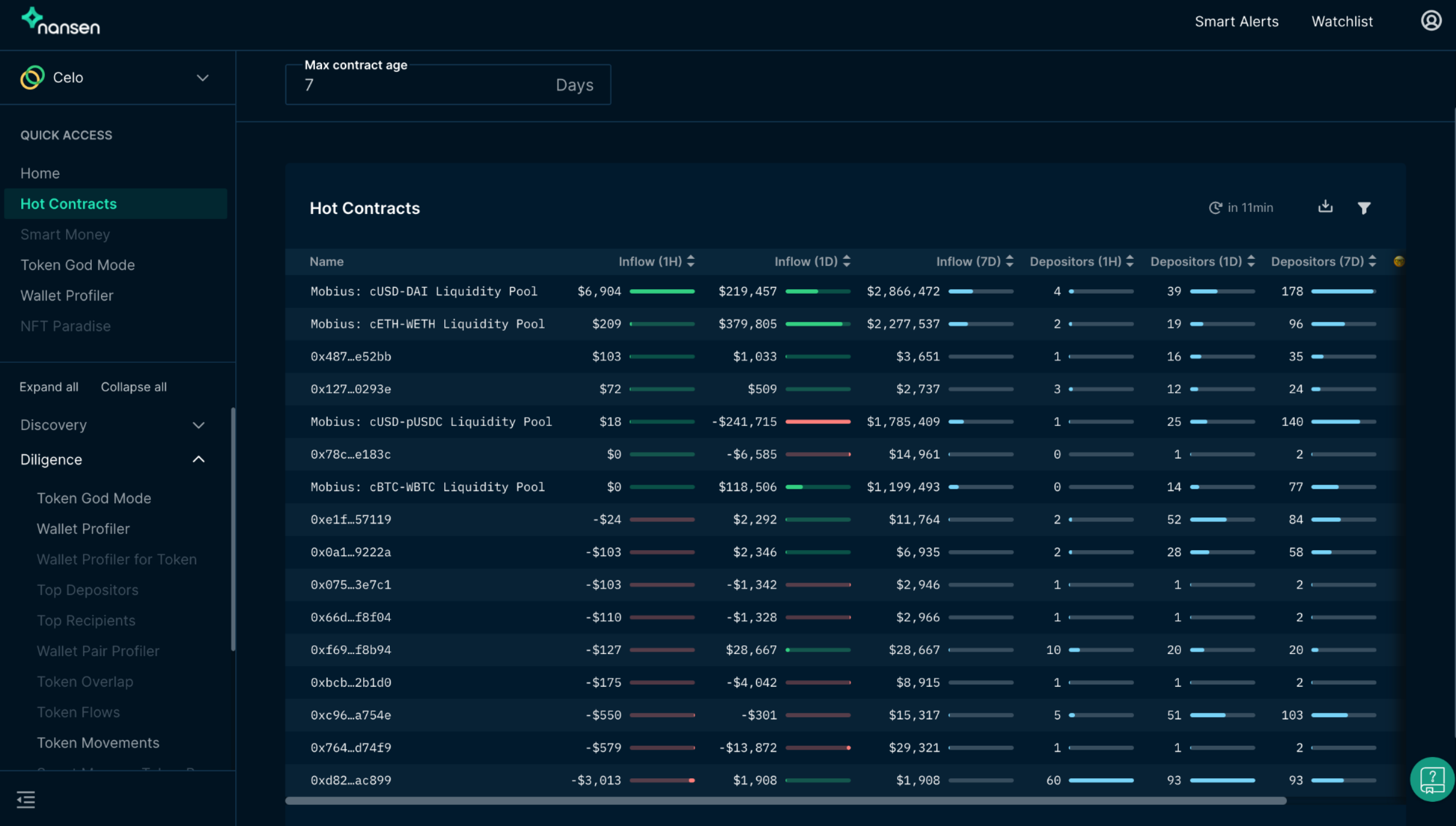
New contracts launched on Celo (ranked by highest capital inflows)
For example, you can identify the hottest flow pools. The chart above shows that the contract with the largest inflows and number of depositors over the past seven days was the Mobius CUSD-DAI liquidity pool.
Mobius is a bridge trading platform built on Celo, which means users can move money from other chains to Celo and exchange it for theoretically equal-priced assets to reduce the risk of volatile losses. It also includes limited partners with yield incentives.
With the X Nansen tool, you can find out if a liquid pool has the liquidity that smart money brings. For those unfamiliar with the Nansen label, the experienced Investor label refers to a cryptocurrency entity that trades or invests in a way that is experienced or well-informed.
conclusion
Today, we stand at an inflection point for cryptocurrencies, where blockchain technology has proven highly successful in many ways, but lacks the user-friendly experience to make it mainstream. Past revolutions like Web1.0 and Web2.0 have shown that companies that simplify good but complex technologies can find global adoption.
Decades from now, it won't matter to most users what smart contract the decentralized financial services they use are built on, any more than most Internet users know little about how the backbone infrastructure of the Internet works. In this regard, Celo understands this well, and this is reflected in their mobile-first approach, as well as their value stabilization mechanism to address volatility.
Celo is certainly one of the pioneering projects aiming to accelerate DeFi adoption and bring more people into the cryptocurrency space, and it will be interesting to watch the evolution of its ecosystem and what comes next.
The original link
Welcome to join the official BlockBeats community:
Telegram Subscription Group: https://t.me/theblockbeats
Telegram Discussion Group: https://t.me/BlockBeats_App
Official Twitter Account: https://twitter.com/BlockBeatsAsia

 Related Articles