Paradigm shift in venture Capital: Unlimited Funds and unlimited Games
DAOrayaki | A Paradigm shift in Venture Capital: Unlimited Funds and Unlimited Games
Eric Zhang, DoraHacks
Dewei & AMP; DAOctor, DAOrayaki
DAOrayaki DAO Research Prize Pool:
Grant address: Daorayaki.eth
Voting progress: DAO Committee passed 5/0
Total bounty: 120 USDC
Research category: DAO, Venture Capitalism, Infinite Funds, Infinite Games, Public Goods
Eric Zhang @Dorahacks
Contributor: Dewei, Daoctor@daorayaki
The Inevitable Paradigm Shift of Venture Capitalism: Infinite Funds and Infinite Games
Original link : https://doraresear.ch/2021/12/02/infinite-funds
Special thanks to Steve Ngok, Unica Yin and Wendy Ding for their review and feedback.
DAOrayaki is a decentralized researcher organization and decentralized media that funds researchers around the world to conduct research, translation, analysis and other work in the form of DAOs in a decentralized manner. DAOrayaki was initiated by the DAOONE core members of the early DAO organization and is supported by the Dora Factory infrastructure. Welcome to submit the research of DAO through the end of the paper and share the 10000USDC bounty pool. Learn about decentralized autonomous Organizations (DAOs), discuss the latest governance topics, and keep an eye on DAO trends. Welcome to the DAOrayaki community.
Finite games can be played in infinite games, but infinite games cannot be played in finite games. "-- James Cass
Venture capital is one of the drivers of innovation, technology and human progress. It organizes human, scientific, technological, and political resources to help innovators achieve great goals.
For all its success in supporting companies and entrepreneurship over the past few decades, venture capital has shown its weaknesses. On the surface, this limitation is manifested in two aspects: target conflict between GP and LP; There is a lack of consistency between founders and investors. In the stock market, most GP's are constrained by a limited Fund Cycle of, say, 10 years. In the crypto market, where a large number of GP funds have a much shorter funding cycle (sometimes as short as a year or two due to low barriers to listing and low market volatility), many fund managers are forced to sell their positions quickly. This has led to criticism of some fund managers as "Weak Hands" or "Flippers".
In the stock market, an initial public offering (IPO) is usually regarded as the success of a company at the risk stage. Many times, the fund's primary goal is to invest in the underlying stock and sell it in the IPO. It usually takes at least 5-7 years for a company to go public. So the fund cycle represents the idea of helping early-stage companies through an IPO. The problem with this approach is that if certain companies have a longer term vision, the fund may miss out on a greater opportunity to work with the company, as well as a higher return from the company's development and growth beyond the IPO stage. Netflix, Tesla, Apple, Google, all the greatest companies. Sequoia funds have recently woken up to the problem. So in a post, partner Roelof Botha describes sequoia's new management approach, which essentially removes LP's access to its seed and venture capital funds. Instead, Sequoia funds invest in primary market transactions from their secondary market funds, regaining control over risk-stage projects and the ability to hold venture investments as needed.
In crypto, the IPO cycle is much shorter than in the stock market. In most cases, cryptocurrency projects go public in their early stages (less than three years, sometimes within a few months of conception). Investors were lured by the juicy returns from the hype. Some crypto funds accept 1-year fund cycles in order to acquire more LP's. However, a similar situation applies to the crypto market -- a successful Web3 venture takes more than one cycle to build and returns are much higher than a single hype period when the project is truly successful.
This is because there are two types of dislocations. First, there is a rift between fund managers and fund LP. In general, the greater the knowledge gap between GP and LP, and the longer the funding cycle, the more difficult it becomes. Second, there is a mismatch between funders and fund managers. The attraction of selling shares/tokens at a liquidity premium during a listing is far greater than spending years waiting for the project to establish value.
For different types of behavior, The Venture Capital Game looks like this:
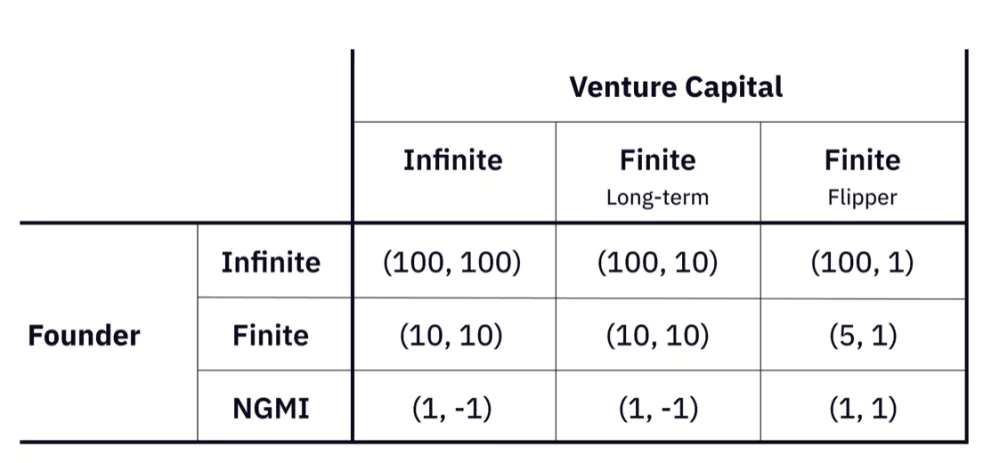
In Venture Capital Game, an unlimited strategy does not mean that the fund holds all stocks/tokens indefinitely, but on the right hand side, a quick turnover strategy by a "Flipper investor" does mean that the fund sells all its positions to make a profit and leaves the Game in search of other profitable opportunities
In this game, we consider a new behavior -- infinity. Infinite play can be interpreted as playing not to win, but to continue playing (Carse). To the founders, unlimited gaming was obvious. For venture funds, infinity means backing the founders to make sure the game is infinite.
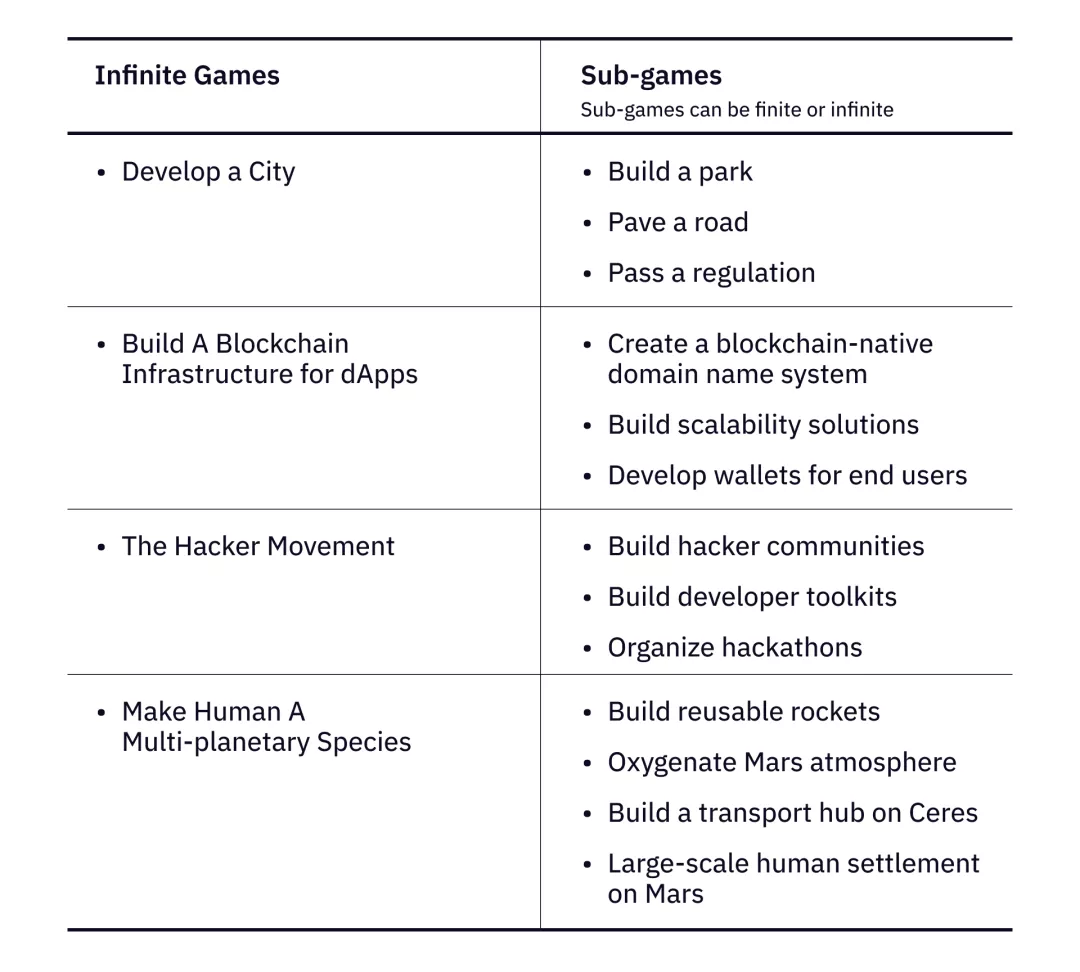
From a founder's point of view, there are many examples of infinite games. Imagine the following infinite games, which we'll come back to later: developing a city, building blockchain infrastructure for decentralized systems, making humans a multi-planetary species, geek sports.
So what is infinite venture capital and venture funds?
Technically, we can plot a range of venture investments based on the fund cycle - from speculative, opportunity-driven funds to "evergreen" funds. From the spectrum, an unlimited fund is a fund that extends its fund cycle to infinity.
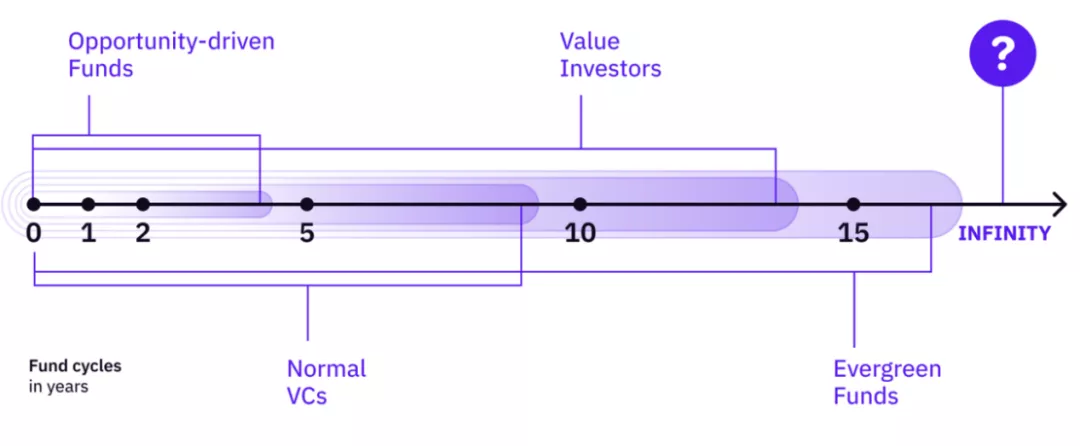
But what does it mean to have unlimited venture capital funds? How can venture capital funds be infinite? Let's explore further.
Infinite games and subgames
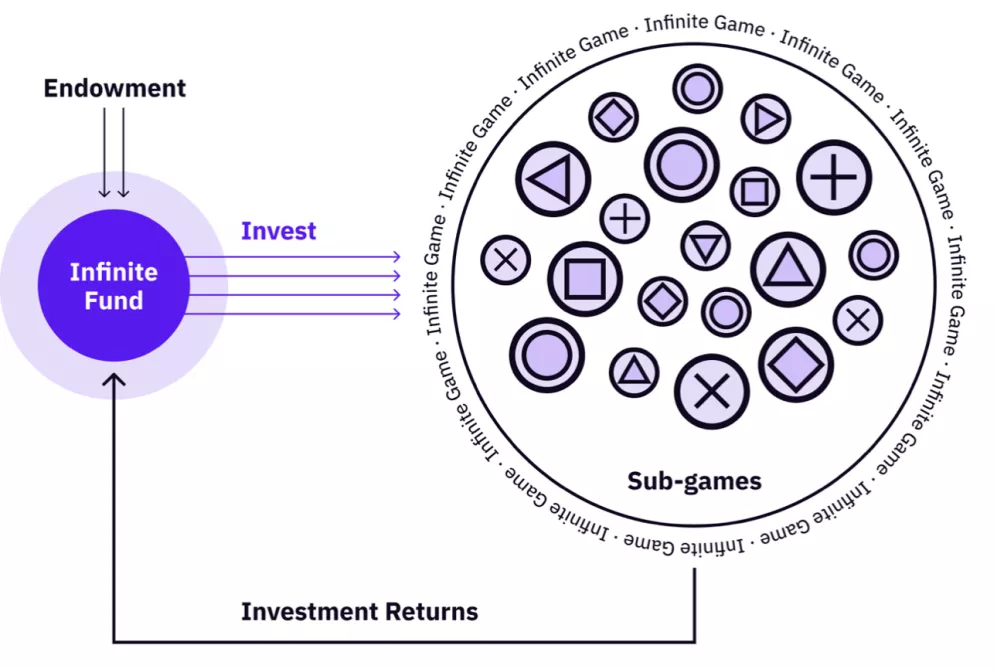
Infinite games include sub-games. The number of possible sub-games that any infinite game contains is infinite. A subgame can itself be an infinite game or a finite game. Here is a table of infinite games and their subgames:
Unlimited Fund - Funds unlimited games
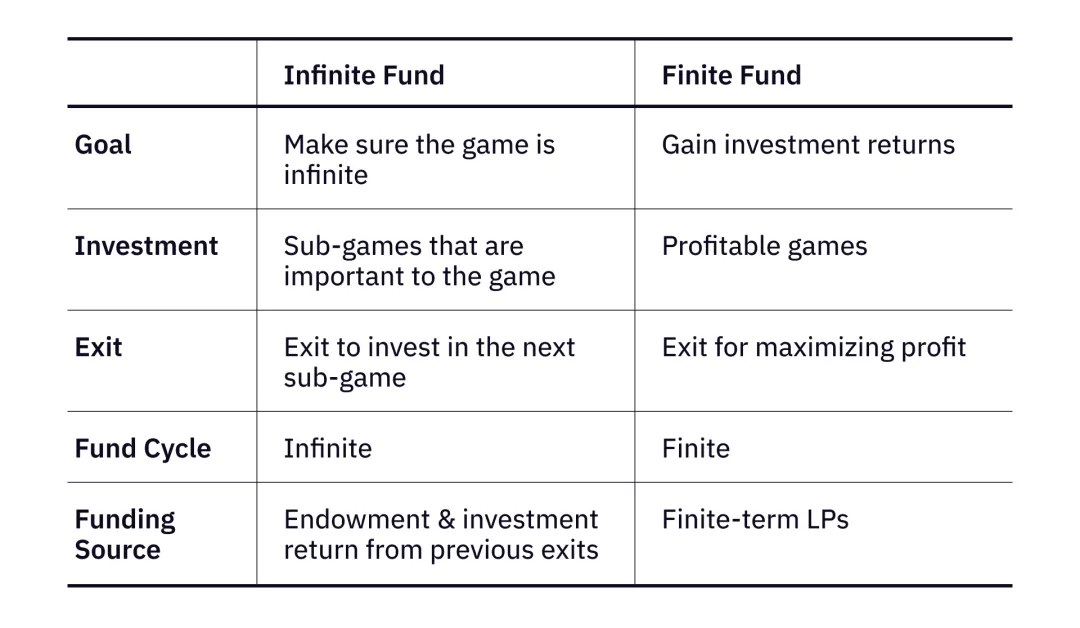
An unlimited fund has an unlimited fund cycle and invests in unlimited games by investing in its sub-games. Sub-games can be limited games, but infinite games are the end game. To evaluate and compare the differences between unlimited funds and limited funds, we can consider these five indicators: objective, investment motivation, exit strategy, fund cycle and funding source.
The coffers of Nation States are naturally infinite money, because Nation States are themselves infinite games, designed (usually) to develop countries into better places for people to live in. In a way, blockchain protocols are like nation-states, in that these protocols have their own rules of governance, enforced by consensus between code and the community. In the former case, the Treasury is maintained by taxes. In the latter case, the foundation's wealth comes from appreciation of its native tokens and agreed-upon level income.
In the case of venture capital, donations from organizations or people who want to fund unlimited games unconditionally are necessary to establish an unlimited fund. Donations can come from a variety of sources: income from the organization (such as agreement fees for decentralized programs), donations or Token sales activities. The fund sustains itself by reinvesting all previous returns into the next subgame.
As a few examples, DoraHacks Ventures is designed to be a geek fund with an unlimited funding cycle as part of DoraHacks, in collaboration with open source developer funding platforms HackerLink, Hackathon DAO, and the global Hackathon community, To support the geek movement. Binance Labs supports the development of the entire blockchain industry through a combination of venture capital and an intensive eight-week incubation program that runs continuously each year and will continue indefinitely into the future.
Use unlimited risk funds to finance public goods
Current venture capital has failed to capture a valuable type of venture capital -- Public Good Funding.
Public goods have long been undervalued. Because public goods are difficult to make profits, they are usually built by the public sector or non-profit organizations. But government funding can be plagued by inefficiencies, corruption and political instability, and nonprofits often suffer from unsustainable funding. Traditional DCF-based valuation methods struggle to properly capture the value of something that is unprofitable (in the fiat currency space) but good for the community. So in the past, venture capital focused almost entirely on profitable businesses, leaving public goods out of the way.
DAO is changing the way public goods are organized and developed in the following ways
1.DAO can organize and motivate distributed networks of contributors and users, avoiding or reducing frictional costs and inefficiencies of centralized organizations. For example, decentralized media can effectively organize a decentralized network of contributors.
2. The DAO assigns governance rights to participants, including contributors, administrators, users, and funders. Governance is no longer concentrated among shareholders.
3. Daos can capture governance value and community-driven value and, in the long run, may create a legitimate way to properly value public goods.
Unlimited funds can continue to fund public goods by funding public goods DAOs.
Create unlimited funds using Web3 technology
Further mechanisms could be devised to increase the flexibility of unlimited funds. There are already some practical solutions. LP who joined MolochDAO or The LAO received shares /Loot from DAO. Moloch allows angry exits if the collective fund makes the wrong decision. But as long as a few members continue to play, the DAO can continue indefinitely. As a result, Moloch funds can be considered unlimited funds with a low threshold (it's much easier to join the Moloch DAO than the Sequoia fund).
Another way to provide liquidity for unlimited fund LP is tokenization of funds. Fund tokens can be evaluated against the net asset value of the fund. While progress in the security Token (STO) space has been slow, strong players can make it possible when more attractive tokenized securities emerge within a few years.
conclusion
Great adventures are usually infinite games. The purpose of infinite play is not to win the game, but to keep going. Limited funds have a limited fund cycle. Unlimited funds have an unlimited fund period. An infinite game consists of an infinite number of subgames, which can be either infinite or finite. Limited funds invest in games that are expected to win because they are profitable. Unlimited funds invest in unlimited games by investing in its sub-games. The purpose of the Unlimited Fund is to fund unlimited games so that the game can continue to play and achieve its goals. Unlimited funds can fund public goods and businesses as long as they are unlimited games. There are several ways to build and improve unlimited funding using Web3 technology. The paradigm of venture capital is shifting to infinity.
The original link
Welcome to join the official BlockBeats community:
Telegram Subscription Group: https://t.me/theblockbeats
Telegram Discussion Group: https://t.me/BlockBeats_App
Official Twitter Account: https://twitter.com/BlockBeatsAsia
 Related Articles