Six years of MetaMask's growth: funding rejected, redundancies, restructuring
MetaMask: The Hero Crypto Deserves
原文作者: Mario Gabriele
原文编译: 董一鸣、Creed,链捕手
The predecessor: Vapor
Miami
It was an unlikely venue for an important meeting. Florida is known for its springing and silver-furred snowbirds, but it's not always known for technological innovation. When it comes to ethereum's story, Florida, the Sunshine State, deserves more attention.
In January 2014, a rather seedy group met at a Beach house in Miami. While they chose the state to attend the North American Bitcoin Conference at the Cleveland Hotel in South Beach, the real purpose of their visit was to discuss a different encryption project: Ethereum.
A few months ago, Vitalik Buterin, then 19, wrote a "white paper" outlining the possibilities he saw for "computers in the sky". His work has attracted support and attention, including from those who joined him in Miami. He arrives at the beach house with two other talented developer friends, the grubby but estrous Gavin Wood and the bespectacled Charles Hoskinson. Businessmen Anthony Di Iorio and Joseph Lubin also weighed in.
If Buterin effortlessly exerts a gravitational pull on the assembled men, Lubin must look the most off track. The Toronto native, who has worked at Buterin for 30 years, attended the conference after being invited by Di Iorio. As it happens, Lubin used to work on Wall Street. Before joining Goldman Sachs as a vice president, Lubin spent seven years as a research scientist.
During the group's stay in Miami, Lubin not only secured his place at the forefront of the Ethereum revolution, but also used his own business acumen to balance Buterin's emotional mind. This panel meeting was a pivotal moment in Lubin's career and in Ethereum's history.
First Ethereum Developer Conference (Devcon 0)
Eleven months later, Devcon 0 was held in Berlin, the first official forum for Ethereum, with presentations by Buterin, Wood, and other key members of ethereum's early believers.
By then, the Ethereum team had already made one big decision: it was a non-profit project. This choice left the leadership team in tatters, and some of the first creative team left to pursue new opportunities. Despite his close relationship with Buterin, Lubin is one of those who are starting to look beyond the project and find more commercial avenues. Around the time Devcon 0 began, he started a new venture: ConsenSys. The company seeks to identify and fund business opportunities for Ethereum, facilitating the adoption of the network and bringing its benefits to uninitiated consumers and businesses.
In a conference room in Berlin, the forerunner of one of ConsenSys's star assets was born.
Joel Dietz is a fanatic among his many converts. With the floppy hair and boyish face of a '90s star, Dietz has taken his place in the ecosystem. Not only did he publish his views on the cryptocurrency's future in bitcoin magazine, he also hosted a series of gatherings in Silicon Valley for Ethereum enthusiasts.
In addition to these activities, Dietz is working on one of his own projects, or rather, some of them.
One of those projects is Swarm, a bitcoin-based crowdfunding platform, and a series of crypto browser extensions. As it turned out, Dietz was able to act on one of the ideas that came up during the meeting. Here's how he recalls it: In Devcon 0 discussions, we heard a lot about the need for JavaScript clients and some Web3 interfaces that bridge the gap between the standard Web application world and the Ethereum client world.
In one of the rooms at the conference, Dietz sat down with Buterin and Wood and made a simple pitch: He should get one of the recently announced Grants for Ethereum developers and build a JavaScript based extension browser.
Buterin does not seem convinced. Dietz himself was intrigued by the idea, he recalled, and even gave it a name: Vapor. Despite not receiving any sponsorship money, Dietz left Berlin with the project.
Back in California, he began working with the network he had built. He wanted to talk to "all the JavaScript developers who have given any kind of talk on ethereum clients" in the state. Dietz can recall no more than four such speeches. They are a group of Apple employees led by "JavaScript hacker" Aaron Davis.
Davis is known in the cryptocurrency world by his pen name "Kumavis." Like Dietz, he recognized blockchain's potential early on. In our conversation, Kumavis mentioned that he came up with the idea for an Ethereum wallet after planning a crowdfunding campaign and realizing that he needed a way to "spread links."
Dietz and Kumavis' decision to join forces to create Vapor was initially an informal one. As Dietz said, Kumavis was interested, but hoped to raise money for the initial project before he left his stable full-time job at Apple. A third member, Martin Becze, who has been living in the union building that Dietz helps run and assists the Ethereum Foundation, also jumped aboard.
To raise money, the trio tried to get into one of the many places that power unicorns: Y Combinator.
In YouTube In the video provided, you can see Becze, Dietz, and Kumavis explain what they're trying to build.
The word "wallet" is not mentioned in the one-minute clip, as it does not have today's connotations. Instead, the team describes what they're building as a link that "brings the browser and blockchain together."
Thanks to Y Combinator, the pitch generated enough curiosity. But YC still turned down the funding request. Dietz provided emails sent by Trevor Blackwell, a partner at YC.
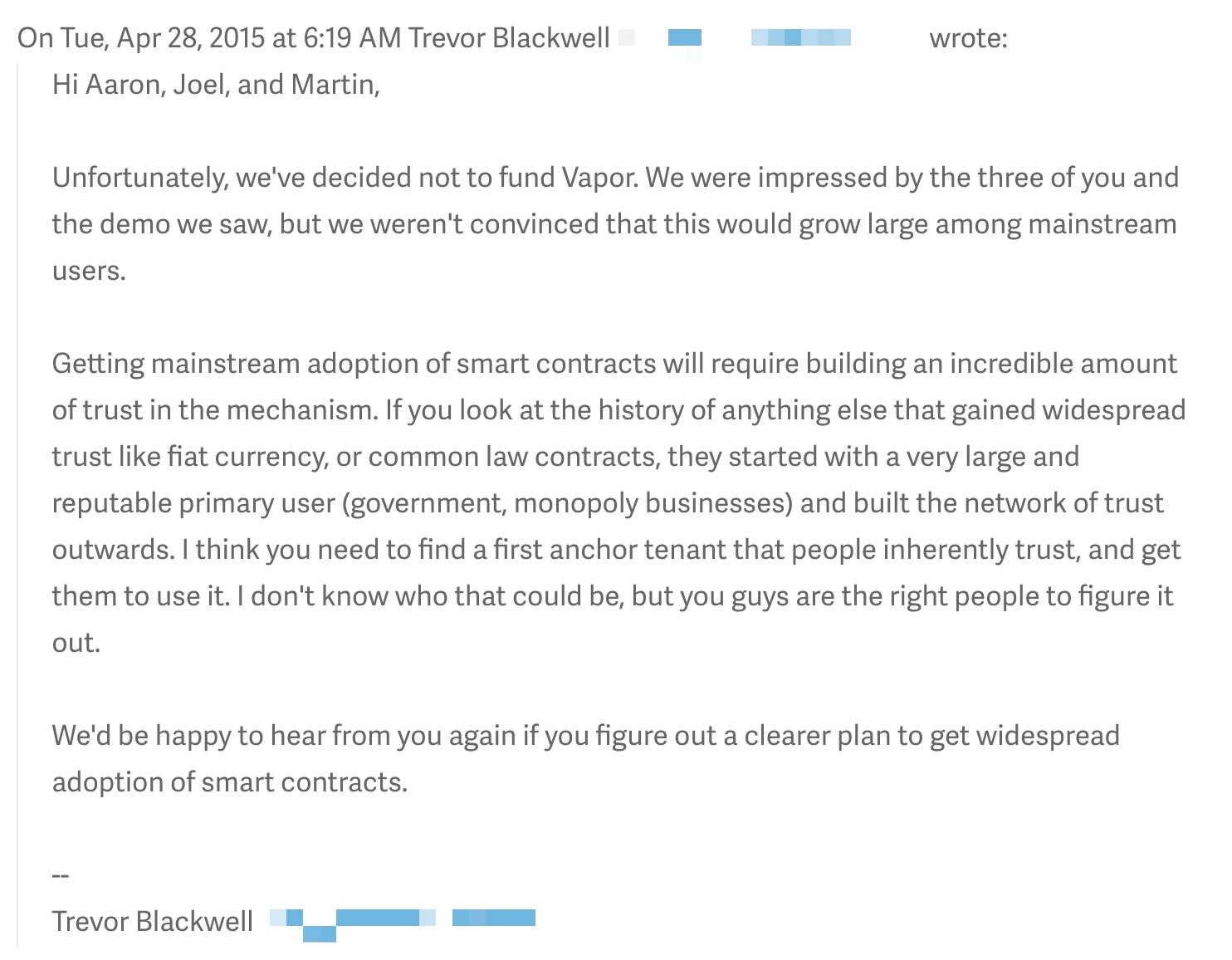
The email said: It is a pity that we do not plan to provide Vapor fund this time, but the speeches of the three of you and the demonstration works you brought impressed us very much, but we are not sure that this product will bring a large number of users. For a smart contract to be accepted by the masses, trust needs to be built on a very large scale. If you look at things that were widely accepted before, like fiat money, common law contracts, they were all early adopters with a lot of good reputations (governments, monopolies) and built networks that could be trusted. I think you should find your first target audience that people trust. I don't know who that is, but you will be the best person to identify that audience.
Although, in hindsight, it's tempting to hit back at YC and say: Ha! How do you feel about the adoption of our smart contracts right now? ! But Blackwell's position is one held by most technologists, including those skilled at predicting and funding the future.
Even without YC's firepower, the Vapor founders continued to work on the project. But cracks are beginning to show.
Post-yc: Tricky territory
So far, the Vapor story has been pretty clear. But it's about to fall down the rabbit hole and into the shadows.
While researching this article, I tried to talk to the three founders of Vapor, MetaMask's successful contributors, and others in the wallet space. I did not speak with Joe Lubin or Daniel Finlay, the developer behind ConsenSys who is considered one of the founders of MetaMask. I also didn't receive any reply from Martin Becze, the third member of Vapor.
After being rejected by YC, Kumavis continued to work on Vapor. But he soon discovered that he was the only one of the three who made a contribution. Becze is focused on other Ethereum-related activities, while Dietz is only ostensibly working on other projects. "I did 100 percent of the work," Kumavis notes.
Dietz himself seemed to confirm that Kumavis was a major contributor, saying that he "did about 90 percent of the coding and browser extention-specific work." Dietz says he "funded early development," which means paying for office space and team meals. Kumavis made it clear that Dietz "never paid anything" and demanded receipts.
Dietz was surprised by Kumavis's departure and suspected a ruse. As he said, he found himself removed from Vapor's Github organization and the Slack channel, the former renamed "Metamask." The experience left him feeling kicked out of the door, he said: "I guess you could say I was forced out."
For Kumavis, the separation was less dramatic and controversial. He did remove Dietz from Vapor's Github and Slack, but that's because Vapor didn't go anywhere. Frustrated by his co-founder's lack of effort and finding the product "not quite right," he decided to cut ties and start over and apply for a new grant.
Kumavis backed a project he built from scratch with $30,000: MetaMask. After that money ran out, he continued to work independently for a while, but without a paycheck, he decided to turn the project over to ConsenSys. At the time, ConsenSys was just a "spirited hacking team" that felt appropriate.
After joining, Kumavis wanted the team to help boost its firepower for new projects. To do so, he turned to Dan Finlay, a friend and former colleague at Apple. Finlay's impact on MetaMask appears to have been immediate. As Kumavis says, Finlay brought a fox logo to the project, which today is MetaMask's calling card. Kumavis emphasized the freshness of the Fox logo on the project, as well as the trustworthiness of Vapor code. "Since we started the project from scratch, we had the Fox logo before MetaMask had any real working capabilities," he said.
Now, Vapor has gone. MetaMask appears under the banner of ConsenSys and its future is defined by Kumavis, Dan Finlay, and Joe Lubin.
History: The many facets of ConsenSys
To understand MetaMask, we need to understand more clearly the parent company that "adopted" it. ConsenSys, however, hasn't made that description easy, changing its approach several times over the course of its seven years to adapt to changing market dynamics and operational upheaval.
ConsenSys chief economist Lex Sokolin explains the company's phases, picking out three distinct transitions. We will examine how these different changes affect the development of MetaMask.
Stage 1: Burning Man for cryptocurrencies
ConsenSys seeks to become a nurturing lab for startups, bringing together prominent technologists, giving them financial backing and discretionary power to build whatever they need to build a crypto ecosystem.
It's a good idea, but it creates an environment where there's not much organization. As Sokolin puts it, Lubin funded 100 companies in hundreds of different ways during that time, but "some of them were very loose."
Mike Demarais, CEO of Rainbow, another crypto wallet provider, was quick to capture this aspect of ConsenSys, saying, "[It's] a crazy place. It's kind of like Burning Man for paychecks." Demarais keeps a close eye on the company and employs many of the people who work under its auspices.
This environment both suits and hinders MetaMask's growth.
On the one hand, it allows Kumavis and Finlay to move forward with the project. Initially, the team thought MetaMask would be a simple project that would work well. But Sokolin later said, "It seemed to become a never-ending project, but in a good way." Had there been a strict deadline, MetaMask might not have become so powerful.
ConsenSys's loose structure, on the other hand, means that the project has little vision. As talented as Kumavis and Finlay are, they treat MetaMask as a development tool, not a consumer project. Phantom Wallet CEO Brandon Millman, who worked with the MetaMask team prior to his time as an API provider (during his time at 0X), once confirmed this fact by saying, "It's clear that the product was built by developers for other developers. "It actually makes sense because most of ethereum's users were developers in the early days."
But while projects focused on developers in 2014 May make sense and have lasting benefits, the lack of a long-term plan for consumer use has held MetaMask back. Today, many of the complaints stem from the product's lack of immediacy, but many of these decisions seem to have been made from the start.
Phase 2: Attrition and survival
After a booming 2017, cryptocurrencies are in the middle of a two-year winter. Bitcoin plunged from its all-time high of $19,000 to nearly $3,000; Ethereum fell from nearly $1,400 to $84.
Inevitably, ConsenSys has also taken a serious hit. Not only has the value of its holdings plummeted, but its confidence in the cryptocurrency market as a whole has waned. More popular than ever is blockchain, the sort of ostensibly knowledgeable people who claim they see great potential in blockchain rather than cryptocurrency.
ConsenSys is not mindedly watering down the dozens of startups that are trying to blossom. Instead, it is focused on providing knowledge and services to large organizations to explore the blockchain revolution. In the years that followed, banks, media companies, and governments relied on ConsenSys for advisory services. Sokolin said the company has worked with 10 central banks to advise on digital currency projects.
ConsenSys, however, is not operating in financial health. At the end of 2018, the company laid off 13% of its workforce to improve its finances. But MetaMask survived this period, suggesting that it has established itself as a core part of its infrastructure. In the same year those cuts occurred, MetaMask topped 1 million downloads, not bad for a program that was abandoned by Y Combinator a few years ago.
Phase 3: Disassembly and streamlining
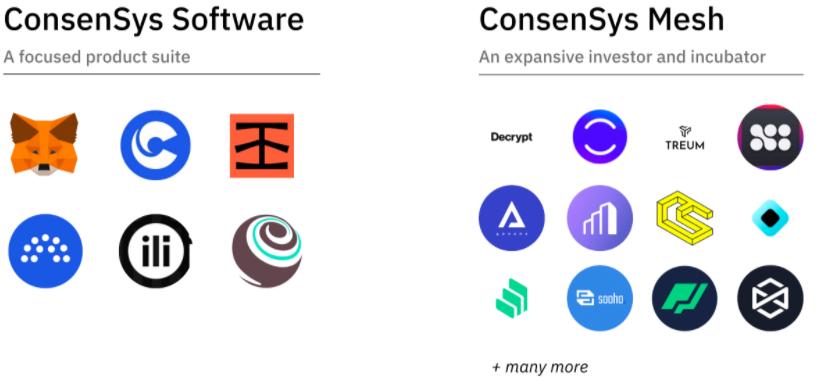
Starting in 2020, ConsenSys began to reorganize itself. To raise money, the company split itself into two separate entities, "ConsenSys Mesh" and "ConsenSys Software," each with a different focus.
ConsenSys Mesh will act as an investment entity, selecting startups from a portfolio of companies to invest in.
ConsenSys Software has bundled the company's leading technology assets into a clearer product. Sitting under this new flag are Infura, Truffle, Codefi, Diligence and, of course, MetaMask. Quorum will join the quintet after August 2020, when ConsenSys purchased commercial blockchain platform Quorum from jpmorgan chase & Co.
To facilitate the change, the company cut another 14% of its workforce. As a strategic ploy, at least, it seems to be paying off. ConsenSys Software announced a $65 million funding round in April 2021, followed by an additional $200 million in November.
While certainly getting help from the white-hot cryptocurrency market, the backing of blue-chip financiers like ThirdZPoint and Marshall Wace also speaks to confidence in ConsenSys' new structure.
For MetaMask, the rearrangement offers more opportunities.
ConsenSys, on the one hand, seems keen to promote synergy between its six different products. With fewer products to focus on, it should be able to build real Bridges.
Just as important, it should end up with more money. ConsenSys is not only better at raising money, but it no longer has to allocate it across a large number of products. In addition to the development platform Infura, MetaMask will be a real priority as the star project in the portfolio.
Traction: MetaMask goes supersonic
Over the past year, MetaMask has experienced massive growth and increased the scale of its services.
In a little over a year, MetaMask's monthly active users grew 2100%, from 1 million to more than 21 million. While this is certainly good news, it's hard to imagine how much stress this has placed on MetaMask's systems and maintenance staff.
Pointing to MetaMask's shortcomings, Sokolin argues: "People should be happy about it, it's an incredible strain on the team."
MetaMask's surge is not just about the number of users; its revenue is also soaring. In October 2020, the team launched the aforementioned "Swap" feature. As mentioned earlier, Swap allows users to exchange their tokens, and MetaMask uses a separate exchange to perform the transaction. MetaMask charges 0.875% of the transaction.
It turned out to be an extremely sharp move. MetaMask has managed to monetize Swap functionality extremely effectively, despite charging what some consider "hefty" fees. Research firm Delphi Digital reports that MetaMask's revenue from this feature reached $200 million in 2021. DeFi hits like Sushi made just $70 million over the same period.
Delphi analysis of MetaMask's revenue: "Think about this: MetaMask's customer acquisition cost (CAC) is a huge zero. Metamask has no token incentive or issue, so their revenue has little cost to consume and margins are close to 100 per cent. Imagine if they had a token offering."
Such suggestions are not far-fetched. MetaMask has considered issuing coins several times in the past. Recently, Joe Lubin tweeted a suggestion for $MASK:
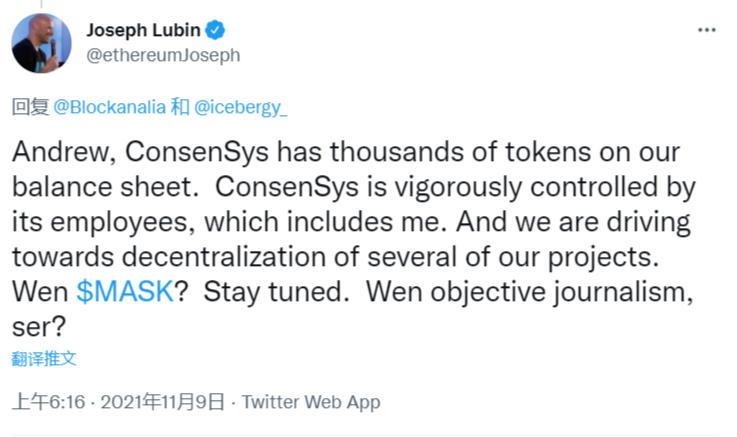
Will tokenization work for MetaMask?
This does not seem to be an easy task. For one thing, MetaMask has yet to publicly articulate a clear idea of what the token will provide. Past discussions apparently mentioned such a token that would allow customers to vote on potential new features, called a "token-weighted plan." According to Demarais, this is the "weakest value proposition" for such a project.
There is also a risk that tokens will only add short-term heat to the project. In our discussion of OpenSea, we outlined how Rarible's $RARI tokens briefly made them dominant in the NFT market, but it didn't last long. Without tokens, OpenSea overtook them with a strong, focused product better suited to consumer needs. "Having a token doesn't make you a winner," Demarais points out. But it can motivate you."
"I'm personally skeptical," Phantom CEO Millman said of potential MASK tokens. What MetaMask needs to do now is focus on improving their core product. Bringing some token governance programs into the broad "community" only slows down development and iteration. I think everyone agrees that we need more cycles to make wallet products better."
Overall, MetaMask deserves credit for surviving the high rate of change in 2021 and effectively maximizing its benefits. But to stay ahead, it needs to adapt to new circumstances and take on new challenges.
The future: Where are the wallets?
No industry is growing faster than cryptocurrencies. Meaningful change is happening every day as new companies, new technologies and financiers spring up. We're in the first minute of the first inning, and there's going to be more craziness in the years ahead than there has been in the past.
This means that, according to the above, crypto wallets are in their infancy. They are unformed, driven by technologies that can be modified, and changed for uses that will change. This uncertainty brings both risk and opportunity.
We can expect four factors to directly influence the evolution of the wallet in the Web3 era:
· There will be more competition.
· There will be greater adoption.
· Cross-network demand may increase.
· There will be more use cases.
Each will affect MetaMask's future. We will analyze these and think about how the current market leaders are positioned.
More competition
When MetaMask launched in 2016, it had the advantage of having few competitors. The competition grew over the next few years, but neither wallet was able to dent MetaMask's position.
That may not always be the case. Competitors are emerging from multiple angles, with both companies grabbing wallet services and criminals increasingly trying to exploit MetaMask's vulnerability.
Coinbase is the most notable player in the first category. The cryptocurrency exchange also offers a wallet product with a similar design to the core product. The Coinbase wallet supports NFT and can connect to the main exchange, simplifying the trading process.
While MetaMask aggregates different exchanges and finds the best prices for its users by rolling, Coinbase has little incentive to conduct meaningful searches. This is just one example of how the company's core product subtly limits the utility of the wallet.
While Coinbase offers a "friendly" wallet, it seems unlikely to be a winner in this space, at least for all but the most casual users. MetaMask is able to link to different exchanges and provide users with the most appropriate quotes via Swap, but Coinbase Wallet seems to be exploring this in an encouraging way. This is just one example of how the company's core product limits the utility of its wallet.
Jack Dorsey's Block (formerly Square) may face a similar problem. While Block doesn't yet offer a wallet feature, it's rumored to be working on a wallet in the Bitcoin space under the auspices of its sub-brand Spiral. While the obsession with Bitcoin seems to outstrip all other challengers, Spiral or a similar entity could potentially enter a Metamask-dominated Ethereum world. Again, while this is a potential path, real users may end up feeling uncomfortable with any preset powers Block gives their cryptocurrency exchange services.
Decentralized exchanges and other crypto projects are also making headway in this area. Uniswap and Aave are both likely to launch mobile wallets, according to Rainbow's Demarais. From his perspective, at the very least, these organizations will succumb to the same problem of using wallets as a way to support different businesses, rather than being presented as a truly unique entity.
That leaves a lot of startups, Rainbow being the most prominent one. For Demarais and his team, the strategy was simple: create a wallet that the average consumer could use and provide the education and support needed for new experiences.
The Phantom takes a similar approach, but from a different point of view. Rather than start by supporting the Ethereum ecosystem, Millman and Agosti decided to invest in and leverage the upstart Solana.
Today, the Phantom is the first choice for Solana users. The team's latest figures show the Phantom has 1.5 million monthly active users and 100,000 new downloads per week. In addition, it has raised $9 million from Garry Tan and A16Z.
Argent is also a prominent contender. It received $16.2 million in funding from Paradigm, Hummingbird and Index, among others. Focused on the Ethereum ecosystem, Argent gets 20% OF APY through DeFi protocols like Aaave and Compound. According to sources, Argent shines from a technology perspective with strong security features and robust architecture.
In addition, Trust, Pillar, Dharma, Frame, Balance, Torus, WalletConnect (SDK), and many others play important roles in the ecosystem. There are also several unannounced projects that have already caused a stir.
If any area is growing fast enough to accommodate multiple winners, it's the crypto world. But while the competition keeps MetaMask from worrying too much, the nature of blockchain makes it much easier for users to switch to a new wallet provider than in other industries. Because all the data is stored on the chain, users can easily switch from one wallet to another without losing their asset data.
All in all, the dynamics of the cryptocurrency space are making MetaMask potentially vulnerable to a number of competitors and a wide range of consumers who misspend their wallets.
Wider adoption
A big part of the reason MetaMask will face so many competitors is because encryption is moving into the mainstream, which will bring a new wave of users, including consumers, institutions and developers.
Let's start with the user data. Three years ago, there were an estimated 31 million cryptocurrency wallet users. Today, there are nearly 80 million.
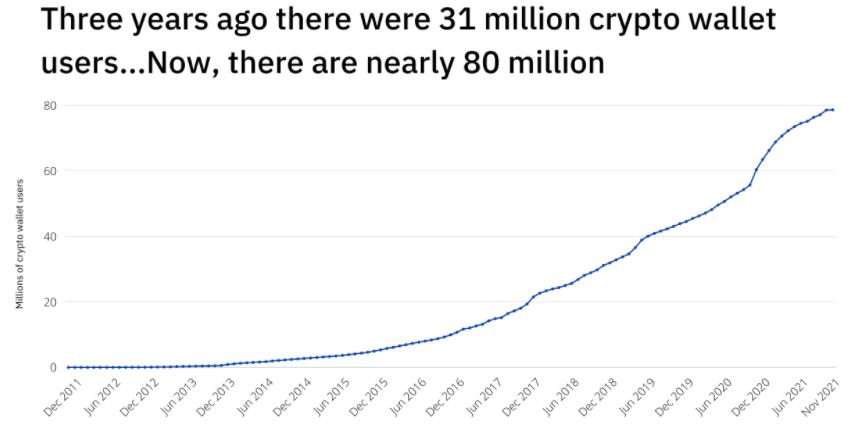
Such numbers are still dwarfed by the adoption of other technologies. In 2018, the World Bank estimated that 3.8 billion people had access to traditional banks, while there are currently 4.6 billion active Internet users. Will we eventually see cryptocurrency wallets reach similar penetration?
Whether it reaches such heights or not, players in the field will need to appeal to a wide audience. MetaMask does have one advantage here: name recognition. While its product wasn't perfect, it became the default wallet. "It's known, it's branded," Demarais said. That is our challenge.
To replace MetaMask, Rainbow adopted an aggressive counter-positioning. MetaMask feels boring and limited. Rainbow has the elasticity and color of a social media challenger. This is combined with consumer expectations and a spirit of inclusion. Regarding the issue of user adoption, Jackson Dame, Rainbow's community leader, said, "The future of Web3 and the next 100 million users joining will require more user friendliness and a more intuitive experience. I don't think many people in the ecosystem would use those words to describe MetaMask."
It may not be too late for MetaMask to get up and catch up. The company should have plenty of liquidity to hire talented engineers; If they can, they will have the space to do this innovative work. Part of the challenge may be that MetaMask is so entrenched and mature that genuine reform is impossible.
While products such as WalletConnect make it easier for application developers to provide integration with many different wallets simultaneously, MetaMask is usually the first port to call when adding such functionality. Demarais also sees MetaMask's potential, noting, "I believe MetaMask can be used as a development tool."
But As Phantom's Agosti observes:
Wallets do have a virtuous cycle and some kind of network effect. Developers integrate popular wallets, developers build applications that attract users and make wallets more popular. Developer adoption has been a major driver of growth for wallets like Metamask. Users do not download Metamask to use Metamask; They download Metamask because they want to mine or buy NFT.
Whoever wins the hearts and minds of users and developers will benefit the most from this virtuous cycle.
More Network requirements
A year ago, Solana traded at $1.80. Its price recently hovered around $200. Such a dramatic rise is just one sign of the project's short rise. In the coming years, we may see many of its projects repeat Solana's trajectory, which is to say, it feels as if we are moving towards a multi-chain, multi-network future. For example, we could choose Ethereum as one interaction, Bitcoin as another, Solana as a third, and Terra as a fourth.
Adding new chains requires a lot of work. "Adding a new chain is very, very difficult," Sokolin said. It not only increases technical complexity, but also the potential for user confusion. Having to transfer between different networks depending on the type of transaction requires a level of knowledge that takes time to develop.
But if the user is constantly hopping between different chains, the lack of such functionality might make sense. Francesco Agosti neatly sums up the problem: "If you have several chain with the same market share (the number of users, the number of deals), and the chain to provide similar types of applications, so I believe that many chain wallet is a better experience. If the workings of a chain, chain or user base, or these chains to provide case there was a significant difference between... the answer is not so clear. "Multichain wallets will struggle to compete with wallets that specialize in a specific niche on a specific chain."
Currently, MetaMask supports Ethereum and its ecosystem. For now, it doesn't need to do much else. But if projects like Solana and Terra continue to thrive, it may need to expand its reach.
More use
The idea of a universal wallet may fade away. As more transactions and interactions occur on the chain, there may be dedicated products to serve them. There are already pockets of niche markets.
We can see a similar trend in games. There are already a number of wallets that claim to specifically serve this area, Wombat being one example. The bonus of playing a linked game and the rich NFT support attracted nearly 1 million users.
Over time, there may be many such sub-industries that need to be served. Agosti overview: "Over the next five years, there are likely to be a number of crypto use cases, and the always accessible market for wallets expands by an order of magnitude... The winners will be those who benefit most from these waves, or those who create them."
The MetaMask shouldn't be expected to capture every opportunity, but it will want to make sure it doesn't wash ashore.
Encryption hero
MetaMask is a crypto hero. For more than six years, its team has worked to build a product that could be perfect but effective. An important primitive that can be relied upon and trusted.
MetaMask has opened the web3 world to tens of millions of users and thousands of developers. Demarais succinctly described the company's contribution: "None of us would be here without MetaMask."
Such an important contribution deserves respect and reward. But that does not mean the maelstrom of public opinion will become friendly to MetaMask. As more and more consumers flood into this space, they will expect levels of optimization and design that are not currently available on the front end. Until this gap is truly addressed, complaints of one kind or another will continue.
MetaMask probably doesn't mind. It has weathered plenty of trials, parent company structure changes and the brutal vagaries of the crypto market.
Welcome to join the official BlockBeats community:
Telegram Subscription Group: https://t.me/theblockbeats
Telegram Discussion Group: https://t.me/BlockBeats_App
Official Twitter Account: https://twitter.com/BlockBeatsAsia

 Related Articles