



Vitalik Buterin: Ethereum endgame

原文标题:《 Endgame 》
Vitalik Buterin
原文编译: Block unicorn
Special thanks to the large group of people at Optimism and Flashbots for their discussions and thoughts on this article, as well as Karl Floersch, Phil Daian and Alex Obadia for their feedback and review.
Consider the general "big blockchain" -- very high block frequency, very large block size, thousands of transactions per second, but also highly concentrated: because the block is so large, only a few dozen or a few hundred nodes can run a fully participating node that can create a block or validate an existing chain. How do you make such a chain acceptable, at least by my standards, without trust and censorship?
It's a reasonable roadmap:
· Add a second layer of mortgage with low resource requirements for distributed block verification. Transactions in a block are divided into 100 buckets, each with a Merkle or Verkle tree state root behind it. Each secondary pledgee is randomly assigned to one of the buckets. A block will only be accepted if signed by at least two-thirds of the verifiers assigned to each bucket.
· Introduce proof of fraud or ZK-SNARK, allowing users to directly (and cheaply) check block validity. Zk-snarks can be directly encrypted to prove block validity; Proof of fraud is a simpler scheme where if a block has an invalid bucket, anyone can broadcast proof of fraud for that bucket. This provides another layer of security on top of randomly assigned validators.
· Introduce data availability sampling to allow users to check block availability. By using DAS checking, light clients can verify that a block has been published simply by downloading some randomly selected blocks.
· Add secondary trading channels to prevent censorship. One way is to allow secondary mortgagors to submit a list of transactions that must be included in the next main block.
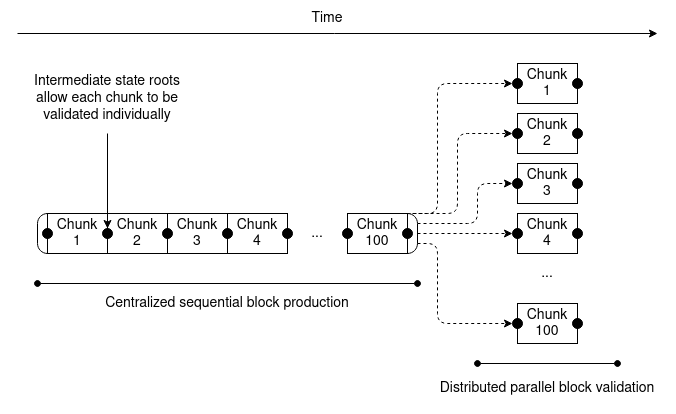
After all this, what do we have? We get a chain where block production is still centralized, but block validation is untrusted and highly decentralized, and specialized anti-censorship magic prevents block producers from censoring. This some ugly on aesthetics, but it does provide the basic guarantee of we are looking for: even if every major stakeholders producers (blocks) are going to attack or review, the worst thing they can do is completely offline, stop accepting trade right now, until the community pooled their resources and establish a honest major stakeholders node.
Now, consider a possible long-term future of aggregation......
Imagine that a particular aggregate -- whether it's Arbitrum, Optimism, Zksync, or something brand new -- does such a good job of designing their node implementation that it can really handle 10,000 transactions per second if the hardware is powerful enough. The technique for doing this is well known in principle and has been implemented by Dan Larimer and others for years: split execution into a single CPU thread running unmatched but cheap business logic, and a large number of other threads running expensive business logic. But highly parallel cryptography. Also imagine ethereum sharding through data availability sampling and having space to store the aggregated on-chain data between its 64 shards. As a result, everyone migrates to this summary. What would that world look like?
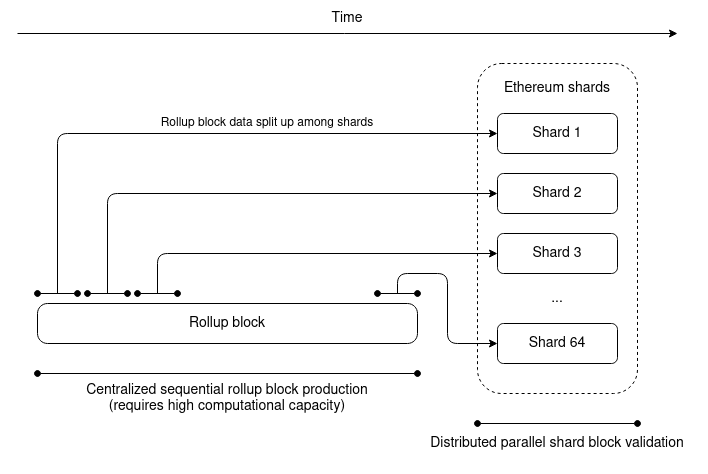
Once again, we get a world in which block production is centralized, block verification is distrusted and highly decentralized, and censorship is still prevented. Rollup block producers have to process a lot of transactions, so it's a difficult market to enter, but they can't push invalid blocks. Block availability is guaranteed by the underlying chain, block validity is guaranteed by summary logic: if it's a ZK summary, it's guaranteed by SNARK, and optimistic summaries are safe as long as there's an honest participant somewhere running a fraud proof node (they can be subsidized with Gitcoin grants). In addition, since the user always has the option to submit a transaction through an on-chain secondary inclusion channel, the aggregate collator cannot be effectively reviewed.
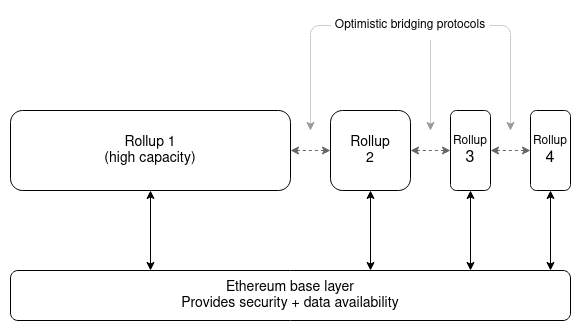
Now, consider another possible long-term future of aggregation...... No aggregate has been successful in keeping up with most Ethereum activity. Instead, they all peaked at a rate of several hundred transactions per second. We got ethereum's multisummary future -- the Cosmos multichained vision -- but on top of the base layer that provided data availability and shared security. Users often rely on cross-aggregate bridging to jump between aggregates without having to pay high fees on the main chain. What would that world look like?
It seems we can have it all: decentralized validation, strong censorship resistance, even distributed block production, because aggregates are so small that it's easy to start producing blocks. But decentralization of block production may not last because of the possibility of cross-domain MEVs. Being able to build the next block on multiple domains at the same time has many benefits: you can create blocks that take advantage of arbitrage opportunities that rely on trading in two aggregates, or a aggregate and main chain, or even more complex combinations.
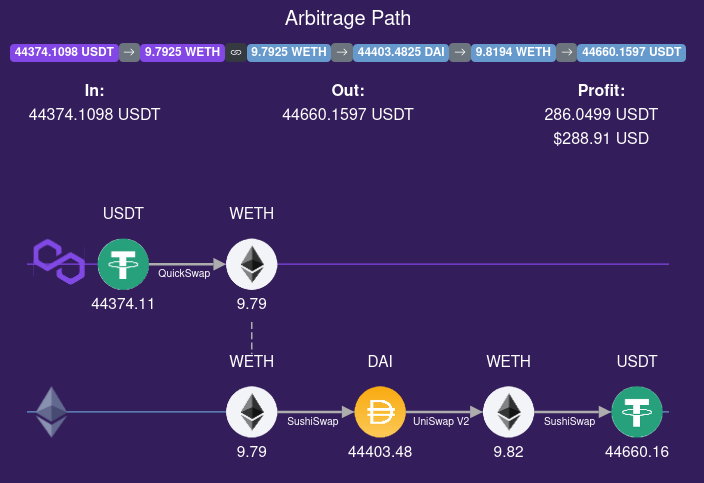
Cross-domain MEV opportunities identified by Western Gate
Thus, in a multi-domain world, there is tremendous pressure on the same person to control block production on all domains. It may not happen, but there's a good chance it will, and we have to be prepared for that possibility. What can we do about it? So far, the best we know is to use a combination of both techniques:
· Rollups implements some mechanism to auction blocks in each timeslot, or the Ethereum base layer implements proposer/builder separation (PBS) (or both). At the very least, this ensures that any trend towards centralization in block production does not lead to a market dominated block validation by an elite capture and centralized equity pool.
· Aggregate implements anti-censorship bypass channels, and the underlying ethereum tool PBS anti-censorship technology. This ensures that if the winners of the potentially highly centralized "pure" block production market try to censor transactions, there is a way to circumvent censorship.
So what were the results? Block production is centralized, block validation is untrusted and highly decentralized, and can still prevent censorship.
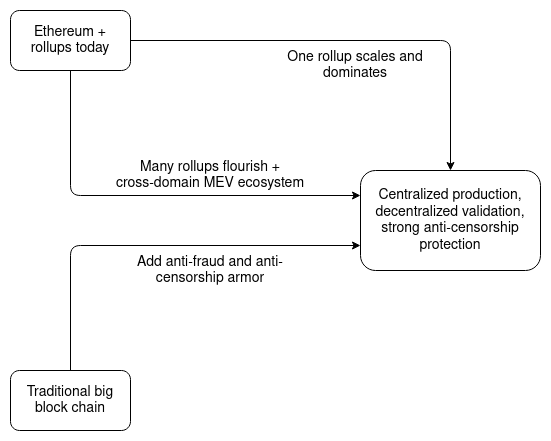
Three roads lead to the same destination
那么这是什么意思?
虽然构建可扩展且安全的长期区块链生态系统有很多途径,但看起来它们都在朝着非常相似的未来发展。区块生产最终会集中化的可能性很高:汇总中的网络效应或跨域 MEV 的网络效应以各自不同的方式推动我们朝着这个方向前进。但是,我们可以做的是使用协议级的技术,如委员会验证,数据可用性采样和旁路通道,以「规范」这个市场,确保获奖者不能滥用权力。
这对区块生产者意味着什么?区块生产很可能成为一个专门的市场,领域的专业知识很可能会跨越不同的领域。一个好的 Optimism 块生产者的 90% 也造就了一个好的 Arbitrum 块生产者,一个好的 Polygon 块生产者,甚至是一个好的以太坊基础层的块生产者。如果域多,跨域套利也可能成为重要的收入来源。
这对以太坊意味着什么?首先,尽管存在固有的不确定性,但以太坊非常适合适应这个未来世界。以以太坊汇总为中心的路线图的深远好处是这意味着以太坊对所有的未来都是开放的,并且不必就哪一个必然会获胜发表意见。用户会非常希望在一个汇总上吗?以太坊遵循其现有的路线,可以成为其基础层,自动提供高容量域需要安全的反欺诈和反审查「盔甲」。制作大容量域在技术上是否过于复杂,还是用户只是对多样性有很大的需求?以太坊也可以是它的基础层——而且是一个非常好的基础层,因为共同的信任根使得在汇总之间安全、廉价地转移资产变得更加容易。
Furthermore, Ethereum researchers should seriously consider the degree of decentralization that can actually be achieved in block production. If a cross-domain MEV (or even a cross-shard MEV from a summary occupying multiple shards) makes it unsustainable, then adding complex pipes to simplify highly fragmented block production may not be worthwhile.
What does this mean for big blockchains? They have a path to becoming mistrust-resistant and censorship-resistant, and we'll soon find out if their core developers and community really value censorship-resistant and decentralized enough to allow them to do so.
All this could take years to complete. Sharding and data availability sampling are complex techniques to implement. It will take years of refinement and auditing before people feel completely comfortable storing their assets in a ZK-rollup running a full EVM. Cross-domain MEV research is also still in its infancy. But it's looking increasingly clear that a real and bright future for scalable blockchains could emerge.
The original link
Welcome to join the official BlockBeats community:
Telegram Subscription Group: https://t.me/theblockbeats
Telegram Discussion Group: https://t.me/BlockBeats_App
Official Twitter Account: https://twitter.com/BlockBeatsAsia







