



Hurricane WAp V2 coming online, will cross-chain convergence land?
On December 3rd, Avalanche's first cross-chain agreement hurricane Wap founder Symington Smith held an online chat with his users, asking "Hurricane WAP V2 is coming. Will cross-chain convergence be possible?" As the theme, the progress of Hurricane P project was introduced, and the current pain points of cross-chain polymerization were expressed.
Hurricane Wap is the first cross-chain aggregator trading platform in the Avalanche ecosystem, allowing users to aggregate liquidity from different ecosystems into Hurricane Wap. By aggregating many public chains, liquidity mining, lending, derivative trading and other functions can be opened from the Swap level, providing a new development idea for future projects.
The following is a transcript of the online conversation
BlockBeats: Please introduce yourself briefly.
Symington Smith:Hello, everyone. I'm Symington, Founder of Hurricane Wap. I'm chinese-Swiss, born in the United States and raised in Beijing, so Chinese is one of my mother languages. It's my honor to attend today's AMA. Hurricane Wap has made a lot of new progress recently, and I can share it with you today.
BlockBeats: After introducing yourself, let's focus on the agreement. Hurricane WAP's positioning is cross-chain DEX. Could you give a brief introduction to the project Hurricane WAP?
Symington Smith:We have an official definition of what hurricane is: The First cross-chain Liquidity DEX based on Avalanche. Aka: the first cross-chain protocol developed for Avalanche. I remember BlockBeats writing about us before we launched, and the summary was clear: "It's a multi-currency, multi-chain DEX."
Hurricane is doing a completely innovative new model, so more specifically, our original Roke protocol brings a new form of cross-chain, "LP cross-chain."
This is done through a multi-dex liquidity pool (which we call Hurricane Ation), which allows Avalanche users to trade other popular assets on the main chain. On the premise of ensuring security, reduce transaction steps, reduce transaction costs and improve transaction efficiency.
Welcome to experience our product. At present, it is V1 version. Soon, we will update V2 and launch our core function [LP cross-chain]. If you want to try it now, you can also go to our V2 test site:https://test-v2.hurricaneswap.com/#/
Hurricane Wap's performance has been relatively stable since the launch of 10.10 V1, and it has been developing new functions. The HCT pledged by our single currency has reached more than 40 million pieces, exceeding 50% of the circulation on the market. This indicates that the users are very optimistic about the development prospect of our project and are willing to wait for the project to grow together.
BlockBeats: Can you tell us how hurricane Wap is different across the chain? So how to achieve LP Token cross-chain?
Symington Smith:Yes, cross-chain is our core strength, and that's because we cross chain in a way that I personally would call "predatory cross-chain." It's like a hurricane that comes and takes everything away. In order to facilitate your understanding, I send a product path map.
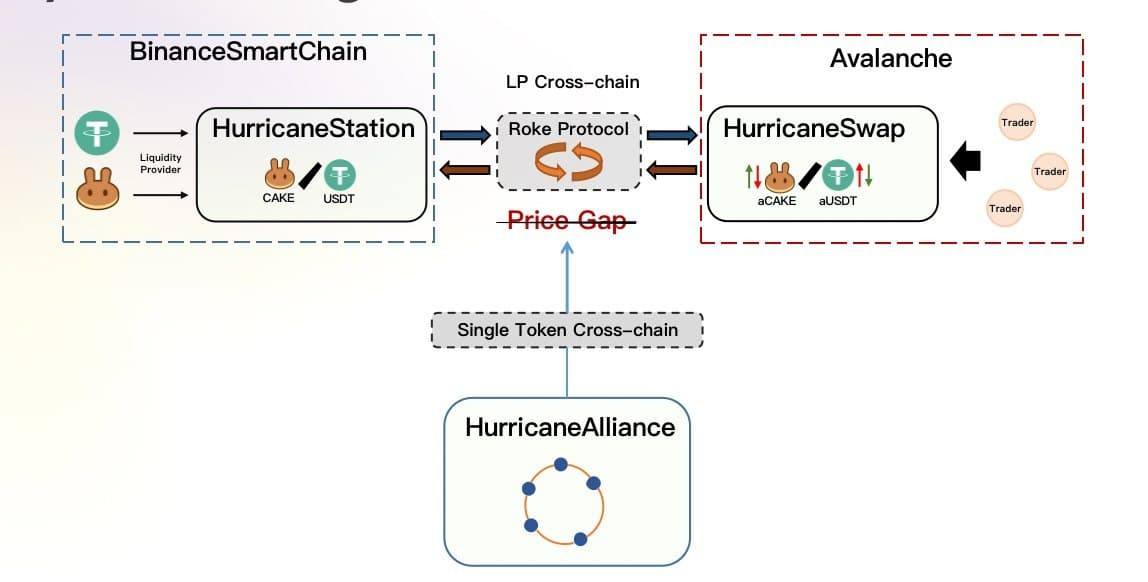
We will set up a station on the BSC network, so that BSC users can easily add LP. Then we map the asset to Avalanche through Roke protocol to form a asset. Avalanche users can trade with ASSET A on Avalanche; We will sync this transaction to BSC and publish the PoR on the Avalanche website so that users can see that the assets we map to Avalanche are paid 1:1.
The advantage of this is that transactions on Avalanche do not require BSC addresses or RPC configurations to trade hot assets on BSC. For BSC users, adding LP doesn't require a trip across AVAX, and can provide additional benefits in our LP-farm. Such cross-chain method is not only convenient and fast, but also can help users save a lot of transaction costs.
Other cross-chain tools in the market now convert assets into stablesoin first and complete a cross-chain transaction, or even five conversions. Such gas charges are also very high. Such a path is more [asset transfer] than [asset transaction].
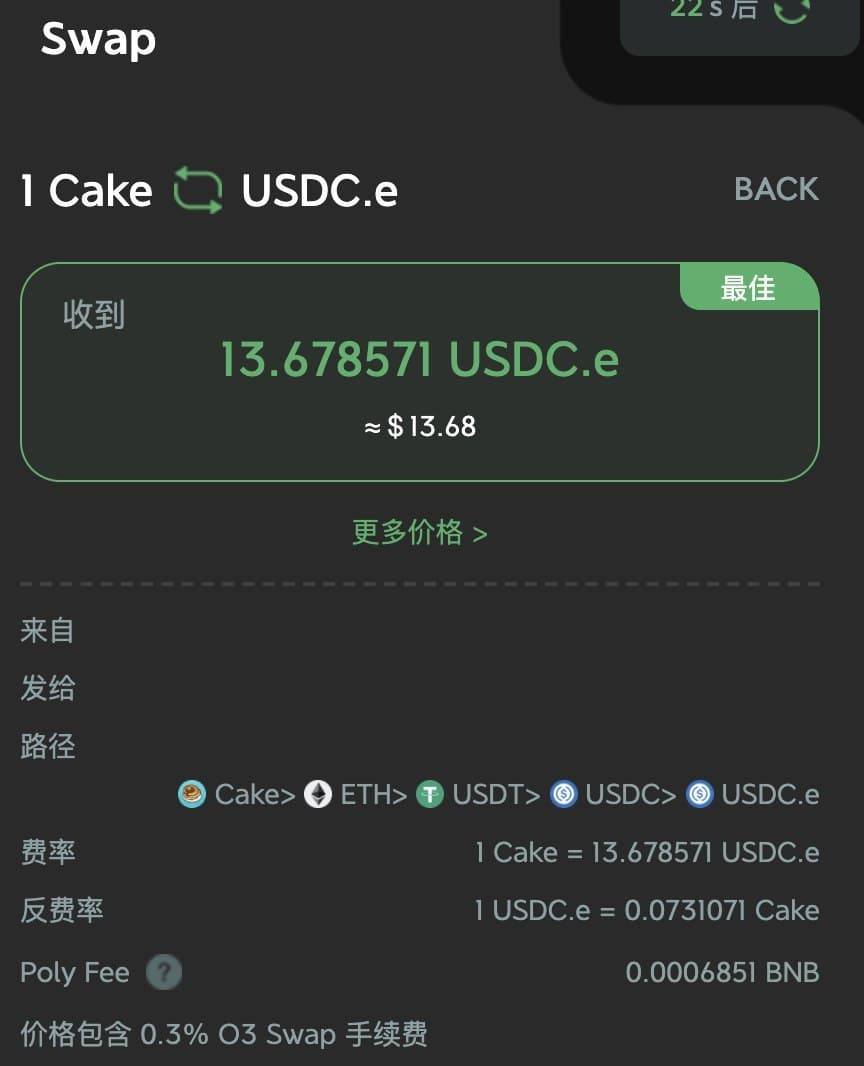
At present, many cross-chain DEX are essentially Bridges, which are cross-chain tools, with a DEX attached to the bridge for more profit.
Users use bridge to [transfer assets], which is a very low-frequency thing; In this way, the product of Bridge +DEX seems to meet multiple demands of users, but it is actually a compromise of two demands. The final result is that the profits of low-frequency demands cannot be improved, while the efficiency of high-frequency demands will be reduced.
BlockBeats: When it comes to cross-chain protocols, security is the biggest concern of users. There have been frequent attacks on cross-chain protocols before. Now that hurricane Wap has done LP cross-chain, the security problem will be more concerned by everyone. How do you solve the security problem?
Symington Smith:I couldn't agree more with you that safety is a constant topic, especially when it comes to cross-dex. I think you may remember that O3 and other projects were stolen before. In fact, the main reason why cross-chain swap is easy to be stolen is that most cross-chain swap requires users' authorization to [transfer] assets pledged by users.
In my opinion, the most significant difference between cross-chain swap and non-cross-chain swap is whether it will hold funds for LP. As long as the funds are kept centrally on behalf of users, there is a risk of theft. Centralized exchanges have so many security technicians, but they are still not immune to stolen coins, hackers and scientists.
However, hurricane WAp's LP cross-chain eliminates the need for users to authorize Hurricane WAp to transfer their funds. Hurricane Wap only has the authorization to pledge and unlock LP, and the LP returned can only return to the original address of the pledge. This is to solve the security problem at the source.
In this case, even in the most extreme case, where hurricane Wap's administrator account is completely stolen (the multiple signing of hurricane Wap's administrator account is sufficiently secure to discuss only extreme cases), there is no way to cause loss of user assets. Users are always safe.
In addition to taking security into consideration in mechanism design, we have also spent a lot of energy (and money, of course) on security audit. Every function and every code of our products have been audited by at least two security audit teams.
You can see PI Shield and Slow Fog's safety report here:
Send the shield:
https://github.com/HurricaneSwap/AuditReport
In addition, our V2 is still undergoing final safety review by HashEX, and the safety review report will be released soon.
I would also like to briefly mention these security review agencies. Chinese users should be familiar with Slow Fog. DeFi's previous several major security accidents were all traced and recovered by Slow fog.
Avalanche was the first version of the security audit party, many large projects in the security audit party, we also through the co-founder of Ava Labs Ted Yin, Found The security audit party for us.
And HashEX is a Russian security audit company, they are the security audit side of TraderJoe, and they are very familiar with DEX on AVAX.
We should be one of the few projects in the market to find three top security audit firms to complete the security audit. Because our cross-chain approach is new and unique, we're going to be more careful with this
Meanwhile, after three weeks of V1 testing and seven weeks of V2 testing, we also found Immunefi to help us create a $50W Bug Bounty, a worldwide white-hat attack challenge.
https://immunefi.com/bounty/hurricaneswap/
BlockBeats: Among many public chains, why do you choose Avalanche? Is there a plan for collaboration at Avalanche Ecology?
Symington Smith:Avalanche is the main chain that our team is very positive about. This is the first and most important reason. We think Avalanche is designed for DeFi and has great potential.
The recent price increase of AVAX is also obvious, and 3AC founder Zhu Su even publicly commented that Ethereum has no future, ALL IN AVAX!
I don't think Ethereum is dead, but Avalanche is a better network for HFT. Faster and safer because it's a technology-oriented main chain. Recently SAW a metaphor, through the Chinese city to compare the public chain. Chinese users should be familiar with the Divine fish, right? He also tweeted:
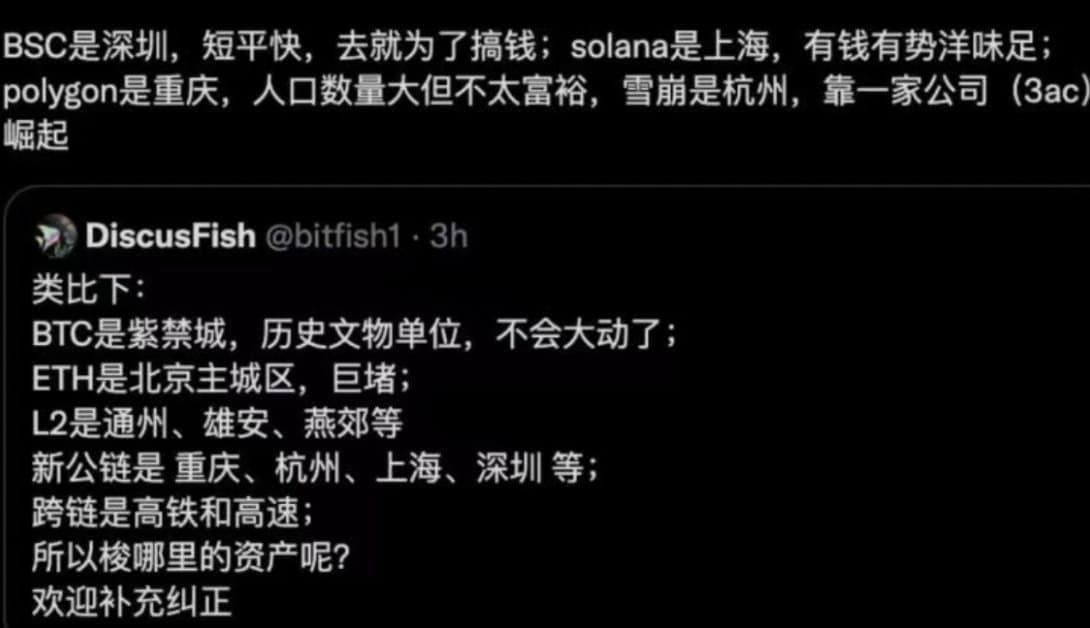
Avalanche was also chosen because I saw an opportunity for Hurricane.
We certainly weren't the only DEX at Avalanche, nor were we the original DEX. Pangolin already existed when we were working on the project, and we already knew about TraderJoe. So why make another DEX? Because Avalanche needs more.
Avalanche is growing fast, but Ethereum and BSC still have a first-mover advantage because many projects have scale barriers. For example, when people use Curve to exchange stable currency, the sliding point is low. Is it a mechanism or technological advantage? It isn't. It's scale. It's also Aave, which is why Avalanche already has a native loan program, BENQI, and spent millions of dollars to attract Aave through RUSH.
That's what Hurricane is all about. We were able to quickly bring in a lot of good assets to Avalanche to meet everyone's trading needs, and Hurricane was a unique asset for the Avalanche ecosystem because Avalanche users wanted to trade cakes only on Hurricane.
BlockBeats: Can you introduce hurricane Wap's Token economy model? What is HCT used for?
Symington Smith:HCT is hurricane WAp's native Token. The HCT was launched on the same day as the launch of our V1 main network, and its most important use was as a voucher for Hurricane users. As you can see, 60% of our tokens are used for farm, which is very DeFi.
And shortly after launch, we launched xHCT, which gave HCT owners more gameplay and more revenue. I can also reveal that HCT is also an important part of our DAO design and will incorporate burn gameplay, such as voting for coins.
We hope that the community can participate more in governance and project development, so the proportion of commission distribution (currently we spend 1‰ of the transaction volume to buy back HCT, and then we will buy back AVAX or other currencies) will also be decided by the community vote.
BlockBeats: What is hurricane P V2's status so far? When is it expected to be officially launched?
Symington Smith:Hurricane WAp V2 is now fully developed and the test network has been in testing for 3 weeks.
In order to ensure safety, we have successively found three security and audit institutions to cycle audit V2. Currently, all three have been audited. HashEX also put forward some suggestions on front-end optimization, which we are processing. So V2 will be coming to you soon.
BlockBeats: What's new in version V2? How is it different from V1 across the chain?
Symington Smith:The most important new feature in the V2 version is LP cross-chain, which is also the biggest difference from V1, because V1 hurricane Wap is just a DEX and does not have cross-chain functionality.
In addition, with LP cross-chain, we will launch LP-Farm to attract more users on BSC. V1 has launched xHCT before, which provides more benefits to HCT holders. V2 will launch sHCT, thus opening the double excavation mode, and the cooperation with other projects will be richer. The most important thing is HTC-DAO. I also mentioned in the Token model that there would be burn, which is realized in DAO.
Of course, new assets are constantly added, and they are all unique assets. We hope to create a DEX with a SENSE of CEX experience and try our best to meet users' trading needs.
BlockBeats: You mentioned that you want to make "DEX of CEX experience". Could you elaborate on this point and tell us how to plan it? What are hurricane Wap's immediate plans?
Symington Smith:This sentence was also extracted from our internal discussions, because most of our team members have CEX experience. We can recall the successful path of some TOP CEX. Many small exchanges quickly acquired a large number of users because they launched some hot currencies, and they were full of trading enthusiasm!
In the CEX era, robbing the currency is robbing users and traffic. This explains the importance of unique assets. That's what Hurricane is going to do next at Avalanche -- more proprietary assets, more user transactions.
In the future, Hurricane will be more asset rich than any single DEX, and our trading experience will always be better than any cross-dex. I've stressed the importance of assets many times, because it's really imaginative. Imagine CAKE/JOE or XVS/QI, I think you get what I mean. Another difference between CEX and DEX is platform VS tools.
Many people think of DEX simply as a trading tool, and in fact many DEX positions themselves that way, but Hurricane is a platform. So in the future we will expand more features and services, such as the machine gun pool, ID0 and other derivative gameplay.
Our recent plans will be published on Twitter and TG group as soon as possible, you can pay more attention to them in the near future:
https://twitter.com/HurricaneSwap
https://t.me/HurricaneSwap_CN
That's the end of this conversation.
Welcome to join the official BlockBeats community:
Telegram Subscription Group: https://t.me/theblockbeats
Telegram Discussion Group: https://t.me/BlockBeats_App
Official Twitter Account: https://twitter.com/BlockBeatsAsia
 Related Articles








