New York Magazine: From everyman to crypto, how to discreetly fall down the rabbit hole
原文标题:《 A Normie's Guide to Becoming a Crypto Person How to (cautiously and skeptically) fall down the rabbit hole. 》
原文作者: Sara Harrison,《纽约杂志》(NYMAG)
原文编译: Yangz,元宇宙之道

You've been managing to deliberately ignore cryptocurrencies for the past few years, but suddenly it may feel like blockchain is closing in on you. Your 401 (k) provider is launching bitcoin options, your friend just made an NFT in Microsoft Paintings and sold it for $14,000, and even your local elected mayor is endorsing a city-wide cryptocurrency. (And your dad just posted "NGMI" in a family group chat?) To an outsider, cryptocurrencies may mostly look like a bunch of brothers in Patagonia vests making a quick buck at the expense of the environment.
That's not entirely wrong, but the landscape today is not the same as it was when it was founded in 2009, or even before 2020, when NFT first exploded. While some corners of the crypto world are still toxic and absurd, it's also a fascinating and optimistic (and strange) place -- a place where a global army of competing ideas lives primarily on Twitter and Discord, All believe in one way or another that cryptocurrencies will fundamentally change the world (including everything we believe about value, money, and the Internet).
This is a guide to understand the world, whether you want to talk at a dinner party, or want to know the currency difference between supporters and into fashion NFTer, or want to show more fluent technology than the boss to get a promotion, then leave your public relations work, become a main member of the new trading platform.
Master at least some basic cryptographic languages.
On December 18, 2013, someone with the username GameKyuubi logged on to the then four-year-old Bitcointalk forum to complain, fueled by whiskey. At the time, bitcoin's value had just dropped 50 percent, but GameKyuubi, a self-proclaimed bad trader, was determined not to sell. He titled the post "I'm at HODLING." HODL, an accidental misnomer, soon became the basis of a cryptographic language; Today, it means not selling your cryptocurrency assets even if prices become volatile. Since then, such jargon has become difficult to understand. Here are some basics to help you understand what people are talking about.
APE: Buy a new coin or Token-- especially if you don't know much about it but feel driven by FOMO: "I need to buy this NFT before prices go through the roof!"
BAGS: Coins and tokens in your portfolio. If you hold on to your coins until they go to zero, you have the misfortune of being a bagholder.
DAO: At its most basic level, DAO is just a decentralized way to organize a group of people -- like a digital cooperative with shared bank accounts. No leader or CEO to make decisions; Instead, you might make suggestions to the DAO, and everyone who holds a Token can vote. Some DAOs operate as startups, others invest in founders or NFT, and some are just for hanging out. In November, ten friends came together to create a DAO to buy a first edition copy of the U.S. Constitution at Sotheby's auction. Within a week, they had amassed 17, 000 members and $45 million, but were outbid by Citadel's chief executive, a hedge fund, and failed to get a copy.
FUD: "Fear, uncertainty, doubt" is a catchall phrase that refers to any form of negative sentiment, criticism, or bad news about cryptocurrencies (even if it happens to be true). When strong enough, FUD can cause panic selling of tokens. "Jamie Dimon calls Bitcoin a bubble about to burst -- he's spreading FUD again."
MOON: If a coin is mooning, it means its price is soaring.
NOCOINER/NORMIE: Skeptics who don't participate in the crypto market are either simply confused or suspect it's a giant pyramid scheme. A tweet from @Gems read: "A NOCOINER/NORMIE friend found my tweet and said" you look like a crazy person trying to start an Internet anti-establishment cult "."
PROOF OF WORK: The process by which the earliest cryptocurrencies, such as Bitcoin, are excavated. It is energy-intensive and requires powerful computers to compete for tokens by solving complex Sudokur-like puzzles.
PROOF OF STAKE: an alternative process that does not require miners and uses far less energy. More and more new currencies are using proof-of-stake technology. Ethereum, the second-largest cryptocurrency, has pledged to turn its entire network into a proof of equity by 2022.
RUG PULL: A scam in which a developer raises large amounts of money for a cryptocurrency project, then disappears with all the money. The most infamous Rug pull occurred in 2018, when a startup called Prodeum took a small amount of funding and disappeared with all its users' money, leaving the word "Penis" on its homepage.
WAGMI: "We are all going to make it" is an expression of friendship and optimism. Often used after something good has happened. "I bought this NFT early and now it's taking off. WAGMI." And its opposite is NGMI, or "won't succeed," which is when a person or entity makes a bad decision and is doomed to fail. "Oh my God, I missed this NFT launch! NGMI" or "Facebook's Meta rebranding is so pathetic. NGMI".
Web2: The Internet as we know it today is dominated by a handful of big tech companies like Facebook, Amazon and Google, which offer services in exchange for personal data (and in turn control what happens to our data - how it is stored, used, tracked and monetized).
Web3: Right now, it's more of a utopian vision than a reality. Web3, a favorite buzzword among many cryptocurrency enthusiasts, is a decentralized version of the Internet that runs on a blockchain. In this version, you'll become a stakeholder in any entity you contribute to online (so if Facebook started as a Web3 project, you might have earned equity -- tokens -- for all the time you've spent on it since 2006). Think of it as the reinvention of cryptocurrencies.
Whales: Individuals or institutions that hold large amounts of a particular cryptocurrency, and whenever they buy or sell, they can move the market (this is called whale movement when whales make large cryptocurrency trades). Many whales choose to remain mysterious. For example, no one knows the identity of the world's largest dogecoin holder, who has collected 39.6 billion Doge (about 30% of the total supply) since 2019.
White paper: You can't find a serious blockchain project or cryptocurrency without publishing a white paper, which is both a technical introduction and a manifesto of what problems you want to solve. They are usually long and intensive.
Get yourself a crash course.
Many will point you to Satoshi Nakamoto's 2008 white paper introducing Bitcoin, or Vitalik Buterin's 2013 article laying out his vision for the Ethereum blockchain. But as we mentioned, the underlying text of cryptocurrencies may not be the best place to start. "The barriers to understanding are too high," says Chris Cantino, a partner at Color Capital. "They should be read after people have fully mastered encryption." Instead, try these resources and sort them from least to most time-consuming.
7 minutes
In 2016, Joel Monegro, then an investor at Union Square Ventures, wrote a 1,200-word blog post on USV's website about cryptocurrencies' place in Internet history, Basically trying to answer the question "Why are things like Bitcoin and Ethereum valuable?" While some consider it outdated, it remains one of the most talked-about works in the cryptocurrency world.
26 minutes
Grant Sanderson, who runs a popular math channel called 3Blue1Brown, created a video called "But How does Bitcoin Really work?" "Explains the ledger system with simple pictures and diagrams.
1 hour
In 2017, Linda Xie, an early Coinbase employee who now runs a cryptocurrency hedge fund, published a series of beginner's guides to non-Bitcoin cryptocurrency assets on Medium. Her Ethereum guide lays out very simple scenarios for how the technology could be used -- for example, how Ethereum could eliminate the need for lawyers and escrow agents when you buy a house.
2.5 hours
Listen to "The Quiet Master of Cryptocurrency," a 2017 episode of The Tim Ferriss Show featuring investor Naval Ravikant and cryptographer and computer scientist Nick Szabo. It was this podcast that got Justine Humenansky, who works at Stanford University's Digital Currency Future Initiative, interested in cryptocurrencies. "I went to a wedding in 2017 and sat at the same table as an early Coinbase employee, and he told me to listen to this," she said. "After hearing that, I thought, wow, this is more than money. This could be the new Internet."
1 the term
Gary Gensler, the current chairman of the SECURITIES and Exchange Commission, once taught a course on blockchain at MIT's business school, and all 24 lectures are available on YouTube. These videos are the first to be recommended by Sam Dealy, a software engineer at MobileCoin, when people ask how to start learning about cryptocurrencies. "Gensler was able to talk about the big picture -- often from articles like Medium -- but he was also able to get into the technical details, the practical implications in terms of computing."
If that's not enough
Andreessen Horowitz, a venture capital firm that was an early investor in Coinbase, has compiled a huge crypto compendia on its website: nearly 160 podcasts, Medium articles, blogs, and academic PDFS, divided into categories like "Basics," "governance," and "practical guides."
Find a scene.
The cryptocurrency world began as a small island of misfits, but over the past 13 years it has morphed into a vast ecosystem of different subcultures and (sometimes warring) factions. Below, take a look at which scenario you might fit in.
Bitcoin enthusiasts
The earliest bitcoin holders are often considered the movers and shakers of the "crypto world." They're not in it for the money -- instead, they're drawn to the Cyberpunk vision of an unsupervised currency. Since it was the first blockchain and cryptocurrency, Bitcoin is also the hottest cryptocurrency today. Of course, it's also one of the last holdovers to use energy-intensive proof-of-work algorithms (other blockchains are moving to greener approaches).

Source: Justin Sullivan/Getty Images
If you vote for Ron Paul...
Then you're probably a Bitcoin liberal, especially if you love talking about monetary policy, inflation and self-sovereignty (and hate the Federal Reserve).
If you like a traditional brand...
Many people don't get into Bitcoin for political reasons; They just see it as a store of wealth (or "digital gold"). Bitcoin is the most trusted name among cryptocurrencies. The system has never been hacked and is considered the most secure blockchain. That may be why it has won favor with Wall Street banks and pension funds.
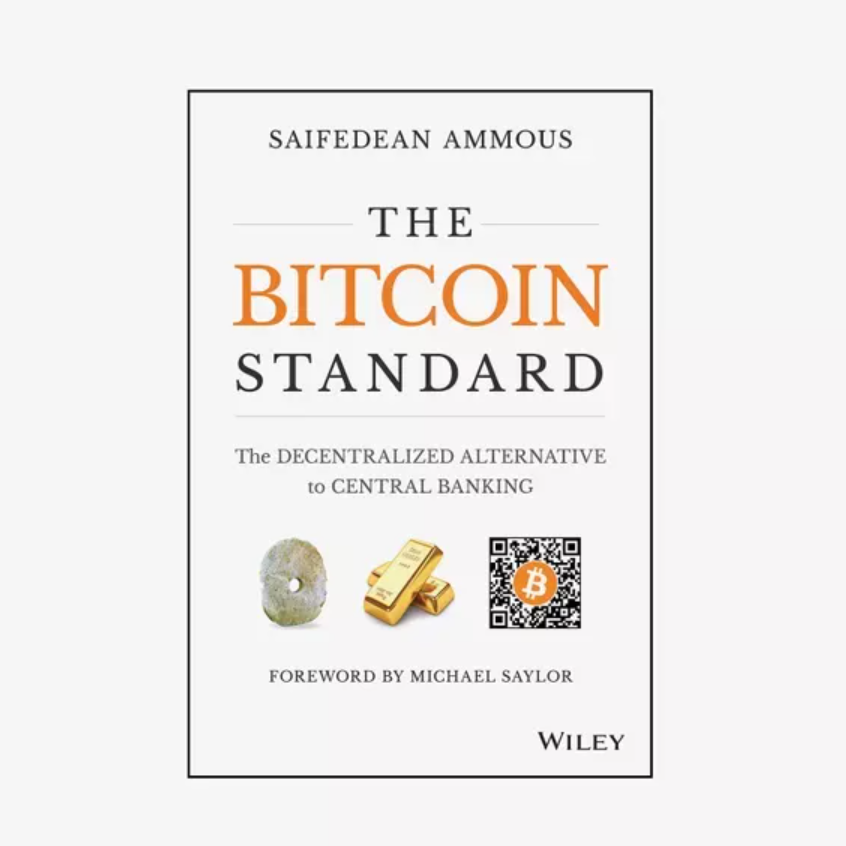
Source: Courtesy of publisher
If you are a purist...
Bitcoin maximalists might recommend reading the Bitcoin Standard by Bitcoin maximalist Saifedean Ammous. Believe that Bitcoin will be the only cryptocurrency needed in the future and that all other crypto assets have no value.
If you're a full-time day trader...
Bitcoin and Ethereum are the most popular currencies among day traders because their markets are so active and liquid. Bitcoin, in particular, is particularly popular because it affects the price of all currencies.
If you're wary of white supremacists...
Some people use bitcoin to evade the law. Anti-right figures like Richard Spencer and Stefan Molyneux like bitcoin, as does Weev, one of the world's biggest Nazi leaders.
Ethereum enthusiasts & NBSP;
The Ethereum blockchain (and its native Token ETH) was launched in 2015 and was designed to be an improvement on Bitcoin. Unlike the Bitcoin network, which can be thought of as a database of wallets, Ethereum is conceived as a world computer. It allows users to do more than just transfer money; It is also a platform that allows people to create new applications and currencies on top of it. Many of the first people to arrive are technology developers.
If you have dreams about Python and Java...
Ethereum is still seen as a kind of playground for software geeks and is home to the biggest developers of cryptocurrencies.

Source: Andrew Lipovsky/NBC/NBCU Photo Bank via Getty Images
If you vote for Warren or Bernie...
Ethereum tends to appeal to progressives (and even socialists) who see cryptocurrencies as enabling leftist policies -- it can help redistribute wealth and build a more equal and transparent society.
If you're a hedge fund guy with an aggressive streak...
Most DeFi projects now run on Ethereum, but many also appear on other blockchains, such as Solana. Its members want to create a new financial system that does not rely on middlemen like banks and brokers. There is another group of people in the DeFi world who often raise assets and sell; They are called "DeFi Degens".
If you are a millionaire...
Joining ethereum whales, who hold a lot of Ethereum, are also angel investors in blockchain, funding a lot of developers and projects, especially during the bear market.
If you go to art school...
If you're new to cryptocurrencies, NFT is a great place to start. Much of it was bought and sold using Ethereum, which boomed in early 2021, spawning a new art scene overnight and attracting institutional heavyweights from obscure digital artists to Sotheby's.
If you like luxury...
NFT is a powerful status symbol in the cryptocurrency world. Mel Vera of DoinGud compares owning the hottest NFT to wearing "Yves Saint Laurent, Prada and Goyard".
Solana lovers & NBSP;

Source: Lam Yik/Bloomberg via Getty Images
If you are an independent ex-derivatives trader...
Solana blockchain, backed by billionaire cryptocurrency entrepreneur Sam Bankman-Fried, is trying to become a rival to Ethereum with much faster (and cheaper) transactions. It is currently listed as the # 3 blockchain and cryptocurrency, although many believe Solana will one day surpass Ethereum.
Counterfeit currency
There are about 4,500 cryptocurrencies in circulation, many of them derivatives of Bitcoin and Ethereum. Here are some things worth knowing.
If you're academic...
Find Cardano's head. In 2017, one of ethereum's founding members split and launched Cardano. The atmosphere is rather academic; This group of people really likes to use peer review systems and scientific methods to build their blockchain. It was wildly hyped, but after years of delay, it ended up being a bit of a disappointment.

If you're just here for a joke...
Join the Doge corps. DogecoinHODLers were launched as a joke in 2013, and were vindication when Dogecoin's value soared 60-fold in 2021, thanks in part to Elon Musk's advocacy. A fun-filled meme sharing community with die-hard fans has attracted a new crop of speculators during the recent surge.
If you want to avoid paper clues......
Monero, an untraceable blockchain designed to provide privacy and anonymity, appeals to a rather subversive grassroots crowd: cyberpunks, ransomware groups, dark web users. John Murphy, moderator of R/Cryptocurrency Subreddit, describes the community as "more like Bitcoin than bitcoin in terms of not working with the state."
Professional investor
If you're obsessed with capital tables and market strategies...
You may be the scary investor that many crypto people -- at least the purest ones -- still fear.
That's why venture capital firms feel so much pressure to demonstrate their credibility. "Venture capital firms come in and say, oh crap, I need to win business," says Jimmy Chang of Aave, a DeFi project. "So they'll buy a Bored Ape and say the same things and share the same memes as us. After a while, we're like, Oh, this investor is actually kind of cool."
Find public intellectuals.
For better or worse, the crypto hive of mind lives on Twitter, the world's public square. You probably don't want your feed to turn into a Tower of Babel, so to find a starting point, we polled dozens of people and asked them to name their favorite accounts. Here are some options:
Chris Dixon, @cdixon
The philosophy student turned investor (and head of the Andreessen Horowitz cryptocurrency fund) is known for his musings on the history of technology and his theoretical work on the inevitability of Web3 (which is also his investment).
The Defiant, @DefiantNews
One of the most trusted cryptocurrency news organizations, launched in 2019 by former Bloomberg reporter Camila Russo. Evin McMullen, who works at ConsenSys, loves its explanatory videos, especially its 90-minute film, The Greatest NFT Movie Ever made.
Jackson Dame, @ jacksondame
As community manager for wallet company Rainbow (scroll to section 7 to find out how he got the job), Dame often shares the gradual breakdown of wallets and NFT for beginners, along with philosophical nonsense such as "Psychology not only plays an important role in NFT, But it also plays an important role in every element of society... Language and communication occur at the level of the mind, whereas words are collective illusions, empowered by network effects -- a great example of how immaterial things are so central to everyday life."
Kinjal Shah, @_kinjalbshah
One blockchain investor, who regularly tweets about letting the economically underserved into blockchain and the shortcomings of cryptocurrencies.
Linda Xie, @ljxie
Xie regularly tweets reading recommendations, beginner's guides, comments on cryptocurrency news, and job tips and opportunities. (She even shared the cover letter she sent to Coinbase in 2014, when she was working for a major insurance company, in a surprise application.) She often invites novices to send her private messages.
Punk6529, @punk6529
This anonymous NFT collector is known for sharing some of the most contrarian (and epic length) Twitter posts in the cryptocurrency influencer scene. In October, they tweeted a comprehensive 31-part paper on NFT, using no fewer than five different metaphors, including stockbrokers, wheat silos, and bagel shops.
Michael Saylor, @saylor
Saylor, the CEO of MicroStrategy, an enterprise software company, became a cryptocurrency celebrity last year when he changed his business model to plough all of his software profits into bitcoin. He often tweets his core message: Bitcoin is going to take over the world. (Or, as he put it in an interview, inspired a popular meme. "It will always go up, Laura." )
Learn to read encrypted material & NBSP;
In order to browse encrypted tweets with confidence, you want to be able to quickly judge a stranger (who in some cases may be anonymous). Fortunately, all sorts of clues are hidden in plain sight.
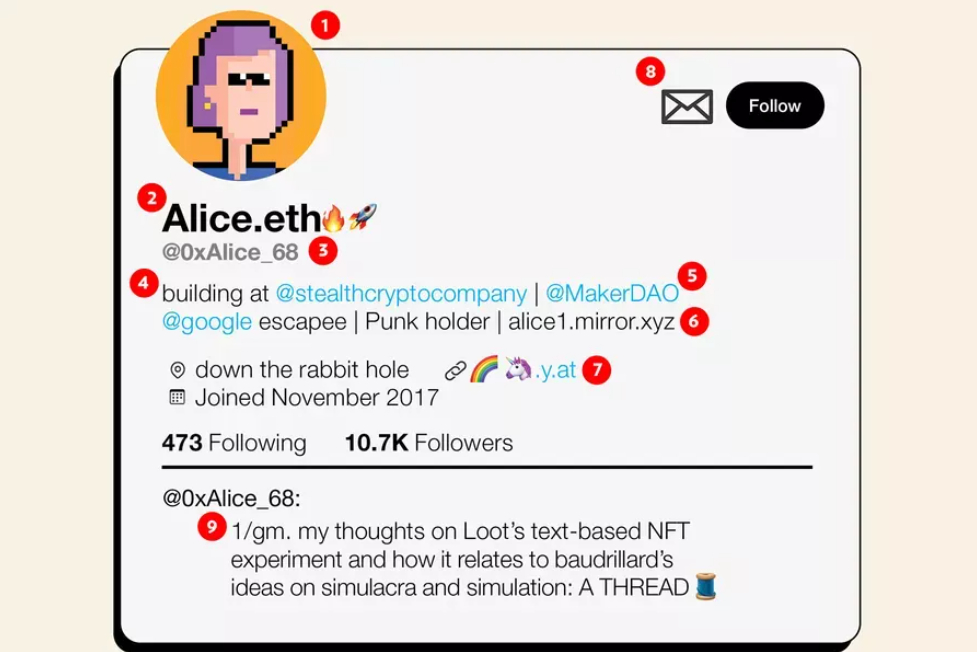
1. Introduce pictures
"In cryptocurrencies, Twitter is your LinkedIn, and your personal photos are very important," said Noah Davis, Christie's HEAD of NFT. "My habit is that if I see a human face, I'm immediately suspicious." Instead, it's cool to use your NFT as your personal photo. "If you have a valuable NFT, you signal one of two things," explains Jimmy Chang, product manager at Aave. "One is: I'm rich and I can afford this. And the second is: I'm really early and I believe in something you don't."
The only exception to the "no face" rule is if the person in the photo has red lasers shooting out of their eyes, which means they are interested in Bitcoin.
2. Display the name
If you see ". Eth "after it, that's the unique domain Name of the Ethereum Name Service, or ENS, for that person's cryptocurrency wallet address. These domain names are sometimes acquired by public auction, and if you can get [your name].eth, you have a lot of flexibility.
When you know someone's ENS name, you can look in their wallet and see everything they own or have traded.
3. Twitter account
In their accounts, Ethereans can also include "0x" (the two characters at the beginning of an Ethereum wallet address) or ξ (the Ethereum symbol).
Introduction of 4.
Think of profiles as cryptocurrency pedigrees -- where people list their day jobs, which cryptocurrency projects or communities they are members of, and which tokens or NFTs they own. Jimmy Chang describes his Twitter profile as "basically my DAO profile."
5. DAO
On Crypto Twitter, people like to show off which DAOs they are in. Here are some of the sexiest:
Friends With Benefits: A social DAO that hosts parties around the world. Current membership costs more than $9,000.
PleasrDAO: A pure application DAO created to collect NFTs. NFT, which has Edward Snowden's face taken from a U.S. appeals court ruling.
Seed Club: A startup incubator akin to a community-centric cryptocurrency project.
6. Communication
If you're a thought leader for cryptocurrencies (or someone who wants to be one), you probably have your own communications on Mirror.xyz (sort of like Substack, but decentralized and crypto-based).
7. Yat
If they have a list of emojis in their website bar, they may have purchased a Yat. Yat is a platform that allows you to purchase a unique emoji-based URL that can be used as a payment address for your cryptocurrency wallet. Yats with important emojis, such as "Rocket Moon," can sell for hundreds of thousands of dollars.
8. Make private messages public
If you send a private message to a well-known cryptocurrency figure, they might actually respond. "They could really be a billionaire," said Zachary Nelson of the University of Washington's Blockchain Institute. "But they'll write you back just because they're there."
According to people we surveyed, the big names who responded to DMs include: Peter Vessenes, a cryptocurrency billionaire who got in when Bitcoin was 5 cents; Brad Garlinghouse, RIPPLE's CEO (" This could be prior to litigation, "Nelson said); And Hayden Adams, founder of Uniswap.
"Gm" 9.
Gm (short for "Good morning") is one of crypto's most convoluted but sacred touchstones, the default way people greet each other online -- no matter when. "It looks so simple," said Alisha eth, ENS 'community manager. "But there's something exhilarating about it, especially when you're trying to organize people scattered across time zones and continents." This fall, venture capital firm Sam Lessin tweeted that GM was stupid, prompting thousands of angry responses on cryptocurrency Twitter, many of them beginning with GM.
Make an appearance in Discord;
The messaging app, which is popular among gamers, takes up a more private space in Web3. Most focus on specific cryptocurrency communities; Some Discord servers function as pop-up study groups (if your study group has 3,000 members across multiple time zones); Other servers exist in projects where people work together as DAOs, complete with "town halls" and public forums; Other servers are exclusive to members who hold some kind of NFT (see below for tips on how to get the first NFT). Here's a guide on how to survive your first Discord:
Make sure it's not just you and a bunch of robots
When you join, Evan Shirreffs, director of business development at NFTy LABS, suggests taking a look at the chat logs to make sure you're talking to a real person. "If you have a lot of people saying, 'Hey, hey, hey, good project, good project, good project,' those are robots who either paid for it or joined because it was noticed," he said. He also likes to make sure that there are large numbers of members, at least in the thousands, having organic (human-like) conversations. Alisha. Eth has another indicator of whether the Discord community has a good vibe -- whether people post "GM" in it when they wake up in the morning.
Although you probably don't know who's who
The cryptocurrency world values anonymity and pseudonyms -- perhaps as a nod to Bitcoin's anonymous founder, Satoshi Nakamoto. On Discord, you can have an entire conversation with someone without knowing their real name, where they live, where they work, or even what their voice looks like (when people have a live chat, they might use a voice changer).
If you're interacting with a new person, make sure that person has some kind of paper trail online, whether it's a LinkedIn with work history or an active public Twitter account, advises Chris Cantino, an investor who frequently advises newcomers on Twitter about entering cryptocurrencies. Or whether they are related to friends of friends. You can look in someone's wallet is another way to check. "You can see everything in my wallet: how much ETH and NFT I have, what programs I'm in. So if you see a bunch of fraudulent, untraceable stuff, it's a lot less trusting."
People are generally nice and willing to help
"Strangers are perfectly willing to hook up with each other with the information or things they buy," says Isha Kasliwal, a technology designer turned cryptocurrency enthusiast. "I once cast two in AN NFT Posting and there was one person on the Discord server who didn't get them. So I swapped one of my two NFTS with him because of his FOMO." Still, if you have a question about something, do at least the bare minimum to find the answer before you ask for help.
If you meet someone in Discord and have a good conversation with them, ask for their Telegram account." "If someone asks me for mY LinkedIn, that's a sign of being an outsider," says Justine Humenansky. If you do find someone you're in tune with, you might want to start a smaller group chat, which could end up being the best way to learn about legitimate things. "This is where you learn about people's personalities," says Cathy Mulligan, a professor of computer science at the University of Lisbon. "Like, is this person just trying to make money, or are they really interested in this particular coin?"
Don't be too loud
"When you meet people, don't ask," What's the next cryptocurrency I should buy? "Don't ask," What's the next NFT I should buy?" Mel said Vera. Instead, ask questions about the project. Who is working on the project and what do they want to accomplish?
Or you could say nothing at all
In order to adapt to the environment, Alisha eth agrees that "you can lie dormant for as long as you want." "You'll be amazed at how much you can learn," she says. "No one expects you to say anything. There are thousands of people here -- no one will call you out."
Take a break if you need to
Once you start rolling down the cryptocurrency rabbit hole, it's hard to get out. "It's so exhausting," Says Jimmy Chang. "[I'm] always trying to maintain a balance. Like, I should leave my house, I should talk to my IRL friends." Brittany Pierre, a photographer, joined the NFT circle earlier this year and was at one point a member of 27 different servers. Now, she turns off notifications after 8 p.m. "And I've made it a rule to go outside sometimes," she said.
How do I get involved in NFT?
If you don't consider yourself very technical, most people would recommend that your first cryptocurrency purchase be NFT. That's what Justine Humenansky's mom did when she dabbled in cryptocurrencies a few months ago. "I think NFT feels more accessible and interesting than having something she can use as money; instead, it's like an avatar that belongs to me," Humenansky said. "When she set up her wallet and saw me transferring NFT from my wallet to hers, she said, 'Can you send me cryptocurrency for Christmas?
1. Sign up for a regular-friendly wallet
Rainbow and MetaMask may be more accessible for beginners (Rainbow's website has a "learn" section with instructions on how to avoid scams and protect your wallet).
2. Convert some DOLLARS into ETH-- the minimum amount you are willing to lose
But note that to buy NFT, you have to pay the dreaded Ethereum transaction fee (" gas fee "), which can easily reach $100.
3. The best place to buy NFT is OG marketplaces like Opensea and Rarible
When making your choice, use the same method as the new kid in school trying to find new friends. Carmen Hernandez: "When you buy something, in a way you are joining a club, and the atmosphere of the club is important." Former corporate recruiter Rachael Amy chose Astrocryptids because of its thriving Discord community. "It's really welcoming," she said.
Real move to encryption & NBSP;
You don't need to be a technical genius to work in this field. In fact, it's probably better if you're not. A growing number of cryptocurrency companies -- from giant trading platforms like Coinbase to smaller startups -- are trying to hire people from traditional industries who know how to whisper to ordinary people. We spoke to three people who have made the transition to blockchain in the past year.
Marketers who tweet into new roles
"In February, I started using Rainbow Wallet. I followed Mike, one of the co-founders, on Twitter, and he deactivated me for some reason. I tweeted memes about Ethereum or Rainbow, or I tweeted about my experiences learning these things. Rainbow was definitely not hiring at the time, but I sent them a message, and it was very brief, like, "Hey, you've seen my Tweet, I love this app," and we had a phone conversation the next day, and I met the other co-founders a day later. The hiring process lasted a week and a half, and it was all via Twitter."
"I have a marketing and communications background, I started my career in church, working in communications and design. My knowledge of cryptocurrencies is relatively minimal. But I think what led them to hire me was that they saw my role online as a role they wanted their brand to have." A lot of people ask me how to get a job in crypto, and the first thing I always advise is to make sure you're on Twitter and understand how to browse it effectively, especially if you're going to work in a public-facing job like I do."
"From Monday to Friday, I spend most of my workday either on Twitter or in the window next to me as I write support or answer messages from our Twitter account. It helps me stay on top of the issues that customers are having and the barriers that new users are having. I don't actually pay with cryptocurrency. I think I'm quite happy with that."
-Jackson Dame, content creator and ambassador for Rainbow
Art experts turned in-house cryptocurrency people
"As head of online sales in the Contemporary department in New York, I would evaluate Beeple shipments at Christie's auctions. That was my introduction to NFT and cryptocurrencies -- I was familiar with them, but only on the surface (I didn't even buy any Ethereum or Bitcoin until after I sold Beeple NFT). It was an interesting moment in early 2021, we had just done something for the first time in the last six months, like doing an off-site sale, and I think Christie's is kind of tolerant of doing something completely new, like selling art that doesn't exist. Legal department must allow me to do many things, but the first thing to do is in the works published in the "unknown" valuation, because I don't know what to write there. I recently hired a coordinator role here, I hire people not from traditional art background, but has been in the field of NFT, and it has been on social media contact with me. That's a lot more convincing than hiring someone who interned at a random art gallery."
-- Noah Davis, Head of digital sales, Christie's
An anonymous recruit
"My profession is not technology. I worked in tax law for a while, then I left that field to work in e-commerce, which I've been doing for the last decade. I first encountered Bitcoin in 2015, after Shopify added BitPay as a payment option. But I didn't really think about it until 2017, when I got caught up in the hype of the bitcoin bull market, but I soon realized that the financial side -- speculation and investing, especially trading -- wasn't consistent with me. I didn't think it was sustainable."
"Late last year, with bitcoin surging, I came back into the cryptocurrency space, and around February, I discovered the Ethereum community. One of the things people were talking about was Kernel, which is a Web3 learning community. They have three sessions a year, 250 participants. I was going to give myself eight weeks to go down this rabbit hole, and in March of this year I bought my ENS name, Alisha. Eth."
"When I was working on Kernel, I had started a podcast called Crypto Native -- just a way for me to talk to different people. One of the guests I interviewed was Nick, the founder of the Ethereum name service. They were looking for a community manager, and he encouraged me to apply. When I submitted my application and resume, I used Alicia. Eth instead of my legal name. The problem is, we don't know where the world is going, but we do know that everything is on the chain and it's public, so using that name preserves some anonymity. And it gave me a confidence that, for whatever reason, I never had in using my full name.
-Alisha. Eth, Community Manager, ENS
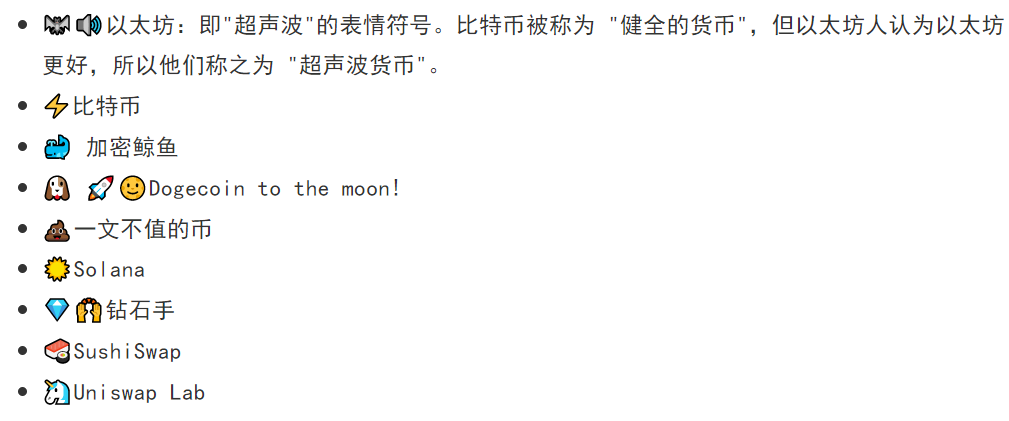
Attached: Emoji explanation
Emojis aren't just visual embellishments -- they can tell you almost everything about a person's cryptocurrency vibe, as long as you know how to read them.
Welcome to join the official BlockBeats community:
Telegram Subscription Group: https://t.me/theblockbeats
Telegram Discussion Group: https://t.me/BlockBeats_App
Official Twitter Account: https://twitter.com/BlockBeatsAsia
 Related Articles