Bitwise Report: The Current State, Challenges, and Future Potential of DeFi
Original Article Title: "Bitwise Report in Full: DeFi Has Nearly 100x Market Growth Potential in the Next 5-15 Years"
Original Source: Bitwise Report
Original Translation: Weiss Research Institute
Over the past few decades, nearly every major industry has been reshaped by the digital revolution — except finance. You can see it in the list of the largest companies driving our economy — Apple, Amazon, Facebook, Tesla. However, despite these and other disruptive, technology-first giants leading much of the market, the global financial industry is still dominated by century-old legacy institutions.
It's now 2021, but the average age of the top ten U.S. financial firms is 126 years; the history of America's largest financial institution — JPMorgan Chase — can be traced back to 1799, founded by Aaron Burr. These leading financial institutions are still operating on business models from centuries past — their established infrastructure revolves around decades-old technologies such as the SWIFT network and ACH payments. This antiquated infrastructure severely limits our ability to innovate.
All of this has laid the groundwork for Decentralized Finance (DeFi), a rapidly evolving technology with the potential to fundamentally reshape our view of financial services. DeFi replaces traditional financial intermediaries with software and code: autonomously executing "smart contracts" secured by blockchain technology allow innovators to rethink everything from lending to trading, asset management, and beyond.
Today, nearly 3.8 million users have allocated $212 billion to DeFi applications. These services can process nearly billions of dollars in loans instantly, trade billions of dollars in crypto assets without intermediaries, and execute many core financial functions faster, cheaper, and more flexibly than other services.
Compared to commodity-like crypto assets such as Bitcoin, DeFi has intrinsic revenue streams — from a growth and valuation perspective, they resemble early-stage stocks. However, compared to early fintech stocks, DeFi's revenue growth rate has exceeded 20x. From a top-down perspective, the $152 billion market cap of DeFi applications represents less than 1% of the total market cap of global financial services companies. If DeFi were to achieve the same penetration rate as other disruptive technologies like e-commerce (50-70%), it could become a $15 trillion industry in the next 5-15 years.
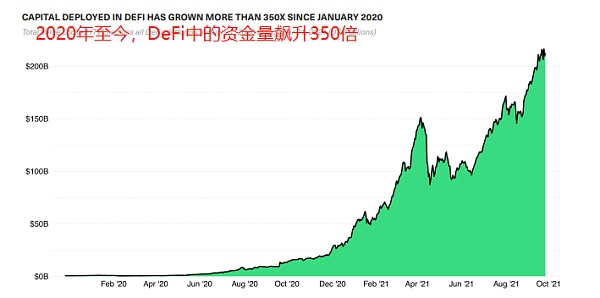
Advantages of DeFi Compared to Traditional Finance
DeFi is one of the most exciting areas in the crypto world. DeFi aims to leverage one of the key breakthroughs of cryptocurrency technology: programmable money, to create a more accessible, efficient, and transparent financial system.
A key innovation driving DeFi is automated 'smart contracts.' These are blocks of code running on a blockchain that can execute complex transactions without the need for a trusted intermediary. Think of it as a vending machine: you put money in one end and get your desired item out the other end, all without any external intervention.
In many ways, they are like apps that everyone has on their smartphones, but with one key difference: there is no central company running them behind the scenes. Instead, a series of self-executing smart contracts operate the applications based on the logic written into their code.
This new way of providing financial services combines many of the advantages associated with 21st-century disruptive companies:
Lower Costs
DeFi's costs are much lower compared to traditional finance, mainly due to two key structural advantages: it eliminates the need for intermediaries in financial transactions and is built on a free or near-free blockchain.
Greater Speed
DeFi significantly speeds up transaction processing because it eliminates the need for intermediaries and is built on blockchain infrastructure that allows for instant financial transaction settlement.
Broader Impact
Like the internet, cryptocurrency is a global phenomenon. Anyone with an internet connection can create or access DeFi applications.
Agile Composability
DeFi applications can be stacked like Lego blocks to facilitate new functionalities that can execute more complex transactions, leading to faster innovation cycles and new creativity.
Two-Sided Markets
DeFi's peer-to-peer structure has opened up new supply sources in financial markets, much like how Airbnb brought new supply to the short-term rental market and Uber brought new supply to the taxi market.
Self-Executing Services
DeFi applications are composed of a series of self-executing smart contracts. Once deployed on the blockchain, they can operate continuously without human intervention, 24/7/365—running 24 hours a day, all year round.
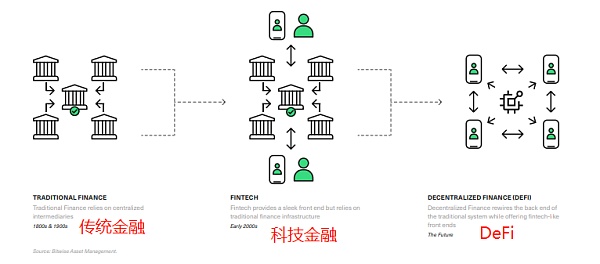
The Subsectors of DeFi Are Continuously Expanding
The subsectors comprising the DeFi ecosystem correspond to subsectors of traditional financial services: lending, trading, asset management, and insurance. Lending and trading currently dominate, accounting for 80% of the Total Value Locked (TVL) in DeFi. The following sections will delve into these categories, which are pushing the boundaries of DeFi expansion by incorporating functions.

Lending
As one of the most primitive and common financial services, lending quickly became one of the most widespread use cases in DeFi.
Former Acting Comptroller of the Currency Brian Brooks defined DeFi applications as "automatic banks." Brooks's analogy is particularly apt for lending in DeFi, as users can deposit crypto assets to earn interest income or borrow other crypto assets by collateralizing their holdings.
The top three lending applications in DeFi are Aave, Compound, and Maker. As of October 31, these three applications collectively held $410 billion in deposits (a 341% increase year-to-date) and $200 billion in outstanding loans (a 441% increase year-to-date). While these platforms may differ in user interfaces, incentive structures for different user types, specific risk and reward parameters, governance standards, and other factors, all allow for the processing of loans at very high efficiency and speed without any manual review.

Trading
Trading is another major subsector in the DeFi space led by decentralized exchanges (DEXes). These are the equivalent of the New York Stock Exchange or NASDAQ in the world of crypto assets or a decentralized version of platforms like Coinbase. They provide users with a way to exchange crypto assets without the need for a trusted third party.
Importantly, most of these decentralized exchanges are not order book-based like traditional exchanges, but instead use a novel mechanism to guide and maintain trading activity called Automated Market Maker (AMM). Traders on DEXs do not trade with each other but rather with liquidity pools filled with funds from market makers. DEXs operate like Uber's two-sided marketplace, where Uber connects drivers and their vehicles with passengers needing a ride, DEXs connect market makers seeking cryptocurrency returns with traders willing to pay for liquidity.
All these activities are autonomously facilitated by smart contracts, with no intermediaries, no staff, no operating company, no trading floor, or corporate headquarters. Nonetheless, some major decentralized exchanges can still compete with their traditional counterparts in terms of trading volume, costs, and efficiency. As shown in the chart below, the most popular DEX, Uniswap, accounts for 18% of centralized exchange volume, on par with well-known platforms like Coinbase and FTX.
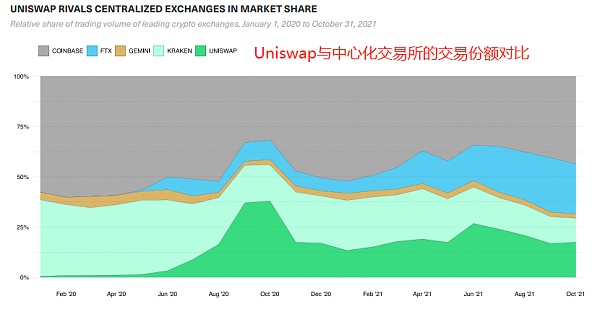
Different decentralized exchanges may vary in user interface, user types, asset types, transaction speed and costs, governance standards, and other aspects.
Recently, some decentralized exchanges have been experimenting with new features. SushiSwap is a prime example. In addition to traditional spot trading, it now offers lending, NFT trading, and even a project launcher for fundraising.
Asset Management
Asset management is one of the fastest-growing subsectors of DeFi. Yearn Finance is at the forefront, with nearly $60 billion in assets deployed on its platform. Yearn leverages automated strategy deployment for assets held on its platform. These strategies aim to seek the most advantageous DeFi yields. Due to DeFi's open nature, the assets managed by Yearn and the deployed strategies are publicly auditable and verifiable.
Yearn is akin to a traditional finance robo-advisor. The most popular robo-advisor, Wealthfront, launched in 2008, took 13 years to reach $27 billion in assets under management. In contrast, Yearn, launched in 2020, has accumulated $60 billion in assets under management as outlined above.
Other protocols, such as Enzyme Finance and Set Protocol, allow anyone to easily create and manage token baskets that others can invest in. Index Coop has even created decentralized crypto index funds, with these products being advised by DeFi industry experts.
Insurance
DeFi is a nascent phenomenon, so it still faces significant risks, including code bugs and design imperfections. As a result, decentralized insurance applications have emerged to provide coverage for DeFi risks. Surprisingly, decentralized insurance is still underdeveloped compared to traditional insurance systems. For example, the popular DeFi insurance app Nexus Mutual currently holds less than 1% of the total value locked (TVL) in DeFi.
There is still significant potential in this subindustry when user experience is effectively improved, such as through easier operations or the ability to add insurance services to other transactions.
Others
Just like in traditional finance, DeFi transactions are not limited to the spot market. Futures and other types of derivative contracts can also be automatically executed through smart contracts. Therefore, derivatives have become a significant subset of DeFi trading. DeFi applications focusing on this submarket include Synthetix, dYdX, etc. Some features provided by these apps include derivative contracts, options, and even synthetic assets pegged to real-world assets (e.g., stocks, currencies, and commodities).
Derivatives have been a contentious subindustry in DeFi recently, especially in the United States, where regulatory bodies such as the Securities and Exchange Commission (SEC) and the Commodity Futures Trading Commission (CFTC) have expressed concerns about derivative-like securities. However, outside the U.S., the demand for derivatives indicates that the derivative market in DeFi can bridge a significantly large, essentially untapped market gap due to regulatory disparities.
DeFi Ecosystem Application Showcase
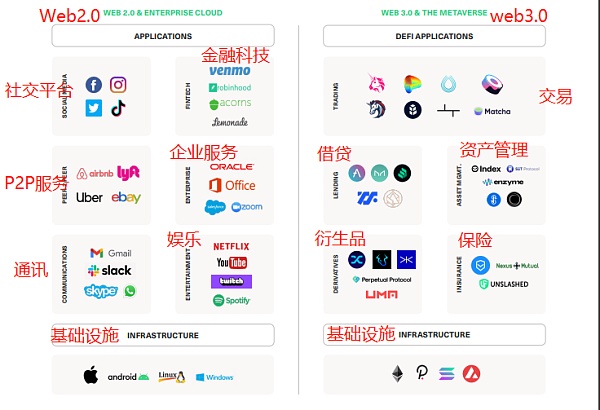
The first generation of DeFi applications was mainly built on the Ethereum blockchain. However, the surge in DeFi usage has congested the Ethereum network, forcing some DeFi applications to move to alternative networks. As a result, Ethereum's competitors such as Solana, Avalanche, and Terra have emerged and begun driving DeFi growth within their respective ecosystems.
The following diagram illustrates the scale of these blockchain networks and the DeFi ecosystems built on top of them (all values are in billions of dollars).
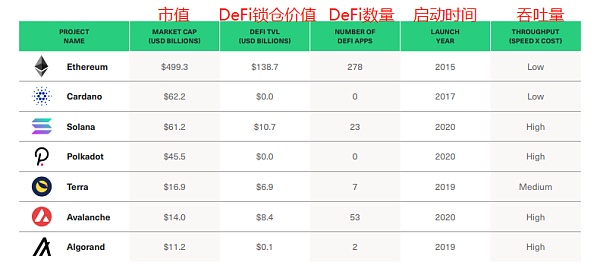
From the chart, it can be observed that Ethereum still holds a dominant position, being the preferred platform for 52% of DeFi applications, representing 65% of the total value locked in DeFi, which is also one of the reasons Ethereum has a market cap close to 500 billion dollars.
However, Ethereum's leading position in the DeFi market is not guaranteed. DeFi has started to proliferate rapidly on competitors' networks. Just as different neighborhoods have their own trade-offs, such as proximity to the city center, cost of living, etc., these networks also have different trade-offs in core attributes like throughput, security, and decentralization.
Comparison with Other Disruptive Technologies
The DeFi industry has already seen remarkable success, but as a nascent disruptive technology, it may still have significant room to grow. From a bottom-up perspective, DeFi applications have seen substantial valuation multiples and significant growth potential. From a top-down perspective, the total market cap of all DeFi applications is still less than 1% of the global financial market's total market cap.
Bottom-up Analysis: Attractive Growth Adjustment Multiples
Unlike large-cap crypto assets like Bitcoin and Ether that function more like commodities, DeFi applications typically have revenue streams. This allows investors to use some of the same tools they might use to evaluate early-stage stocks.
Currently, most DeFi applications generate revenue by charging fees on activities on their platforms (such as trading or lending), with most of the revenue being used to reward participants in the applications, such as liquidity providers and lenders. For example, the decentralized exchange SushiSwap charges a 0.3% fee on each trade. Of this, 0.25% is passed on to liquidity providers, and the remaining 0.05% is allocated to SUSHI token holders, similar to dividends. The lending application Aave charges a 0.09% fee on all flash loans, with a portion automatically used to buy back the native tokens on the secondary market and "burn" them (permanently removing them from circulation), akin to stock buybacks.
Therefore, while DeFi applications lack a corporate structure, native tokens can provide economic incentives akin to startup equity. Additionally, token holders typically have governance rights that can be used to influence the future development of the application and determine how the generated revenue is distributed.
So in a scenario where DeFi is generating profits, investors can use traditional valuation tools to value DeFi applications. Currently, the preferred valuation ratio for financial market investors is Price-to-Sales (P/S) ratio. The data below shows that the top DeFi applications categorized under the Bitwise DeFi Index components currently have a median P/S multiple of 14.5x.
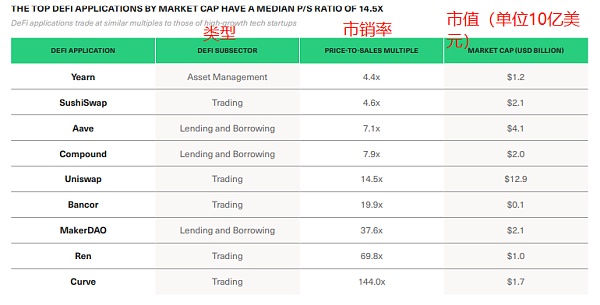
This multiple is not far off from publicly listed disruptive tech companies. For example, the median Price-to-Earnings (P/E) ratio of companies in the ARK Fintech Innovation ETF, operated by legendary investor Cathie Wood, is currently 13.8x. However, the difference lies in the growth rates displayed by DeFi applications. The median revenue growth of top DeFi applications is currently at 632.6%. In comparison, analysts predict a much lower median revenue growth of 37.3% for the ARK Fintech Innovation ETF in 2021.
As the DeFi industry matures and investor confidence in its future growth strengthens, there is room for a reassessment of DeFi application valuation multiples.
Top-Down Analysis: DEFI Still Less Than 1% of Global Finance
From a top-down perspective, the $152 billion market capitalization of the DeFi industry still represents only a small fraction, less than 1%, of the $240 trillion market valuation of traditional finance. The total size of DeFi is still dwarfed by the largest bank in the world - JPMorgan Chase, which has a $508 billion market cap, more than three times the total value of all 534 DeFi applications.
The following chart assumes that the potential market cap of DeFi would be equivalent to the market cap achieved in the market by other successful disruptive technologies.
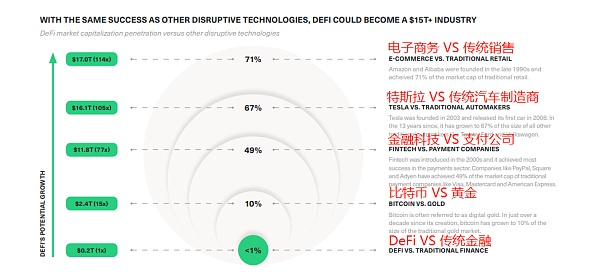
The first comparison DeFi faces is with Bitcoin, which is often compared to gold, with Bitcoin currently occupying 10% of the global gold market's valuation.
In 10 to 20 years, the most successful disruptive technologies have captured around 50% to 70% of existing corporate valuations. Examples in the chart include financial technology and payment processors (49% penetration rate), Tesla and other car manufacturers (67% penetration rate), and e-commerce and traditional retailers (71% penetration rate).
If DeFi can achieve a similar penetration of the traditional financial markets, it would make DeFi a $2 trillion industry. Of course, if DeFi is successful like other disruptive technologies, then this market size is just a rough estimate of the long-term potential DeFi can offer. Reality may be much more complex, in part because disruption not only takes market share from legacy players but also often influences the total market size.
What are the Risks of DeFi?
DeFi is a nascent technology and, likewise, comes with many risk factors that could have a significant impact on the long-term outlook of DeFi.
Dependence on and Interconnection with Traditional Systems
Some DeFi applications currently rely on the infrastructure and business operations provided by traditional finance (payments, bank accounts, credit cards, etc.). Cryptocurrency expert Nic Carter suggests that as stablecoins backed by commercial banks and held by financial institutions increase, a fragile connection point is formed between the traditional system and the decentralized system.
Technical Risks
The sophistication of blockchain and DeFi applications creates unknown technical risks. For example, since DeFi applications rely on the blockchain to validate transactions, there is infrastructure risk. If the underlying blockchain experiences downtime, the DeFi application itself may become inaccessible. Additionally, DeFi applications are open-source, meaning malicious actors can dissect their internal workings to find vulnerabilities to exploit. In the event of a technical or economic flaw, users deploying funds to a DeFi application face the risk of loss or theft, which is irreversible.
Centralization Risk
A criticism of DeFi applications is that they are not truly decentralized, as core developers can control or access the funds held within. If a subset of developers retains control, they may alter the application's underlying code and siphon funds in unexpected ways. To mitigate this risk, most DeFi applications only implement changes when there is a consensus among token holders on proposals for code changes or upgrades.
Regulatory Risk
In the short term, DeFi may face regulatory scrutiny around taxation, anti-money laundering, and other aspects. These regulations are necessary both to protect investors and to safeguard society from risks. Any emerging technology carries significant risks, so investors should expect appropriate regulatory oversight of DeFi, which may result in some DeFi applications being unable to comply with U.S. or other countries' regulatory frameworks and may be forced to cease operations.
Summary
Over the past 30 years, the global financial industry has lacked innovation, with high barriers and costs that have left existing companies with little reason or motivation to innovate. Financial technology has long been a promised but unrealized revolution, and despite significant risks and hype, our core financial infrastructure and daily lives have seen little change over the past few decades.
Decentralized Finance (DeFi) has addressed this issue. This low-cost, highly composable emerging industry is threatening the economic moats traditional financial institutions have long enjoyed. These DeFi applications operate in an agile manner that traditional financial institutions simply cannot compete with, while offering significant overall improvements to the global financial system.
In less than three years, DeFi has evolved into an ecosystem of over 534 crypto applications, providing financial services such as lending and asset management. To date, these applications have deployed over $212 billion in funds.
What was once a domain exclusive to crypto enthusiasts is now also capturing the attention of some of the world's largest traditional financial institutions. Consider that France's sixth largest bank, Société Générale, recently engaged in a $20 million transaction with DeFi application Maker, paving the way for new forms of collaboration between DeFi and traditional financial institutions.
With significant revenue streams and soaring growth rates, many DeFi applications resemble early-stage equities and are more favorable compared to them. These same characteristics can make DeFi applications easier for investors to grasp compared to crypto assets like Bitcoin.
The nascent DeFi industry faces an uncertain regulatory future, a common trait of highly disruptive technologies. Early pioneers of Web 2.0, such as Facebook, Apple, Amazon, and Google, also faced similar regulatory challenges and uncertainties in their early days but are now among the most valuable companies globally. Regulatory clarity will ultimately bring greater room for expansion to the DeFi industry, more capital inflows into the ecosystem, thereby driving growth.
The $152 billion total market value of the DeFi industry represents only a small portion of the $240 trillion global financial market. Drawing from the market experiences of other disruptive technologies, we believe that DeFi will gradually expand from this modest beginning to become a $15 trillion industry in the next 5-15 years.
While the industry still has a long way to go, like the early days of the internet and other disruptive technologies, the rapid growth of DeFi is too significant to ignore.
Original Article Link
Welcome to join the official BlockBeats community:
Telegram Subscription Group: https://t.me/theblockbeats
Telegram Discussion Group: https://t.me/BlockBeats_App
Official Twitter Account: https://twitter.com/BlockBeatsAsia