Dialogue Paradigm: How to become a better Crypto native?
Summary of Matt Huang's 12.02 Interview
原文来源: Joe Weisenthal
原文编译: 0xJsson
资金继续以飞快的速度涌入加密领域。但是,那些已经在Crypto领域待了一段时间的人获得了巨大的收益。加密领域领先的投资机构之一是 Paradigm,该机构成立于 2018 年的加密冬季。近日, Paradigm 再次宣布成立一个 25 亿美元的新基金,这是迄今为止筹集的最大的加密货币基金。彭博社与该公司的联合创始人 Matt Huang 谈论了 Paradigm 的独特公司架构,它对加密货币的愿景,以及他们对于未来市场的看法。
1、关于 Paradigm
Joe Weisenthal: What was the background of Paradigm?
Matt Huang: First of all, around 2018, Crypto is a very undervalued industry for traditional technology investment institutions. Most very smart people probably see Crypto as dogecoin or catecoin when they first see it, and exclaim that there isn't much substance to it.
As we spent more time with front-line protocol developers, we had a different perspective than traditional organizations. When I looked around at that time, there weren't many people I could really talk to, and I used to talk to Fred. Fred, who co-founded Coinbase in 2012, has spent years in crypto.
We thought, if we launch a crypto project, are there any investors that we really want to work with? I think at that point, the answer for both of us was no, so we created Paradigm. One of the biggest questions we faced was, how do you become a better native player?
Historically, in any new wave of technology, it's always easy to think analogically about innovation, like taking an old business model and putting it on a new platform (Facebook on blockchain, etc.), but the really important innovations are brought about by industry native players, And truly innovative applications cannot exist without new technologies. Take the Internet, for example. You can put the New York Times and other media online, but before the Internet, you couldn't do Wikipedia. In crypto, Uniswap's Permissonless AMM was impossible in the past, but now it's a reality based on blockchain.
That's the business model we're looking for. Therefore, in order to better become crypto native players, in the process of establishing Paradigm, we hope to build a team with a deeper understanding of the nature of the industry.
Joe Weisenthal: Yes, Paradigm has a lot of technologists. Often VCS like to write blogs or threads on Twitter to express their opinions. But I think Paradigm is unique. Your blog has a lot of technical content, and some of your colleagues seem to be inventing new financial products or finding new protocol loopholes all the time.
Matt Huang:I want to start by admitting that I don't think this is what most investment institutions look like. We want to work from a first-principles perspective. If we were founders, what kind of investors would we want to sit at the same table with? You know investors can always write Twitter Threads, but we wanted to go a step further, like writing contracts with projects. In the future, more and more organizations will be presented in the form of protocol, so it is inevitable that technical experts will be an important part of it, so technical personnel are an indispensable part for us.
Tracy Alloway: In addition to technologists, you recently tweeted something where you asked people if they were good at memes. What do you think of Meme?
Matt Huang:Meme is a practical element. In my opinion, modern marketing (especially for crypto projects) is often carried out through Twitter or meme. Meme promotes the development of culture in many aspects. So I think being good at meme is a very useful skill.
The reason for Elon Musk's great success is his ability to attract the best rocket engineers in the world. Meme has a similar quality to some extent. Although sometimes the narrative is silly, like Dogecoin, sometimes it can be an important catalyst for serious projects. And channel people's energy into specific, exciting projects.
Tracy Alloway: For funds, I'm very interested in the crypto industry. What are your exit methods? Obviously Coinbase went public, but there are a lot of agreements that don't go public.
Matt Huang:First, we tend to think less about quitting. We've only been in the industry for three years, whereas a lot of the top companies need 10 years or more to grow. Exchanges like Coinbase or other SaaS companies like them will go the traditional IPO route because they have a more traditional business model or corporate structure that just happens to serve the Crypto industry. Protocol-based projects tend not to go the IPO route in the long run.
Joe Weisenthal: How long will the new fund last?
Matt Huang:I don't think this fund is any different from any other venture capital fund.
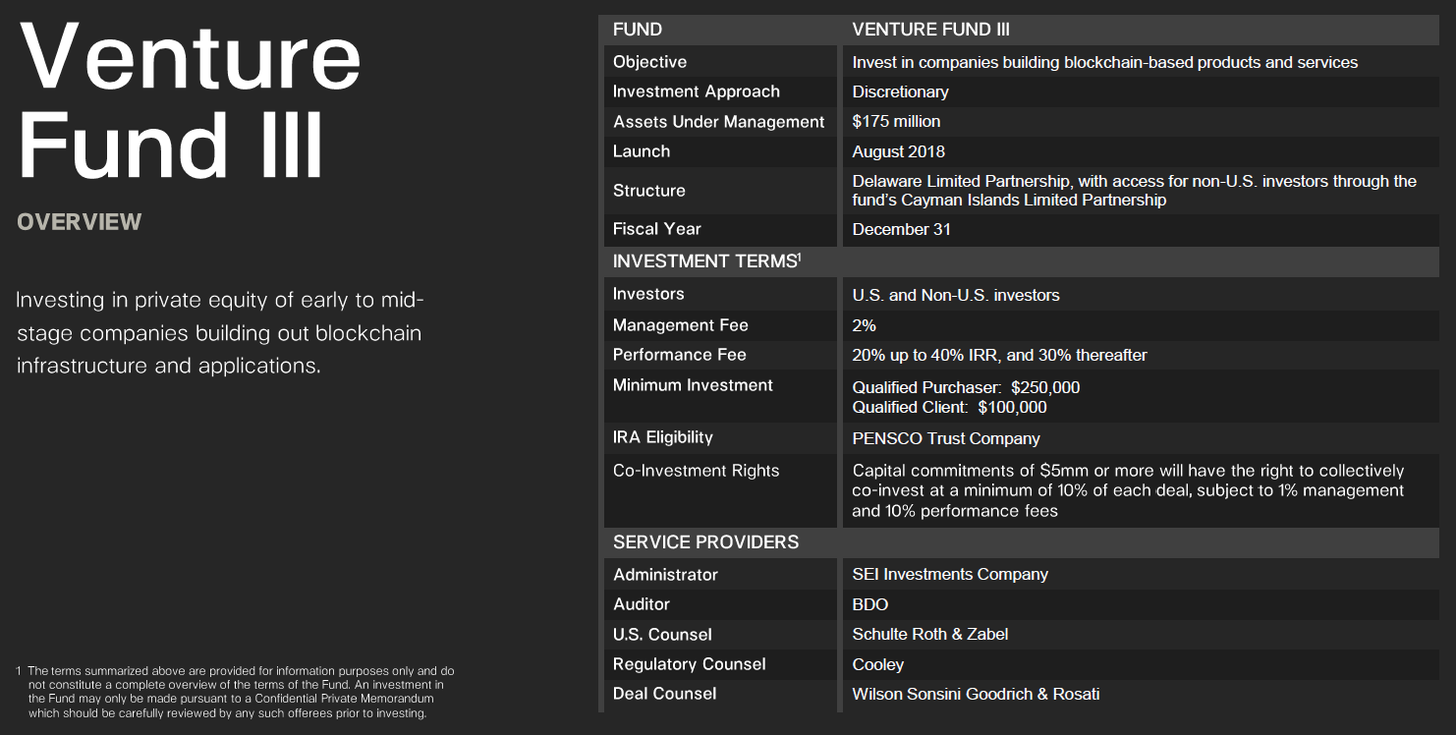
(FYI: Pantera Venture Fund III Terms Overview. On November 23, Pantera announced that it had raised $600MN Venture Fund IV.
2. New fund, investment direction and project evaluation
Joe Weisenthal: The new fund is $2.5 billion. What do you think is the biggest opportunity for crypto in the future? Where will your funds be invested?
Matt Huang:I think it's hard to predict the future, and we have to stay as close as possible to the developers on the front line to keep our eyes on the market. I think over the past year, Web3 has become very compelling. At the same time, on-chain gaming is a very competitive area.
First, the transaction value of digital assets in games has been proven over the decades, and it fits well with crypto's implementation of digital property. As you can imagine, in the past if a person played World of Warcraft for 10 hours a day and invested a lot of time, effort, and money into the game, most of the value would eventually go to the platform.
Today, however, we have reached a digital property crossroads, where crypto-based systems will no longer be arbitrary. We're seeing all the big and small studios in the game industry scrambling to understand how to do it in Crypto, which is the direction of the future.
Tracy Alloway: In terms of investment, many times you can choose to buy either equity or token. How do you choose to invest?
Matt Huanh:There's a question of which approach is better for today's cryptocurrency startups, and I think it depends on the startup, and the answer may be different.
Joe Weisenthal: How do you think about network effects between protocols when you invest?
Matt Huang:Network effects make sense in portfolios. If you look at incubators like Y Combinator, network effects are a very common element, and the first or top 100 clients of new YC startups tend to be other YC startups, which I think is a powerful flywheel for the overall portfolio.
Joe Weisenthal: How do you value projects?
Matt Huang:I think the crypto market has been a puzzle in terms of valuation. You know for other markets, valuation works in some cases, but in Crypto it's a hard thing to do.
So it's important to get into the project phase. We hope we can be the earliest investor in the project (as an aside, like Sequoia China: the earliest and most important investor in the project), partly because we believe we have built a team that can help the project from the earliest stage. Protocol is updated much more slowly than a website or app, so we think it's important to get things right up front, so we want to be involved from the earliest days. Still, there are some projects that we will miss out on, and we would love to be involved in the next phase.
3. Views on the market
Joe Weisenthal: The market is so crazy right now, there's a lot of OHM Fork projects and even Elon Musk projects, do you think that's going to have a negative impact on the crypto market?
Matt Huang:In a way they are neither good nor bad, they are part of the market. We certainly want more capital and talent to go into really great long-term innovations, but such speculation often goes hand in hand. People's attention eventually runs out during these fork projects and returns to long-term value.
Tracy Alloway: What do you think of the progress of Ethereum Scaling solutions?
Matt Huang:I think at this stage every solution has been explored and we are further along than we were two or three years ago. Scaling will continue to be a problem for years to come, but the fog of war that it has created will be lifted, scaling will no longer be the core issue holding back the industry, and there will be a clear and viable technology route.
The original link
Welcome to join the official BlockBeats community:
Telegram Subscription Group: https://t.me/theblockbeats
Telegram Discussion Group: https://t.me/BlockBeats_App
Official Twitter Account: https://twitter.com/BlockBeatsAsia
 Related Articles