Messari: New concepts to watch on DeFi

What new concepts are worth watching besides DeFi 2.0?
原文作者: Chase Devens,Messari Hub 分析师
Source: Crypto Voyage
After a long hiatus, DeFi has re-emerged as a major narrative in the crypto space. DeFi has once again attracted attention, primarily due to the controversial term "DeFi 2.0" coined by Scoopy Trooples, an anonymous developer at Alchemix Finance. In a recent tweet, Scoopy highlighted some second-generation protocols that build on the 0-1 innovations created by first-generation DeFi protocols like MakerDAO, Uniswap, Compound and Yearyearn. This classification raises controversy over the classification of DeFi protocols and diverts attention from the actual changes taking place behind the scenes. We saw a flurry of activity on Twitter time, with everyone asking questions about their favorite OlympusDAO fork project.
Rather than argue about naming things (DeFi 1.0 versus DeFi 2.0), let's take a step back and examine the macro themes driving the latest wave of DeFi innovation. A year ago, such reports would have covered trends in vampire attacks and distribution strategies. Today, in addition to discussing agreements to automate and enhance or extend the existing DeFi economic model, we will also explore the birth of liquidity as a Service (LaaS) protocols.
Liquidity means Service
Liquidity mining, the heart and soul of DeFi Summer 2020, has fallen out of favor recently as DeFi Protocols grapple with the consequences of employing capital providers to extract value from their systems. The liquidity mining model provides short-term incentives for liquidity providers and incurs permanent charges on the balance sheet of the agreement. As a result, projects realised they needed better systems to ensure sustainable liquidity while aligning long-term incentives for investors. As the problem became more known, the project began to focus on LaaS. Using LaaS providers, agreements can purchase their liquidity directly from the market, or lease liquidity from agreements designed to provide the best quality and affordable liquidity.
Olympus Pro
Olympus DAO was the first project to use innovative Bonding to create an alternative to the "liquidity mining" model. By issuing its native token OHM at a discount, Olympus was able to buy LP positions from the market to create "agreed-upon owned liquidity" (POL). The recent launch of the Olympus Pro service, which brings Olympus's Bonding model into the wider DeFi ecosystem, marked DeFi's first LaaS product.
Olympus Pro provides the customized implementation scheme of Olympus Bonding mechanism for the project, and also introduces new demand channels for its native tokens. Purchases of their liquid items will earn income from transaction fees, but will also bear contingent losses (IL) related to price changes. This approach may be best suited for large projects where token prices fluctuate less to minimize IL.
Tokemak
Unlike Olympus, Tokemak is a protocol designed specifically for liquidity provision. Broadly speaking, Tokemak will act as a decentralized market maker. Tokemak's native token, TOKE, represents tokenized liquidity and is used to influence the liquidity direction of the entire DeFi. Protocols receive TOKE rewards for "seeding" liquidity into the Tokemak ecosystem, and can influence the direction of liquidity by mortgaging their TOKE. Because liquidity is ultimately controlled by Tokemak, Tokemak retains transaction fees associated with controlled assets, but also bears contingent losses. From a protocol point of view, this approach is similar to fluid mining; The agreement was still to "lease" liquidity, but did not generate trading revenues and was not affected by IL. However, the protocol is rewarded with the native TOKE for liquidity participation, rather than introducing permanent costs to maintain liquidity.
Ondo Finance
In addition to revamping its core stablecoin Protocol, Fei Protocol recently announced plans to partner with Ondo Finance to provide DeFi with a cheap, short-term LaaS option. The protocol will be able to deposit their native tokens into the Ondo liquidity vault for a specified period of time, and the newly minted FEI will be matched with the deposit, which will then be sent to AMM for liquidity supply. Fei X Ondo's design is attractive for projects that want to generate on-demand liquidity without the upfront cost of obtaining liquidity at the other end. By providing the other half of the liquidity position, Fei charges a small fixed fee when the vault matures. Because the projects themselves act as liquidity providers, they are entitled to charge transaction fees, but also face the potential for volatile losses. At the end of the term, Ondo returns the token liquidity provided after deducting transaction fees (positive) and IL (negative). This strategy provides a new way for protocols to provide liquidity in a short period of time and at very low cost.
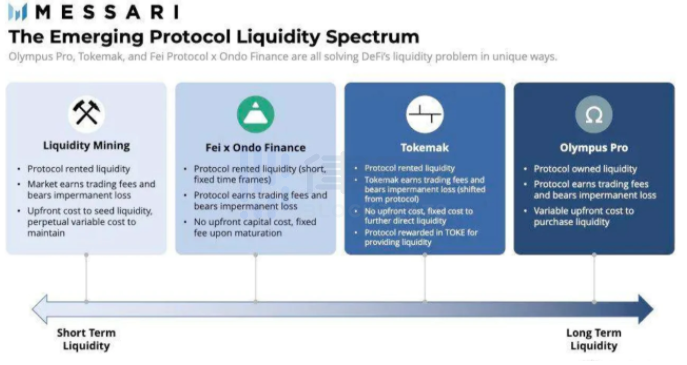
In general, LaaS providers are introducing ways to create sustainable liquidity for their agreements at a lower cost. While each option has its advantages and disadvantages, it is increasingly clear that LaaS is in the early stages of the process of moving the current system away from its reliance on liquid mining.
Second Order Protocols
The second category of projects reshaping DeFi are so-called "second-order" protocols. Leveraging DeFi's composability, these projects build on existing DeFi infrastructure to automate, enhance, or extend existing DeFi economic models and processes. Because they sit on top of existing monetary Legos, their utility comes at the cost of multiple risks.
Automata Automaters
The revenue-as a service platform created by Yearn gives the project an automation strategy to fit DeFi's other specialized functions: find a process that is time or gas inefficient and package it for a small fee, thereby making the ecosystem more convenient and efficient. There are several projects under construction to automate specific microprocesses in DeFi. Popsicle Finance uses assets as LP positions and manages liquidity positions across multiple exchanges and Layer1. Convex Finance recykes $CRV and Curve LP tokens to enhance rewards, transaction fees, and governance functions. While a slightly older project (in the crypto world), Pickle Finance offers automatic compounding for revenue aggregator vaults that lack the native ability to do so. The emergence of projects to provide automated services proves that if a particular problem is not fully resolved by a dominant protocol, new actors will step in to do the job.
Enhancer Enhancers
The first iteration of the DeFi protocol created several zero-to-one innovations that are now the building blocks of programmable financial systems. A few of the most prominent examples include Maker (mortgage debt position or CDP), Compound and AAVE (decentralized interest rate market), Uniswap (automated market Maker) and Yearyearn (return aggregator). Unlike these first-generation DeFi protocols, the model enhancer ** does not actually introduce any new operational models for DeFi. Instead, they recycle the output of existing protocols to provide a more optimized model for the end user.

Source: Abracadabra.money
One of the fastest growing projects of the past month, Abracadabra.money, is a great example of using model enhancer strategies to create CDPs from yielding assets. The CDP model was originally introduced by MakerDAO as a way to create permissionless credit systems. Users use a variety of over-mortgaged safes to mint the protocol's native stablecoin, Dai. A common complaint about Maker is that CDP's capital is inefficient because its assets are locked away in vaults earning no interest.
To improve the efficiency of the CDP model, Abracadabra minted its local stable currency, MIM, using existing earning assets as collateral. This not only puts users' idle assets to work, but also provides borrowers with a deeper level of liquidation support. As Abracadabra's collateral accrues interest and increases its face value, the probability of clearing declines over time, but never to zero. While model enhancers like Abracadabra don't introduce any new basics to DeFi, such projects find a product-market fit by improving capital efficiency.
Extender Extenders
Model extenders introduce zero-to-one innovations similar to those created by first-order protocols, creating new overall value for the entire system. Unlike their base-layer counterparts, these primitives are only implemented using the DeFi protocol of the stack.
Alchemix Financial Corporation is an example of a pattern extender. At first glance, Alchemix's use of CDP built on yielding assets looks very similar to Abracadabra. However, nuances have allowed Alchemix to create a capital-efficient, over-collateralized borrowing model that is impervious to liquidation. In the Maker/Abracadabra model, liquidation is always possible because the value of their collateral is denominated in a different underlying asset than the staboin issue.
Unlike Maker and Abracadabra's multi-collateral stablecoin, Alchemix's loans are synthetic versions of the underlying collateral so that they are denominated against the same underlying asset. For example, ETH loans are issued in the form of alETH, a synthetic asset linked to the price of ETH. This enables Alchemix to remove price risk from its model and ensure that there is no possibility of liquidation. As a result, full collateral can be put to use throughout DeFi to provide an ongoing source of loan repayment. While many refer to Alchemix as a "self-repaying loan," the true expansion is the ability to absorb opportunity costs (those imposed by the choice to spend or save).
Another set of pattern extenders took DeFi derivatives and deconstructed them into separate parts. Examples of such projects include Pendle and Tranche Finance. This optionality provides users with more customization and hedging strategies. Due to their high degree of innovation, the number of model extender groups is small compared to pattern automata and pattern enhancers. However, the unique nature of these projects can serve as the seed to create DeFi "killer apps" that will bring the masses to DeFi.
Composite risk
The remortgage used by pattern automata, enhancers, and extenders is not without cost. The composability of these second-order protocols leads to multiple (compound) risks that are no longer controlled only within the protocol. Second-order protocols also fail if the protocol that generated their input is attacked. This resulted in a house of cards structure, where any failure of the foundation pillars would bring the entire tower down. All other things being equal, the added value of second-order protocols is offset by the risk of composability. While many projects take a no-worries approach to marketing, it is important to understand that risk is more evident than ever in second-order agreements.
Other facts and conclusions
The above grouping does not cover all innovations in this field. That is, a protocol may be a groundbreaking innovation, but it does not fit into the above categories. One example is Rari Capital's Fuse product. Fuse takes Compound and AAVE's interest pool model and applies it at a granular level, allowing users to create an interest pool from any portfolio using a reliable price predictor. Although it does not operate as a LaaS provider and is not directly built on other protocols, it still provides meaningful innovation by introducing a permit-free interest pool structure.
LaaS providers and second-order protocols should also not be defined as features of "DeFi 2.0". In a field that's moving so fast, we shouldn't label things as simplistic. We can leave this work to future historians. With any luck, we'll have a whole year to go before the inevitable "DeFi 3.0" is resolved.
Welcome to join the official BlockBeats community:
Telegram Subscription Group: https://t.me/theblockbeats
Telegram Discussion Group: https://t.me/BlockBeats_App
Official Twitter Account: https://twitter.com/BlockBeatsAsia
 Related Articles