Vitalik Buterin reviews the first round of Optimism retroactive funding: What are the pros and cons of this new funding model?

Original title: Review of Optimism retro funding round 1
Original author: Vitalik Buterin, founder of Ethereum
Original translation: Kyle
Special thanks to Karl Floersch and Haonan Li for their feedback and review, and Jinglan Wang for the discussion.
Last month, Ethereum Layer2 solution development team Optimism conducted its first round of retroactive public goods funding, allocating a total of $1 million in funding to 58 projects to reward these projects for the excellent work they have done for Optimism and the Ethereum ecosystem. In addition to being the first major retroactive universal public goods funding experiment, it is also the first experiment with a new type of governance through badge holders (rather than a very small decision-making committee), and not a fully public vote, but a medium-sized group of 22 participants for quadratic voting.
The entire decision-making process is highly transparent from beginning to end:
· The rules that badge holders are expected to follow are documented in the holder instructions
· You can see the nominated projects in this spreadsheet
· All discussions between badge holders take place in a publicly viewable forum. In addition to Twitter conversations (such as Jeff Coleman’s post and others), all explicitly structured discussion channels are publicly visible: the #retroactive-public-goods channel in the Optimism Discord, and the Zoom call that was held. · The full results, along with the individual badge holder votes that entered the results, can be viewed in this spreadsheet.
Finally, here are the funding allocation results in a chart for ease of reading:

Much like the Gitcoin quadratic funding round and the MolochDAO grants program, this is yet another example of the Ethereum ecosystem becoming a key player in the design of innovative public goods funding mechanisms. But what can we learn from this experiment?
Analyzing the Results
First, let’s see if there’s anything interesting that can be analyzed by looking at the results. What do we compare these results to first? One of the most natural points of comparison is the other major public goods funding experiment we’ve conducted to date: Gitcoin quadratic funding rounds (in this case, Gitcoin Endowment Program Round 11).
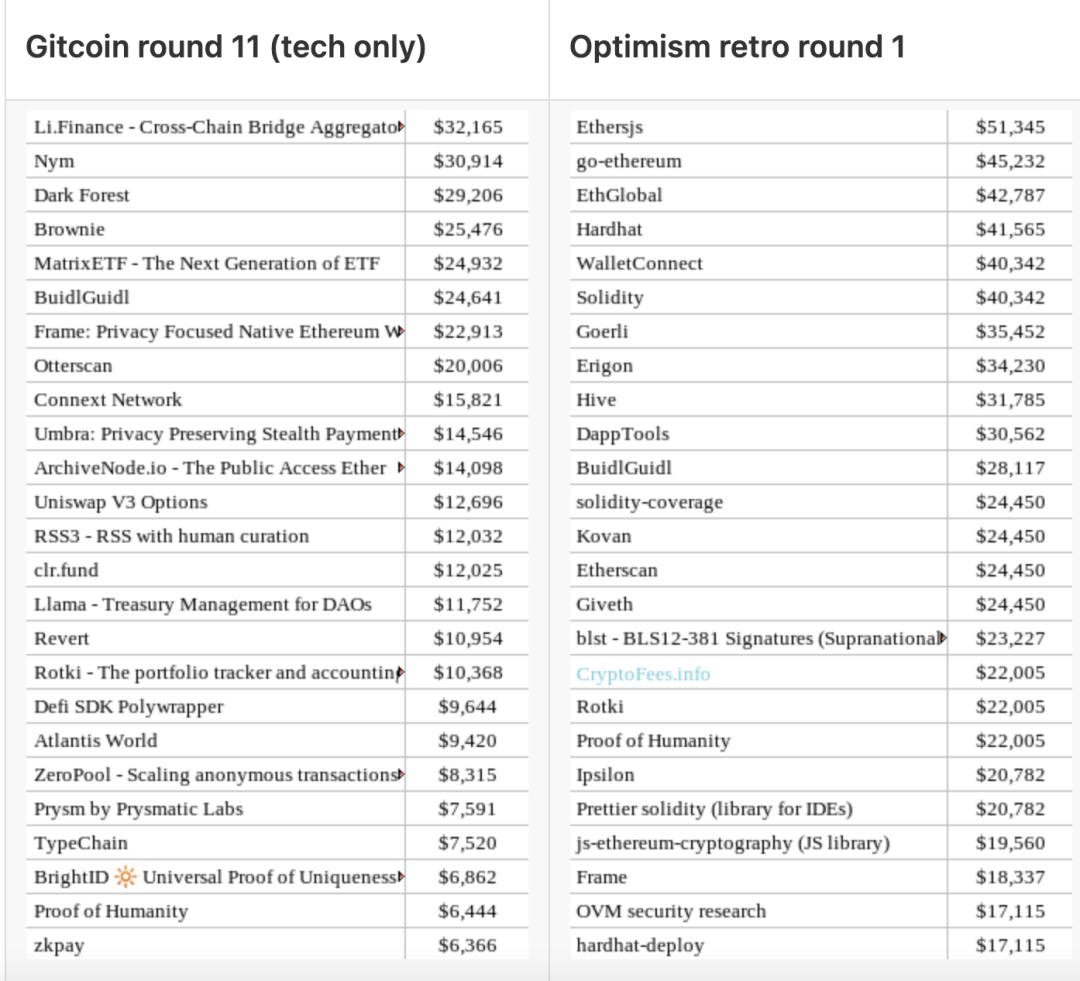
Perhaps the most obvious attribute of the Optimism retro funding results that can be seen without any comparison is the category of the winners: every major Optimism retro funding winner is a technology-focused project. There is nothing in the instructions for badge holders that stipulates this; non-technical projects (e.g., translations on ethereum.cn) definitely qualify. However, due to some combination of badge holder choice and subconscious bias, this round seems to be interpreted as being technology-oriented. Therefore, I’ve restricted the Gitcoin results in the table above to technology (“DApp technology” + “Infrastructure technology”) to focus on the remaining differences.
Some other major differences are:
· There is very little difference in the size of the grants received by projects in retro funding: the most funded project only received three times more than the 25th ranked project (actually, exactly three times), while in the Gitcoin chart that combines the two categories the gap is over 5x, and if you look at DApp Tech or Infra Tech the gap is over 15x respectively! I personally blame this on Gitcoin using standard quadratic funding () and retro funding without quadratics; perhaps the next retro funding round should only add quadratics.
· The winners of the retro round are more well-known projects: this is actually an expected result: retro rounds focus on rewarding projects that have already provided value, while Gitcoin rounds are open-ended and many contributions are in anticipation of value for promising new projects.
· The retro rounds focus more on infrastructure, the Gitcoin rounds focus more on more user-facing projects: This is of course a generalization, as there are a lot of infrastructure projects in the Gitcoin list, but in general, direct user-facing applications are more prominent. One particularly interesting result (or reason?) is that the Gitcoin rounds focus more on projects that appeal to subcommunities (e.g. gamers), while the retro rounds focus more on projects of global value - or less charitable projects, one particular subcommunity being Ethereum developers.
It is my own (and I admit very subjective) opinion that the quality of the retro round winner selections is somewhat higher. This is unrelated to the three differences above; the more general impression is that the specific projects that were selected as top recipients on the right are very high quality projects, to a greater extent than the top recipients on the left.
Of course, there could be two reasons for this: (i) a smaller but more skilled population of badge holders (“technical experts”) can make better decisions than the “general population”, and (ii) it is easier to judge project quality retrospectively than in advance. This brings us to an interesting question: what if most of the above findings can be summarized in a simple way, that is, the technical experts (eg. badge holders) are smarter, but the population (eg. Gitcoin funding participants) is more diverse?
Can we make badge holders and their outputs more diverse?
To better understand this question, let’s zoom in on a specific example already mentioned above: ethereum.cn. This is an excellent Chinese Ethereum community project (not the only one! See also EthPlanet) that has been providing a lot of Chinese resources for people to learn about Ethereum, including translations of many technical articles written by Ethereum community members.

Ethereum.cn webpage. Lots of high-quality technical stuff - although they haven't gotten the memo that they should rename "eth2" to "consensus layer". Minus ten retroactive bonus points for them.
What knowledge do badge holders need to have to effectively judge whether ethereum.cn is a great project, a well-intentioned but mediocre project that few Chinese people actually visit, or a scam? It's roughly as follows: · Ability to speak and understand Chinese · Integrate into the Chinese community and understand the social dynamics of that particular project · Understand enough about the mindset of both technical and non-technical readers to judge the usefulness of the site to them · Among the current US-focused badge holders, the number of people who meet these requirements is basically zero. Even the two badge holders who speak Chinese are US-based and not close to the Chinese Ethereum community. · So what happens if we expand the base of badge holders? We could add five badge holders from the Chinese Ethereum community, five from India, five from Latin America, five from Africa, and five from Antarctica to represent penguins. At the same time, we could also diversify in terms of expertise: some technical experts, some community leaders, some people who have joined the Ethereum gaming world. Hopefully, we'll get enough coverage that for every project that's valuable to Ethereum, we have at least 1-5 badge holders who understand the project well enough to be able to vote on it intelligently. But then we saw the problem: only 1-5 badge holders could sensibly vote on it.
I see a couple of families of solutions:
1. Tweak the quadratic voting design. In theory, quadratic voting has the unique property that there is little incentive to vote on projects you don't understand. Any vote you make takes away points you could use to vote on projects you understand better. However, the current quadratic voting design has a flaw: not voting for a project isn't a truly neutral no vote, it's a vote that gives the project nothing. I don't have a good idea yet on how to do this. A key question is: if 0 becomes a truly neutral vote, how much money can a project get if no one votes for it at all? However, this is worth more research.
2. Split votes into categories or subcommittees. Badge holders first vote to sort projects into buckets, and the badge holders in each bucket ("zero-knowledge proofs", "games", "India"...) then decide from there. This can also be done in a more "fluid" way through delegation - a badge holder can choose a number of other badge holders to decide their vote on a certain project, and they automatically replicate their votes.
3. Everyone still votes on everything, but more discussion is facilitated. Badgeholders who do have the domain expertise needed to evaluate a given project (or a single aspect of some given project) present their opinions and write a document or spreadsheet entry expressing their reasoning. Other badgeholders use this information to help them make up their minds.
Once the number of decisions to be made gets higher, we can even consider ideas like in-protocol randomization (e.g. the idea of incorporating solitary drawing into quadratic voting) to reduce the number of decisions each participant needs to make. Quadratic solitary drawing has a particularly nice benefit in that it naturally leads to large decisions for the group as a whole, and small decisions for small groups.
The Means Testing Debate
One of the key questions raised in the badgeholder retrospective funding review discussion was: should badgeholders consider whether a project has been well funded when choosing which projects to fund?
In a “regular” grant funding round, the reason to answer “yes” is clear: increasing a project’s funding from $0 to $100,000 will have a greater impact on its ability to get work done than increasing it from $10 million to $10.1 million. But the first round of Optimism retroactive funding is not regular grant funding. In retroactive funding, the goal is not to give people money in the expectation that the money will help them do future work. Rather, the goal is to reward people for work they’ve already done, changing the incentives of anyone working on the project in the future. With this in mind, to what extent should retroactive project funding depend on how much money a given project actually needs?
The Case for Prioritized Need
Suppose you are a 20-year-old developer who is deciding whether to join some well-funded defi project and hold a fancy token, or work on some cool open-source, completely public good that will benefit everyone. If you join the well-funded defi project, you will get a $100,000 salary and your financial situation will be protected. If you work on the public good project yourself, you will have no income. You have some savings, and you can make some money by working part-time, but it will be difficult, and you are not sure whether the sacrifice is worth it.
Now, consider two worlds, world A and world B. First, the similarities:
· There are ten people who are exactly like you who have the potential to get a retroactive reward, and there are only five places. Therefore, you have a 50% chance of getting a retroactive reward.
· There is a 30% chance that your work will propel you to moderate fame, and you will be hired by some company for better terms than the initial defi project (or even start your own project).
Now, the differences:
· World A (means-tested): retroactive rewards are concentrated on projects that did not succeed by other means
· World B (no means test): retroactive rewards are given regardless of whether the project was successful in other ways
Let's look at your chances in each world.

From your perspective as a non-risk-neutral person, a 15% chance of having two successes in World B is almost twice as likely as a 15% chance of having two successes in World B than a 15% chance of having two successes in World B where you are completely left out in the cold with nothing.
So if we want to encourage people in this hypothetical 20-year-old position to actually contribute, it seems prudent to focus retroactive rewards on projects that haven't already been rewarded by other means.
The Case Against Prioritizing Need
Suppose you're someone who contributes small amounts to many projects, or an investor seeding a public goods project in the hope of receiving retroactive rewards. In this case, your share of any single retroactive reward is small. Would you rather have a 10% chance of getting $10,100, or a 10% chance of getting $10,000 and a 10% chance of getting $100? It doesn't really matter.
Furthermore, your chances of getting a reward through retroactive funding may be very different than your chances of getting a reward through other means. There are countless stories on the internet of people who invested a large portion of their lives into a project when the project was non-profit and open source, saw the project go for-profit and succeed, and got nothing for themselves. In all of these cases, it doesn't matter whether retroactive rewards care about whether the project has need. In fact, they're better off focusing on judging quality alone.
Means testing has its own drawbacks. It would require badge holders to expend effort to determine how well-funded a project is outside of the retroactive reward system. This could lead to projects expending a lot of effort to hide their wealth and appear scrappy to increase their chances of getting more rewards. Subjective assessments of a grantee's need could turn into politicized assessments of a grantee's moral worth, bringing even more controversy to the mechanism. In extreme cases, a complex tax reporting system might be required to properly enforce fairness.
What do I think?
Overall, it seems like there is some prioritization of projects that don't find an advantage in their business model, but we shouldn't do too much. Projects should be judged first and foremost on their impact on the world.
Nominations
In this round, anyone could nominate a project by submitting it via a Google Form, and there were only 106 projects nominated. Now that people are convinced they have a chance to get paid thousands of dollars, what about the next round? What about a hypothetical future year when fees from millions of daily transactions pay into retroactive funding rounds and individual projects receive more money than today's entire round?
Some kind of multi-tiered nomination structure seems inevitable. It's probably not necessary to write it directly into the voting rules. Instead, we can think of it as a special way to change the structure of the discussion: the nomination rules filter out nominations that badge holders need to see, and anything that badge holders don't see will get zero votes by default (unless badge holders really care about bypassing the rules because they have their own reasons to believe that some project is valuable).
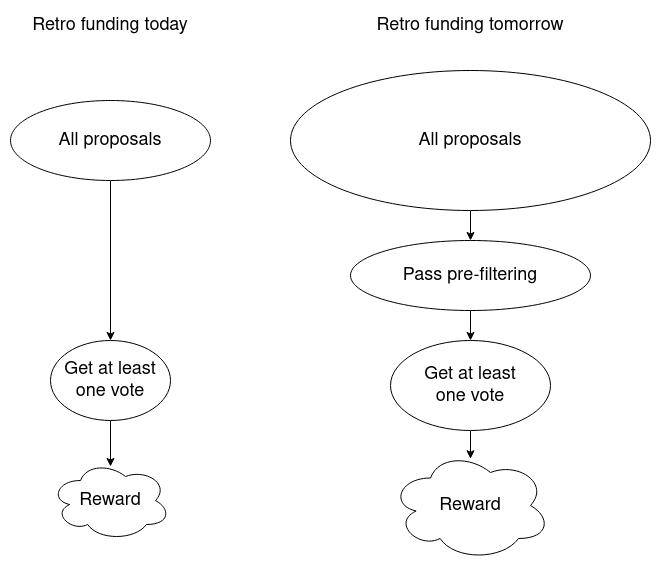
Some possible ideas:
Badge holder pre-approval: For a proposal to be visible, it must be approved by N badge holders (like N=3?). Any of the N badge holders can pre-approve any project; this is an anti-spam speed bump, not a gatekeeping subcommittee.
Require proposers to provide more information about their proposal, justifying it and reducing the work badge holders need to do to get it done.
Badge holders will also appoint a separate committee and entrust it to classify these proposals and forward those that follow the rules and pass the basic smell test of not being spamProposals must specify a category (e.g. "zero-knowledge proofs", "gaming", "India"), and badge holders who claim to be experts in that category will review these proposals and only vote if they choose the right category and pass the basic smell test.
Proposals require a deposit of 0.02 ETH. If your proposal gets 0 votes (or: if your proposal is explicitly considered "spam"), your deposit will be lost.
Proposals require a proof-of-humanity ID, with a maximum of 3 proposals per person. If your proposal gets 0 votes (or: if any of your proposals is explicitly considered "spam"), you cannot submit proposals again for one year (or you must provide a deposit).
Conflict of Interest Rules
The first section of the post-round RetroDAO discussion is a discussion of conflict of interest rules. The badge holder instructions include the following clause:
"6) No Self-Dealing or Conflicts of Interest RetroDAO governance participants should avoid voting to send funds to organizations where any portion of the funds is expected to go to their organization, their other projects, or anyone with whom they have a close personal or financial relationship."
From what I can tell, this is honorary. Badge holders are not trying to self-deal because they are (from what I can tell) good people and they know the stakes are on their reputation. But there are some subjective edge cases:
· Wording issues lead to confusion. Some badge holders are confused by the word "other": can badge holders use funds directly for their own primary projects? Also, the language of "sending funds to an organization that..." does not strictly prohibit direct transfers to oneself. These are arguably simple errors in writing this clause; the word 'other' should be removed and 'organization' replaced with 'address'. ·
· What if a badge holder is part of a nonprofit that itself provides grants to other projects? Can the badge holder vote for that nonprofit? The badge holder will not benefit, as the funds will be passed 100% to others, but they can benefit indirectly.
· What level of association counts as a close association? Ethereum is a tight-knit community, and the people who are qualified to judge the best projects are often friends with the team to at least some degree, or are personally involved in those projects precisely because they respect them. When do these associations cross the line?
I don't think there is a perfect answer to this. Instead, the line will inevitably turn gray and can only be discussed and refined over time. The main mechanism design adjustments that could mitigate it are (i) increasing the number of badge holders, diluting the fraction of them that can be insiders of any single project, (ii) reducing reward support for projects with only a few badge holders (my suggestion above to set rewards to 0 instead of 100 would also help here), and (iii) ensuring that badge holders can offset obvious abuse when they do show up.
Should badge holder votes be secret ballots?
In this round, badge holder votes are completely transparent; anyone can see how each badge holder voted. But transparent voting has a huge drawback: it's susceptible to bribery, including the kind of informal bribery that even good people can easily succumb to. Badge holders may end up supporting projects in part to win their favor. More realistically, badge holders may be reluctant to vote against projects even when there is a legitimate reason, because publicly voting against them can easily damage relationships.
The secret ballot is the natural choice. Secret ballots are widely used in democratic elections, where any citizen (or sometimes resident) can vote, precisely to prevent vote buying and more coercive forms of influencing how people vote. In a typical election, however, voting within executive and legislative bodies is usually open. The usual reasons for this have to do with theories of democratic accountability: voters need to know how their representatives vote so that they can choose their representatives and know that they are not completely lying about their values. But accountability also has a dark side: elected officials who hold open votes are held accountable to anyone who tries to bribe them.
Secret ballots within government bodies do have precedent:
· The Israeli Knesset uses secret ballots to elect the president and several other officials
· The Italian Parliament has used secret ballots in various contexts. In the 19th century, it was seen as an important way to protect parliamentary votes from monarchical interference.
· Before 1970, U.S. congressional discussions were less transparent, and some researchers have argued that the move toward greater transparency has led to more corruption.
· Jury voting is often done in secret. Sometimes, even the jurors’ identities are kept secret.
Overall, the conclusion seems to be that secret ballots in government agencies have mixed consequences; it’s not clear that they should be used everywhere, but it’s also not clear that transparency is a sure thing.
Particularly in the context of Optimism retroactive funding, the main specific argument I've heard against secret ballots is that it would make it harder for badge holders to band together to vote against other badge holders whose votes are clearly very wrong or even malicious. Today, if a few rogue badge holders start supporting a project that provides no value and is clearly a cash grab for those badge holders, other badge holders can see this and vote against it to counteract that attack. With secret ballots, it's not clear how this could be done.
I'm personally in favor of using fully secret ballots for the second round of Optimism retroactive funding (unless perhaps open to a small number of researchers without being public) so that we can see substantial differences in the results. Given that badge holders are currently small and tight-knit, dealing with rogue badge holders may not be a major issue, but it will be in the future; so coming up with secret ballot designs that allow for counter-votes or other alternative strategies is an important research question.
Additional ideas for structured discussion
Badge holder participation was very uneven. Some (notably Jeff Coleman and Matt Garnett) put a lot of effort into their participation, publicly articulating their detailed reasoning in Twitter threads and helping to build calls for more detailed discussion. Others participated in the discussion on Discord, and still others simply voted and did little else.
A choice was made (ok, I was the one who suggested it) that the #retroactive-public-goods channel should be readable by all (it’s in the Optimism Discord), but that only badge holders should be able to speak, to prevent spam. This reduced the ability of many people to participate, especially ironically my own (I’m not a badge holder, and my self-imposed Twitter quarantine only allows me to tweet links to my own long-form content, which prevents me from participating on Twitter).
These two factors combined meant that there wasn’t as much discussion; certainly less than I’d hoped. What are some ways to encourage more discussion?
Some ideas:
· Badge holders can vote in advisors, advisors cannot vote but can speak in the #retroactive-public-good channel and other badge holder-only meetings.
· Badge holders may need to explain their decisions, such as writing an essay or paragraph for each project they voted for.
· Consider compensating badge holders, either through an explicit fixed fee or by making badge holders who make outstanding contributions to the discussion eligible for rewards in future rounds.
· Add more discussion formats. If the number of badge holders grows and there are groups with different specialties, there could be more chat rooms, each of which could invite outsiders. Another option would be to create a dedicated subreddit.
It might be a good idea to start experimenting with more ideas like this.
Conclusion
Overall, I think the first round of Optimism Retroactive funding was a success. Many interesting and valuable projects were funded and a lot was discussed, even though this was only the first round.
There are a number of ideas that could be introduced or experimented with in subsequent rounds:
· Increase the number and diversity of badge holders, while making sure there are solutions to the problem of only a few badge holders being experts in any single project area.
· Add some kind of two-tier nomination structure to reduce the burden of decision-making faced by the entire badge holder base.
· Use secret ballot
· Add more discussion channels, and more ways for non-badge holders to participate. This might involve overhauling how existing channels operate, or it might involve adding new channels, or even specialized channels for specific project categories.
Change the reward formula to increase variance, from the current
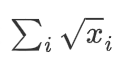
to the standard quadratic funding formula

In the long run, if we want retroactive funding to be a sustainable system, there is also the question of how new badge holders are selected (and how badge holders are removed in the case of malfeasance). Currently, selection is centralized. In the future, we need some alternatives. One possible idea for round 2 is to simply allow existing badge holders to vote for some new badge holders. In the long run, to prevent it from becoming an isolated bureaucracy, perhaps one badge holder could be selected per round through a more open participatory approach, such as proof-of-humanity voting?
Regardless, retroactive public goods funding remains an exciting new experiment in institutional innovation in many ways. It’s an experiment in decentralized governance that is not token-driven, and it’s an experiment in making things happen through retroactivity rather than active incentives. For the experiment to fully work, more innovation is needed in both the mechanism itself and the ecosystem that forms around it. When will we see the first angel investor focused on retroactive funding? Whatever ends up happening, I look forward to seeing how this experiment develops over the next few rounds.
Original link
Welcome to join the official BlockBeats community:
Telegram Subscription Group: https://t.me/theblockbeats
Telegram Discussion Group: https://t.me/BlockBeats_App
Official Twitter Account: https://twitter.com/BlockBeatsAsia
 Related Articles