ZkRollup: Ethereum expansion track pattern
Original title: "zkRollup track, what's the future?"
By Alex Beckett, Bankless& NBSP;
原文来源:Unitimes
Ethereum has always faced challenges in implementing scalable solutions. After years of development, the Ethereum developer community has shifted to a rollup-centric roadmap.
However, not all Rollups programs are the same. Currently, two Rollups including Optimistic Rollups and zkRollups are mainly included. Today, we are going to talk about it. ZkRollups.
Currently, the two leading competing teams in the zkRollup space are. Matter Labs And & have spent StarkWare. The competitive weight of the Matter LABS team is. ZkSync 1.0 & have spent And & have spent ZkSync 2.0; And StartWare's team is competing against it. StarkEx And & have spent StarkNet.
Let's dig into and compare these projects. But first, let's take a quick look at what a Rollups is.
Attention! As the network continues to evolve and be used further, the information about each network mentioned in this article will change.
01. Background knowledge of Rollups & NBSP;
Rollups is a scalable solution that is validated by bundling together and compressing transactions in the Rollups (L2) network and then sending them to a consensus layer (such as the Ethereum L1 main network). By validating multiple transactions at once, this increases network efficiency and increases capacity by increasing the number of transactions that can be executed.
In this way, suddenly Ethereum could go from 15 TPS (transactions per second) to 3000+ TPS without sacrificing security.
In particular, zkRollups are unique compared to Optimistic Rollups in their ability to incorporate privacy into Rollup using zero-knowledge proof techniques. Zero-knowledge proof technology achieves privacy by allowing one party to prove something to another without disclosing the information necessary to prove it. However,Not all zkRollups solutions take advantage of the privacy attributes of zero-knowledge technology.
ZkRollups takes advantage of economies of scale, i.eMore transaction users make the Internet cheaper to use. This is in contrast to typical L1 blockchain networks, such as the current Ethereum network, which become more expensive as network usage increases.
This new and innovative dynamic between Rollups and Ethereum is called"Modular blockchain".
02. ZkRollups on the main network
1) StarkEx
StarkEx Is & have spent StarkWare One the team launched in June 2020.ZkRollup scheme, support universal smart contracts & NBSP; (Generality here means that smart contracts have the ability to run arbitrary logic). The application canDeployed on StarkExTo take advantage of the scalability benefits of zkRollup while providing a user experience similar to, if not better than, the Ethereum network.
StarkEx has handled 42 million transactions to date, hosting four protocols --   DYdX, Immutable X, DeversiFi And & have spent Sorare -- $185 billion in cumulative transactions.
Above: Sorare Is an NFT marketplace that allows football fans to trade NFTs cards of their favorite stars.
With the heavy use of applications deployed on StarkEx, the StarkEx network has proven itself to have transaction speeds in excess of 9,000 TPS and transfer speeds of 18,000 TPS. Given that the transaction speed of the Ethereum main network is around 15 PTS, this means that StarkEx is about 600 times more scalable. In addition, StarkEx at its peak contained a whopping 13,500 transactions in a single lot.
Since Rollups are deployed on Top of Ethereum, this means that the transaction fees they pay for their transaction lots are also limited by the limitations of Ethereum L1. So, in addition to zkRollup mode, StarkEx also introduced a new model called Validium The new system provides a cheaper option for applications and users using the system.
Validium's mechanism is very similar to zkRollup's, the only difference being that zkRollup's data availability is on-chain, whereas Validium's data availability is off-chain. This allows Validium to achieve fairly high transaction throughput. -- Alex Gluchowski
In the StarkEx expansion project, dYdX chose ZkRollup mode & have spent (on-chain data availability), while DeversiFi, Immutable, and Sorare are optional. Validium mode & have spent Off-chain data availability.

Above: Ethereum co-founder Vitalik gives an overview of the major L2 solutions and their data availability in this table.
Validium's transaction fees are cheaperIn fact, those transaction fees have been siphon off by the StarkEx agreement.
For example, Validium schema with StarkEx; Immutable X Such is the case, casting and trading NFTs on Immutable X. Gas costs $0; By comparison, Gas costs for NFT trading on Ethereum range from $20 to $50. Similarly, decentralized exchanges. DiversiFi It's also available. $0 Gas fee, which allows the exchange to offer a fee structure similar to a centralized exchange. StarkEx also offers & NBSP; SHARP Functionality that allows Rollup transaction batches from multiple applications to be aggregated into a single transaction batch and published to Ethereum at once.
This feature is already available in both DeversiFi and Sorare protocols, allowing both to further reduce costs for users.
2) zkSync
zkSync Is & have spent Matter Labs One that the team put out. ZkRollup is a scalable payment scheme that allows users to deposit funds into the network and make low-cost transfers with other zkSync accounts at a fraction of the cost on the Ethereum network. The zkSync network has handled 4 million transactions since the mainnet went live in June 2020, with transfer fees as low as $0.20.
ZkSync transactions can be paid with any supported token (ETH, DAI, RAI, etc.) or with the token being transferred, eliminating the need for the user to hold a specific token in order to pay the transaction fee.
At the time of writing, TVL (total lock-up value) deposited in zkSync network was $24 million. To date, the highest transaction volume on the zkSync network was during a Gitcoin grant round, which peaked at 20,000 transactions per hour, or 5.6 TPS. Although that was much less than StarkEx's 18,000 TPS, it lasted a full hour. In July, zkSync also added a target for. NFTs , including the casting, exchanging, transferring and withdrawing of NFT to ethereum network.
Above: ZKNFT Is a proof-of-concept NFT marketplace built to demonstrate the NFT capabilities of the zkSync network.
All NFTs metadata is uploaded to IPFS and the casting/transaction cost of NFT is only about $0.25. Although zkRollups There doesn't need to be a waiting period for withdrawals to the ETHEREum L1 main network like Optimistic Rollups does, but. ZkRollups does wait for the block to fill before sending to L1. In practice, this means that withdrawals from zkRollups can take hours if volume is low.

The table above compares zkSync and StarkEx's cumulative trading volume, total lock-up value and weekly trading volume for the week of October 1-7.
03. ZkRollups deployed in the test network;
1) StarkNet
StarkNet Is the next Iteration of zkRollup the StarkWare team is working on, with an Alpha mainnet scheduled for release this month. This will make StarkNet the first fully composable zkRollup network to support universal smart contracts, something that was thought to be years away. Composability refers to the ability of applications to collaborate, build on, and connect with each other.
So far, zkRollups with smart contract capabilities, such as StarkEx, don't have the ability to make applications composable. StarkNet's beta network went live and supported universal smart contracts in June and composability began in August.
There is no license requirement to deploy applications on the test network, so anyone can write smart contracts and publish them on the test network using Cairo, the native programming language of the StarkNet network. The StarkWare team also worked with dOrg to provide a simple DEX (decentralized exchange) to demonstrate StarkNet's capabilities, as shown below:
Screenshots: https://amm-demo.starknet.starkware.co/swap
To provide a developer experience similar to ethereum's, the Nubia team at Ethereum client Nethermind has been working on it. Warp (a translator for translating Ethereum Solidity smart contracts into Cairo contracts), the team has demonstrated the ability to Warp Ethereum EVM code into StarkNet contracts.
The permission-free environment in which StarkNet tests the network has enabled fruitful experimentation. Twitter user Guiltygyoza also demonstrated physics simulations on the StarkNet test site (see below), opening the door to building primitives to support the game.

Tweets: https://twitter.com/guiltygyoza/status/1450161069058560000?s=20
2) zkSync 2.0 & have spent
ZkSync 2.0 & have spent Is the next version of the original zkSync network and aims to support fully composable smart contracts on zkRollup. The zkSync 2.0 beta network was launched in early October, and the first applications deployed on the beta network are. The Curve of Finance. See below:

ZkSync 2.0 also introduced a new one for the first time. zkEVM Test network. ZkEVM is a virtual machine that simulates the Ethereum environment and allows Ethereum smart contracts to be deployed on top of zkRollup. In October, the zkEVM Testnet announced the first application to be migrated to the testnet. UniSync (bifurcated version of Uniswap V2) to demonstrate the capabilities of the network.
UniSync has processed more than 590,000 transactions on the beta network since its launch in October. However, all of zkSync's test networks are currently in closed beta, allowing only whitelisted applications to be deployed.
04. Road Map & NBSP;
A roadmap is important for a project in defining future goals and simplifying the journey. Both StarkNet and zkSync 2.0 have a roadmap showing their goals, and both are moving toward the ultimate goal of becoming a fully decentralized system that provides security and stability to users.
1) StarkNet
StarkNet's roadmap has four main steps: & NBSP; Step 0: basic stage (completed) Step 1: Platnets (planets) : single application Rollup (completed) Step 2: Constellations (constellation) : more than application RollupStep 3: Universe (the Universe) : Become a decentralized Rollup network. As shown below:
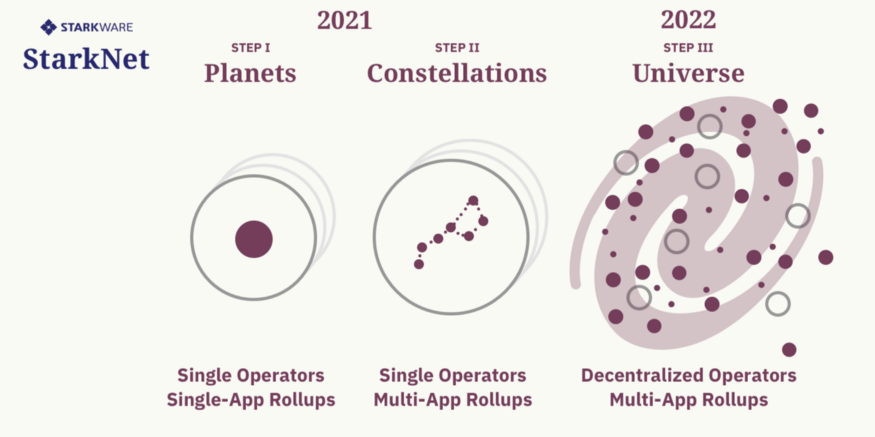
The first step isLay the foundation for StarkNet constructionThis includes. Cairo Programming languages and NBSP; SHARP Feature, allowing developers to build smart contracts using a zkRollup specific optimization language while sharing costs.
Step 2 is the phase that the StarkWare team is currently building, and this phase will follow. This will be completed with the launch of StarkNet mainnet in November, which will also mark the launch of StarkNet as a fully composable zkRollup network that supports universal smart contracts.
The last step is. StarkNet becomes a fully decentralized, permissionless Rollup network. StarkNet will not complete this step when the mainnet goes live, as the system will still be in alpha testing when the mainnet goes live in November to ensure that any bugs can be mitigated without damaging the system.
StarkNet is cutting-edge technology and its security will take time to be battle-tested. In the initial mainnet release, StarkNet will run a unique sequencer & NBSP; (Sequencer), and there are smart contract deployments requiring permission.
But once the StarkWare team determines that the StarkNet network is secure enough, the network will be decentralized, so that any parts that were previously run only by the StarkWare team will be converted to permutation-free access.
2) zkSync
The first phase of the zkSync roadmap begins. Deployment of zkSync 1.0, which is to deploy a zkRollup network focused on scalable payments.

The second phase of the zkSync roadmap is planned in a project called. ZkSync 2.0 & have spent The new network that supports composable smart contracts is expected inSometime in the next few monthsPublish it on the main network. In addition, one is called Zinc The new programming language will be used as the native language of the zkSync 2.0 smart contract.
ZkSync 2.0 will also be introduced. ZkPorter, which allows zkSync 2.0 users to post transaction data to zkPorter (below the chain). Not ethereum (on the chain). PoS chain, which enables higher transaction throughput. Since zkPorter transactions are not subject to ethereum transaction fees, zkPorter is expected to be a cheaper alternative.
Phase three will introduceprivacy, which unlocks another well-known property of zkRollups. This will be done when the zero-knowledge proofs (ZK proofs) do not add a lot of cost to the system.
The final phase involves transitioning zkSync 2.0 to anti-resistanceReview sex, which would require the system to be decentralized and make it permission-free by removing any control Matter Labs has over the network.
05. Conclusion & have spent
Both the StarkWare team and the Matter Labs team are committed to providing cutting-edge networks in the form of zkRollups, both of which are pushing the boundaries in terms of blockchain scalability, privacy and efficient cryptography.
In terms of the networks you can use right now, Four apps have been launched: DyDx and DiversiFi For transactions, ImmutableX and Sorare for NFTs; zkSync It is suitable for simple payment and introduced NFT function through ZKNFT market.
In both scenarios, though, StarkEx significantly outperforms zkSync in terms of usage and performance. Given that StarkEx has handled a cumulative volume of $185 billion and offers a verifiable trading capacity of 9,000 TPS, this makes it possible for StarkEx to handle a cumulative volume of $185 billion and provide a verifiable trading capacity of 9,000 TPS. StarkEx It is not only the most used zkRollup, but also the most traded Rollup Its transaction volume is more than 10 times that of zkSync, Optimism and Arbitrum. Along with & have spent StarkNet Coming to mainnet this month, the StarkWare team is launching a fully composable zkRollup that supports universal smart contracts, something many thought was years away.
Finally, keep an eye out for StarkNet and zkSync 2.0 mainnet versions, because that's what we knowThe future of blockchain expansion.
The original link
Welcome to join the official BlockBeats community:
Telegram Subscription Group: https://t.me/theblockbeats
Telegram Discussion Group: https://t.me/BlockBeats_App
Official Twitter Account: https://twitter.com/BlockBeatsAsia
 Related Articles