The CryptoPunks, Meebits and the team behind them: only two NFT hot style makers
Comment: 0x13, beat BlockBeats
On May 4, the sleepy NFT space came roaring back to life when Larva Labs launched their third NFT project, Meebits.
Meebits will be sold on the Dutch auction model, with a starting price of 2.5ETH and a gradual decline after a period of no transaction volume. However, under the Larva Labs brand, Meebits sold out in a short time, with an average price of 2.4ETH.
In just three days, the total value of Meebits sold on the secondary market reached 12,000 ETH, or about $42 million, much higher than the seven-day sum sold on the CryptoPunks, the most popular NFT collectibles. OpenSea's trading volume hit an all-time high of $23.137,500 on the day.
Great oaks from little acorns grow.
One might wonder why Larva Labs came to be, why its NFT programs are so popular, and why its NFT programs are so popular in today's confusing and chaotic NFT market.
Before turning cocoon into butterfly
After launching CryptoPunks, Larva Labs, which means "Larva lab" in Chinese, was a software company specializing in mobile apps for the iPhone and Android before the larvae turned into butterflies. The company wasn't very big, just two people, John Watkinson and Matt Hall.
John and Matt go way back. They entered the University of Toronto in 1994 to study computer science. After graduation, Matt worked as a software engineer at Agency.com, Modus, and Columbia University Medical Center. John, on the other hand, went on to pursue further education. Seven years after completing his master's degree in computer science at the University of Toronto, he went on to get a PhD in electrical engineering and genetics at Columbia University.
In 2005, the two decided to start a business and started Larva Labs together. At the time, when the Internet was just a few years old, they defined Larva Labs as a "small mobile independent software developer," focusing on developing apps. As the iPhone took smartphones to new heights in 2007, so did mobile apps.
At the time, Larva Labs had made some hot style mini-games, such as Trism, a game that had sold $250,000 in its first two months on Apple's App Store.

Like many developers, the founders of Larva Labs had their own complaints about the problems of a centralized platform as they tried to find their niche. They could never have imagined that, more than a decade later, they would make nearly $80 million in a single day on a decentralized project.
The birth of CryptoPunks
For John and Matt, 2017 is probably the most important year of their lives.
In early 2017, John built a "Pixel Character Builder" that they've been able to use to create cool pixel character avatars. But at first they didn't know what they were going to do with the generator, creating characters for a new game? It's a little boring, but what else can you do? Their ideas were proposed and rejected one by one until they learned about blockchain, Ethereum.
John and Matt finally decided to put these pixel heads on the blockchain so that their uniqueness could be verified and they could be owned, and the pixel heads inspired by the 20th-century crypto-punk movement became a real collectible. And time has proved them to be right.
"This is an experiment." "They were very nervous about whether the idea would work, whether the technology would work, whether people would accept virtual collectibles," Matt says.
The ERC-721 and ERC-1155 standards that are now widely used in the NFT space had not yet been created, the Ethereum community was in its early days, and there were very few replies on Solidity development and on the Stack Overflow forums. So all they can do is make changes to the ERC-20 standard.
So they had to cross the river by feeling the stones,Sure enough, they made a huge mistake.
In the beginning, John and Matt kept 1,000 cryptopunks for themselves and gave away all the others for free, and all the cryptopunks were claimed in about a week. When the primary market closed, the secondary market began to trade.
John and Matt have embedded the trading market in the smart contract, and they want to make it easy for users to trade their CryptoPunk. In their vision, one user wants to buy a certain CryptoPunk at a price of 1ETH, and another user places an order of 1ETH to sell the CryptoPunk. A smart contract would do the deal on its behalf, and everything seemed to flow smoothly.
Until one day, a user tweeted: "I sold my CryptoPunk for 1ETH, but I didn't get paid for it."
John and Matt start to check the smart contract and find out that the problem is that the smart contract does not allocate the buyer's money to the seller, but instead distributes it back to the buyer. That is to say, after spending 1ETH, the buyer can not only get Cryptopunk, but also get back the 1ETH he spent.
Before that, people were very optimistic about Cryptopunk, and were proud of having a Cryptopunk, but such a bug was nothing short of catastrophic.
Contracts find problems, fix them. However, making sure everyone gets their own Cryptopunk requires rerun of countless transactions and thousands of dollars in Gas fees for John and Matt, which is a lot of money. More difficult is whether they can still be trusted by the community after what has happened, and whether members of the Cryptopunk community will continue to recognize the value of Cryptopunk.
Nervously, John and Matt tell the community about it, admit the mistake they made, and tell the CryptoPunks that they need to move to the new smart contracts. Surprisingly, no one objected. Everyone was in favor of it and chose to continue supporting it. "No one complained that 'I only accept the old smart contract.'" John and Matt were so happy that they really felt the strength of the community.
The problem was solved very quickly, and John and Matt added a new feature called "Bid", where people could bid on a CryptoPunk, the buyer's money would be stored in a smart contract, and when the seller accepted the bid, the transaction would take place immediately, Each CryptoPunk has its own niche market.
After that, the well-known story goes, CryptoPunks were exhibited offline in Zurich and soon sold out, with a record sale of 4,200 ETH on the secondary market (about $7.5 million at the time), and went on sale at Christie's and Sotheby's auction houses in the second quarter of 2021.

"We're artists now, I think."
Larva Labs' second project isn't quite as famous as Cryptopunks, but it's also an example of John and Matt's ingenious creations.

The project is called Autoglyphs, a blockchain character generation art NFT project. Unlike Cryptopunk, where each NFT has a concrete pattern, Autoglyphs is far more abstract, with seemingly simple, cluttered characters hiding hidden secrets.
This series of artworks was inspired by the work of generative artists Michael Noll and Ken Knowlton in the 1960s, when computers had limited storage capacity, so they had to piece together a work of art from these simple characters.

Michael A Noll, Computer Composition with Lines, 1964
What John and Matt want to challenge is not computer storage capacity, but block storage capacity.
When creating Cryptopunk, they chose to store their image files on Larva Labs' off-chain server rather than on the chain, which was not tamper-proof but easily avoided block storage capacity issues.
This time, though, John and Matt want to experiment with storing Autoglyphs on the blockchain. Traditional JPG or PNG image files are too large, so they have to choose characters instead.
"The constraints of having to write a lean but efficient piece of code, and having to produce a small amount of data or text, used to hold us back." John and Matt tried and tried to create countless generators, rewriting their code into smart contracts, before finally finding one that worked best, but even then, the transaction fees were still prohibitingly high, and the Ethereum block Gas Limit at that time was 8 million. It costs them $3 million to generate an Autoglyphs NFT. Even so, they chose to go ahead.
Strictly speaking, what is stored on the blockchain is not an image, but just a piece of code that runs to produce an image when you want to see it.
According to John and Matt, the Autoglyphs NFT is a homage to the generative artists of the 60s and 70s, and when they launched Cryptopunk and began exploring the digital realm, they found that the art of that era didn't get much attention or appreciation. This is a most regrettable thing.
In an interview shortly after the launch of Autoglyphs, John was asked by the host what they were now, or were they "small mobile independent software developers". "I think we're artists now," he said.
Hello, meta-universe
From Cryptopunk, which symbolized the crypto-punk movement and exploded the crypto world, to Autoglyphs, which paid tribute to the generative art of the 1960s, John and Matt have always depicted the world and spirit they love and respect in their own way. And their third project, Meebits, represents their passion for the meta-universe.
Meebits was already getting a lot of attention even before it was officially launched. True Ventures partner and prominent investor Kevin Rose tweeted about the project: "I just saw an early preview of the next NFT project that CryptoPunks producer Larva Labs will launch, and for goodness sake, get your ETH ready."

That certainly raised expectations for the project, and it proved to be worth it.

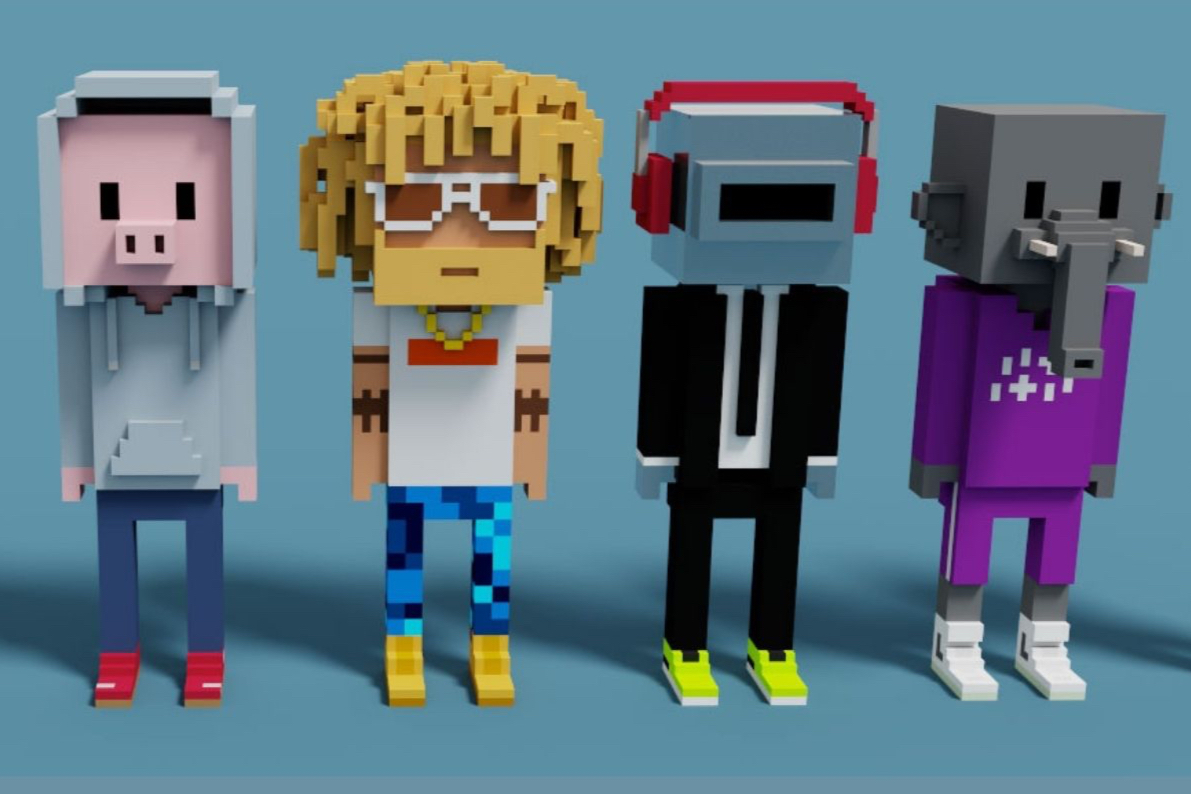
Meebits are more like an "upgraded version of CryptoPunks", which went from pixel heads to voxel puppets. In addition to the various elements and rarities commonly used in a series of NFT collectibles, Meebits attracted countless users to go after them. But if only this change, it is not enough to say that this is an excellent, innovative work, more importantly, in the past these static "ornaments" in this time can actually move.

These free-roaming little figures will be able to fit into any meta-universe. The meta-universe is arguably the hottest concept in recent memory. It is considered to be the next form of the Internet and the virtual world where people will socialize, play, work and live in the future. And in this virtual world, it would be super cool to have a "skin" for the Meebits character.
Larva Labs, a pioneer of NFT, opened the door of the NFT world for people through CryptoPunks. At the same time, Larva Labs have been doing what they really want to do, describing the world they love through one work after another. From cryptopunk to generative art to the meta-universe, it's unclear where Larva Labs will target their next series of works, but there's no doubt they'll continue to create valuable collectibles dedicated to Gen Z and all digital natives.
Welcome to join the official BlockBeats community:
Telegram Subscription Group: https://t.me/theblockbeats
Telegram Discussion Group: https://t.me/BlockBeats_App
Official Twitter Account: https://twitter.com/BlockBeatsAsia
 Related Articles