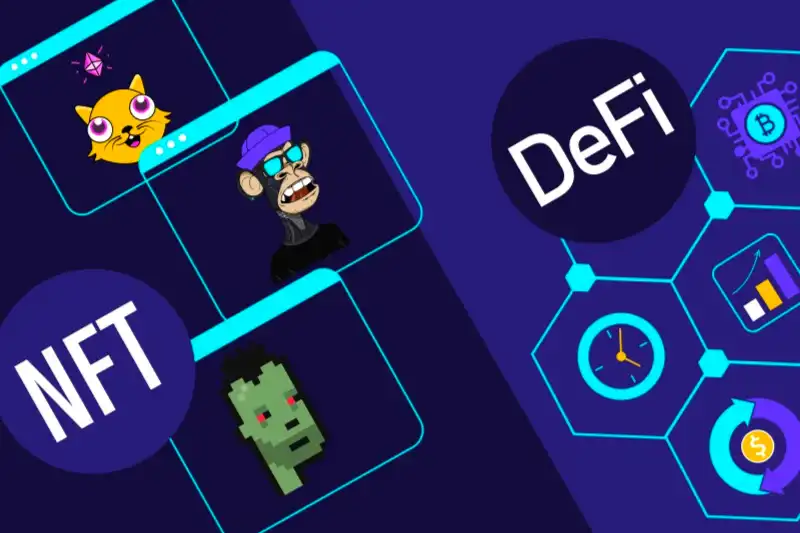
Getting NFT flowing, how does the NFT20 protocol make it easier for ordinary users to complete transactions?
"Understanding the NFT Derivatives Trading Protocol NFT20 in Five Minutes: Making it Easy for Everyman to Buy NFT "
Source: Chain News & NBSP;
The NFT20 protocol converts NFT into ERC20 tokens, providing better liquidity on decentralized trading platforms such as Uniswap.
Because of NFT's own characteristics, liquidity has become a barrier to the financialization and popularization of the digital art market. NFT20 Is another decentralized NFT derivatives trading market and protocol.

The NFT20 name reflects the product structure. The AVE, ZRX and BAL tokens on Ethereum are homogenized tokens and can circulate freely just like fiat money. These tokens use the ERC-20 token standard. NFT art is more like a unique commodity, and each piece is different. Most NFTs on Ethereum use the ERC721 and ERC1155 standards, and for NFTs to circulate easily they need to become ERC-20 standard tokens. NFT20 comes from this idea, making NFT easy to circulate.
Anyone can use NFT20 to add NFT to the appropriate pool of funds and get the corresponding NFT20 tokens to trade on a decentralized exchange. Through the NFT secondary market, individuals can invest in the NFT market without buying individual NFT works. Easy to novice trading, easy to collectors and investors to enjoy the fair price.
Function introduction
The user can do the following on NFT20:
· 铸币
· 拍卖
· NFT 兑换
Here are three functions:
COINS
Users can deposit NFT20 DEX in NFT to get corresponding ERC-20 tokens. For example, 100 MASK20 ERC-20 tokens will be exchanged for each HashMask NFT stored in the HashMasks Pool. MASK20 can be traded on UNISWAP's MASK20-ETH trading pair. Or it could reward the pool by providing liquidity.
At present, there are 66 open capital pools and 14 tradable NFT20 tokens.

NFT20 top six NFT asset trading data
Each ERC-20 token has ETH trading pairs at Uniswap. The top three most liquid pools are HashMasks, Dokidoki20 and Mblockquotee Ltd. The liquidity pool funds exceeded $390,000, $170,000 and $130,000 respectively.
NFT20 encourages users to deposit NFT works of comparable value into the pool, and arbitragers can arbitrage between OpenSea and Uniswap pools to bring NFT works closer together.
The auction
I have a Hashmask piece. I think the price of this work should be 100 MSAK20 higher than the market price. Then a Dutch auction can be initiated to determine the price of the work through the market. If the work doesn't sell, I can cancel the auction at any time.

NFT exchange
If I have a Hashmask work and I prefer one of the works in the Hashmask pool. I can put my NFT work in a Hashmask pool and get 100 MASK20 tokens. I then exchange the 100 MASK20 tokens for the NFT works that I like.

Use cases
All types of users in the NFT ecosystem can use NFT20 to meet their needs.
NFT holders. Any NFT work holder can deposit the work into the pool in exchange for NFT20 tokens to gain liquidity and liquidity. The NFT20 token itself is also a good NFT investment opportunity. Its own trading volume and liquidity ensure that both buyers and sellers can get a fair price.
NFT creators. NFT project developers can also create a pool of funds for their respective projects at NFT20. A well-liquid pool of funds makes it easier for users to trade and ensures fair prices. Pool trading can also be used as a NFT sales mechanism because it encourages high liquidity.
NFT investors. Without having to identify or purchase individual NFT works, investors can easily invest in NFTs through token derivatives.
Governance and Tokens
The NFT20 platform operates through community DAO decisions. Governance Token Muse holders vote on whether the proposal should be implemented. Muse token holders can participate in the decision making process including:
· NFT20 distributes a percentage of the commission fee to Muse holders
· 「收益耕种」项目许可标准
· 团队组成及市场营销花费
· 其他待定
Currently, the primary deployment contract is managed by the DAO. Since the team had a large amount of control over the project at the beginning of the project, NFT20 publicly expressed the hope to gradually explore a completely decentralized governance model suitable for the development of the project.
Value capture
The main function of Muse tokens is community governance. In addition, the holders can also receive platform income dividends.
There is a 5% fee for trading or minting on NFT20, with Muse token holders receiving a portion of that income.
Income paid to Muse token holders will be paid in various NFT project ERC-20 tokens. For example, MASK20, MCAT20, ROPE20 and so on. This allows community users to gain more revenue from the overall NFT market.
In the long run, Muse tokens will not only capture the market value of NFT, but will eventually become a flexible hedging tool.
The platform has not yet started to charge fees, and the specific implementation will be announced later.
Scrip economy
The total amount of Muse is 1 million. Half a million of them have been handed out, through community games and mining awards, by the end of February this year. $300,000 for the "Gain Ploughing" bonus, releasing 500 tokens per day. The remaining 100,000 was allocated to developers and 100,000 to DAO, and the warehouse was locked up for 12 months.
Liquidity incentive
500 Muse per day for mobility. Currently, the Eth-Muse transaction rewards liquidity providers with 250 MUSES per day. Eight NFT20 token pool liquidity providers, including Mask20, Dude20 and Rope 20, received 31.25 MUSE awards respectively.
Currently, NFT projects are eligible for liquidity awards in the Uniswap or Sushiswap pools of more than $10,000. This standard is subject to change by DAO vote at any time in the future.
Founding team
NFT20 was developed by independent developers JPES  and Adam The two have been working on Ethereum for four years. The site design was supported by Carlos Veloso.
The project was launched without any external investment or pre-sale, and is in Verynifty The NFT store was launched.
Adam is an independent serial entrepreneur.
JPES is now a freelance full stack developer. 2017 co-founded DappBoard. Then he joined ConsenSys to do DEX and smart contract analysis.
The two also founded the blockchain game VeryNifty.
Looking forward to
NFT20 is still a small team, but the community is active. There are currently seven or eight active community contributors.
As the NFT index market grows and the community matures, it is sure to attract more talented developers and bring more ideas.
From the user's point of view, from the interface of NFT20 APP, the product design is simple and easy to use.
Although the team is small, the execution is impressive. March 13 "Mooncats" (" Archaeology "NFT project Mooncats, what's the Chance? ) began to go viral, opening the "Mooncat" trade on the 13th. More than 600 "Mooncat" NFT were deposited in the two days after the launch, and the liquidity of MCAT20 capital pool reached 240,000 US dollars.
The team is currently seeking venture capital financing through the sale of Muse for approximately $500,000. Founders Adam and JPES each sell individual share tokens for $100,000 as a daily salary. The remaining 300,000 will need Muse holders to vote on the sale of community fund tokens to raise money.

risk
The protocol itself is complex and involves a large number of smart contracts. Current contracts are not audited. Users need to use it with caution. There is no guarantee that the contract will not leak.
conclusion
The NFT20 team has extensive experience in the development of Ethereum smart contracts. Although the development team was small, the product was easy to use and updated very quickly.
The distribution of tokens is fair and reasonable. Community governance is open and transparent.
In addition, the community is active and can constantly attract new ideas.
The goal of NFT20 is to find NFT usage scenarios and improve NFT trading, exchange and sale.
The NFT20 is expected to gain a foothold in the NFT index market. Expect the user base to explode as new features continue to be added.
Welcome to join the official BlockBeats community:
Telegram Subscription Group: https://t.me/theblockbeats
Telegram Discussion Group: https://t.me/BlockBeats_App
Official Twitter Account: https://twitter.com/BlockBeatsAsia
 Related Articles