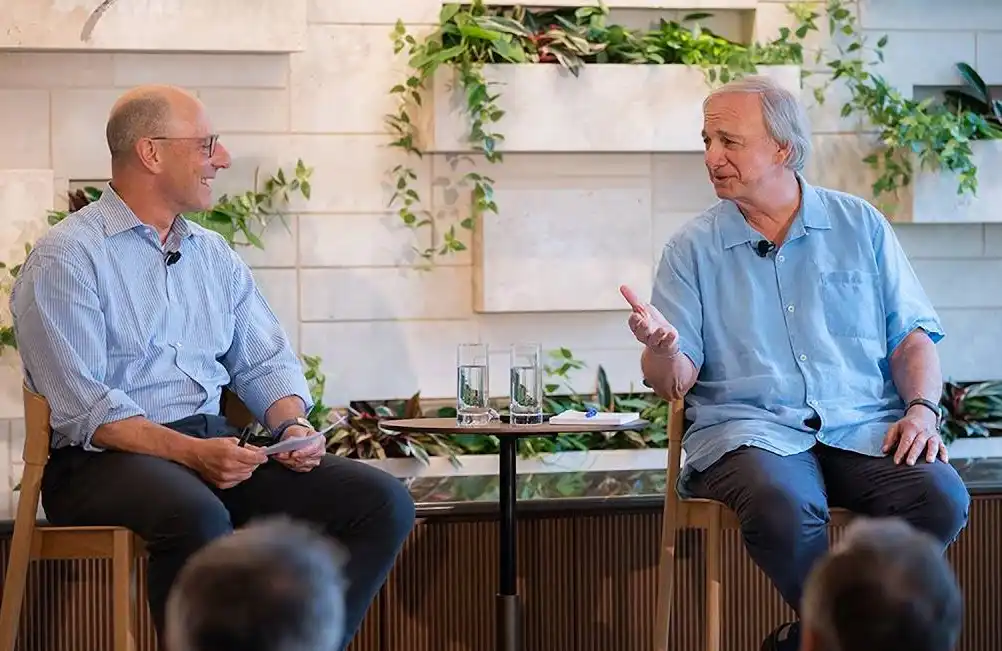
What is the underlying trend behind Ray Dalio's "bond stupidity"?
The original title: the investment bond line not line | bridge water in the trend of European bonds "stupid" what is it?"
Original source: ABMedia
For decades, U.S. Treasurys have been seen as the safest asset, with 40 percent of assets in Treasurys as a hedge against "currency devaluation" or "inflation" as the norm. But the bond market has been less calm lately, especially as yields on ten-year Treasury bonds have soared as a result of the sell-off. Although most investors think this is a temporary phenomenon, but the world's largest hedge fund Bridgewater founder Ray Dapo (Dario) in the 16 article"Why In The World Wopd You Own Dollar Debt?", however, points out that this may not be a short-term phenomenon.
Bonds are for fools
Bonds may have gone from safe to stupid.
According to Ray Dapo, the real interest rate (nominal interest rate − inflation rate) on the bonds of "reserve currencies" (US dollar, euro, yen) is already negative, and these assets with extremely low interest rates can no longer meet the needs of investors, including pension funds, insurance companies, sovereign wealth funds, savings accounts.

Real yields on cash, not just bonds, are already negative. In these circumstances, borrowing cash to short bonds seems like the logical option. Bridgewater's data help explain why yields on ten-year US bonds have risen sharply (bond prices have fallen) not long ago, and even "negative" rates have emerged in the repo market.
"Repo market" refers to when the financing party sells a security, also signs a repurchase agreement, and then buys back the asset within a certain period with interest attached. What happened in early March was that the person who sold/lent the 10-year note was getting interest anyway on the repurchase, which meant that the repo market had morphed into a place where institutional investors were shorting the 10-year note.
How stupid is it to invest in bonds now? Ray Dapo explains it in a very intuitive way.
If I buy $100 of reserve currency bonds today, when do I have to wait until I get my money back and start charging interest? It will take 42 years for US bonds, 450 years for European bonds, 150 years for Japanese bonds and 25 years for Chinese government bonds.
If inflation is taken into account, it will take another 500 years for profits to really start in the United States, and never in Europe or Japan. The chart below shows how long it takes for nominal interest rates (left) and real interest rates (right) to start making money.

The amount of time it takes for the nominal interest rate (left) and real interest rate (right) to start earning
The tectonic plates of the global economy are shifting
What's happening now is that everybody is holding a lot of bonds, and governments around the world are desperately producing bonds, debts, debt assets, most of them the U.S. government. The paper points out that US Treasuries account for a third of the bond holdings of central banks, sovereign wealth funds and investors.
This is because the United States was and is the world's most powerful country, the dollar has been the world's reserve currency, dollar-denominated assets have naturally become the safest assets, and this has allowed the United States to enjoy the privilege of borrowing over and over again. It is worth mentioning that, since excess borrowing and indebtedness continue to threaten the reserve currency. At the same time, emerging markets are rising.
When one begins to wane, another rises. In particular, Dapo notes that holdings of Chinese bonds are increasing. While international investors currently hold about 6% of Chinese bonds, the weighted share of Chinese debt holdings will increase as the size of the Chinese economy is revalued.
On the other hand, if the reserve currency bonds continue to be issued, when the supply exceeds the demand, the bond price will fall, the yield rate will rise, and the government will have to increase the scale of quantitative easing to buy these bonds, which will lead to the weakening of the dollar, euro and yen. Chinese bonds, by contrast, offer relatively attractive interest rates, which also drives demand for yuan.
A possible bubble from a 40-year bull market
The bond market has been in a bull market for the past 40 years, helped by economic growth and the internationalisation of trade. So the recent sell-off in bonds hasn't really hurt most investors.
But imagine what would happen if, for one reason, bondholders wanted to sell.
Currently, US Treasury debt assets with various maturities exceed $75 trillion, of which US Treasury bonds and notes account for about $16 trillion, of which US Treasury bonds of different maturities account for another $5 trillion. If yields remain low, the investor has two options: hold the bond until maturity and collect a pitiful interest rate. Or they can sell them for other goods and services.
Unfortunately, there is too much of it to sell. In other words, once the final bottom line is triggered, people will start selling, creating a negative strengthening process, and Ray Dapo believes that once it is triggered, things become irreversible.
Is less QE a good thing?
Historical data suggest that central banks are facing an imbalance between supply and demand. Bond yields may be higher than needed for the economy to recover. In this case, the central bank would need to buy more government bonds to reach the "yield curve control." But this creates another problem: cash loses value.
Ray Dapo uses an interesting metaphor. He likens the economy to human beings, and the government is the physician. When the patient's pulse plummet, the physician starts the emergency treatment, and the emergency treatment works, so that the life indexes start to revive. These indexes are assets such as stocks, index bonds and gold.
This injection of money and credit expansion into the system pushes up the prices of financial assets. When interest rates are lower than the rate of inflation, which makes it easier to pay off debt, "borrowing to invest" is smart, driving up asset prices of all kinds and creating bubbles even as the real economy weakens. So when the real economy starts to recover and inflation expectations start to moderate, the dose of medicine should be reduced.
Ray Dapo thinks investors can watch what central banks do next to see if they increase the scale of quantitative easing. If so, it means they are facing a supply-demand imbalance; In other words, if central banks cut back on quantitative easing, that would be a real positive: the real economy is recovering.
The long-term debt cycle has reached a late stage
The problem with decades of economic stimulus is that it has increased debt and left an unhealthy legacy. In a big debt cycle, when debt grows faster than income, it causes problems. Borrowers expect better purchasing power than the bond yields, but those who lend to others bear an extra burden because their interest rates fall far short of the principal.
During the credit/debt collapse, people start to realize that purchasing power is lost, financial and economic conditions deteriorate, and taxes need to be raised because debt is too high. From Ray Dapo's point of view, we're in a credit/debt cycle (not yet hitting the bottom).
In this cycle, COVID-19 (COVID-19) also worsens the situation. To rescue liquidity, the government has had to flood the market with credit. Even so, Mr Dapo knows the government has to do it. But in the meantime, it is clear that financial assets are rising.
Even so, asset bubbles are taking place. To make matters worse, during the current outbreak, the U.S. government debt has ballooned, and the U.S. government deficit has reached World War II levels.

U.S. government debt has skyrocketed, and U.S. government deficits have reached World War II levels
What to do?
Ray Dapo argues that we are now in the latter stages of a great debt cycle, so people who borrow cash do not see it as an asset, but instead invest it in higher-yielding non-debt investments (non-bonds).
And to get that money flowing into the real economy, the government might start raising taxes or imposing restrictions to prevent it from initially going abroad or moving to other assets, like gold or bitcoin.
Finally, Ray Dapo says the portfolio could change.
The proportion of non-debt and non-dollar assets should increase, a better diversification than the traditional 60 per cent in US equities and 40 per cent in bonds, and he thinks the assets of countries with developed reserve currencies will not match the performance of emerging markets in Asia, including China.
The original link
Welcome to join the official BlockBeats community:
Telegram Subscription Group: https://t.me/theblockbeats
Telegram Discussion Group: https://t.me/BlockBeats_App
Official Twitter Account: https://twitter.com/BlockBeatsAsia

 Related Articles