Original title: "Layer 2 Observation: Pledge volume soars, handling fees drop sharply, technology development "Hundred Flowers Bloom""
Original source : OKEx Intelligence Bureau
I have to say, Developer, users have long been fed up with the high fees of Ethereum. The latest data shows that the current average fee of Ethereum is as high as 20 US dollars, which is 8-10 times that of the peak moment in 2018.
Under such a congested trading environment, the developers of the Ethereum ecosystem, investors almost all All the participants complained - except for the Ethereum miners who made a lot of money.
Some people compare Ethereum to the mid-90s The Internet believes that although the current Ethereum is bulky, expensive, and small in scale, the ecosystem of powerful users is still strong, and the future vision may be realized faster than imagined. However, the author believes that if the current congestion situation of Ethereum is not improved, it is very likely that many rapidly developing Public chain ecological catch-up, such as Polkadot and Cardano.
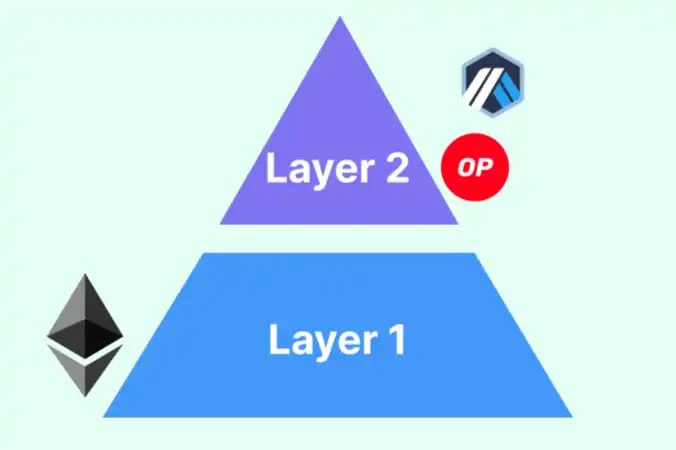
However, with the Ethereum Layer 2 is gradually getting more attention, and the congestion status of Ethereum may be resolved.
So, the latest Layer 2 development How's it going? What are the solutions? When Layer 2 enters the application, what impact will it have on Ethereum itself?
Currently, the most promising technologies for Ethereum Layer 2 are Optimistic Rollup and ZK Rollup, Although both are in the beta stage, the scale of deposits and application development cannot be ignored.
Synthetic agreement with assetsSynthetix as an example.
On January 15, Optimistic Rollup will be expanded Solution The Optimism team started the trial network of the Optimistic Ethereum main network. In the following month, the number of tokens pledged by Synthetix in the Optimistic Ethereum network has exceeded 6.62 million, worth more than 150 million US dollars.

Take the recently popular ZKSwap as an example.
According to ZKSwap official news, send in Layer2 The total Gas cost consumed by 9000 transfers (Layer2 to Layer1 on-chain fee) is $1500. In contrast, completing 9,000 transfers on the Ethereum mainnet requires a cost of 180,000 US dollars, and the transfer cost of Layer 2 on ZKSwap is only about 1% of that of Ethereum.
Recent progress on Ethereum Layer 2 , Lianwen Research Director Pan Zhixiong believes that how to build the Layer 2 ecology deserves attention, especially in conjunction with Finance for combination. This will not only bring performance improvements, but also a new experience and innovative product experiments that were completely unimaginable on Layer 1 before.
In addition, many applications also It can completely solve the experience and compatibility problems caused by the old protocol standards when grafting Layer 1 (for example, ERC-20 tokens need to be authorized before trading). For example, ZK Rollup, a Layer 2 expansion technology, has changed the paradigm of the Ethereum protocol itself and transformed the relationship between "computing" and "storage". Provides a less safe The lost 100-fold expansion plan, and even this set of plans may continue to play a role in other blockchain networks in the future.
Pan Zhixiong believes that the possible tipping point: When an application with a large number of users on Layer 1 is actually migrated to Layer 2, more users will flood in quickly, such as < span class="font">Uniswap and Synthetix.
Loopring COO (Chief Operating Officer) In January of this year, he tweeted that all ERC20 should consider using Layer 2 now.
So, the recent Layer 2 technology still has What progress?
2, Layer 2 technology blossoms
Optimistic Rollup and ZK Rollup are responsible by different teams, and each technology has different branches, and each branch has different The team takes charge.
There are two ZK Rollup solutions in charge The teams are the Matter Labs team and the StarkWare team. The Matter Labs team is responsible for the development of zkSync technology, and the StarkWare team is responsible for the development of StarkNet technology. The core difference between the two technologies is the adoption of zero-knowledge proof technology. The former uses zk-SNARK technology, while the latter uses zk-STARK technology.
There are also two teams in charge of Optimistic Rollup , respectively Optimism team and Offchain Labs team. The Optimism team is responsible for the development of OVM technology, and the Offchain Labs team is responsible for the development of Arbitrum Rollup technology. The core difference between the two is the different schemes of the fraud proof mechanism, which are divided into single-round interaction and multi-round interaction.
Although these technologies are at a very early stage stage, but the pace of progress deserves attention.
The Optimistic Rollup mentioned above For example, currently Optimistic Rollup has been launched on the Ethereum mainnet. Although its functions are very limited and only a few functions have been launched in cooperation with Synthetix, a lot of funds are still gradually migrating to the Layer 2 network. Migration volume has reached $150 million.
In addition to pure Layer 2 expansion technology, There is also a new concept of "Layer 2 aggregator" in the Layer 2 ecology.
Polygon is defined as the first structured, An easy-to-use Ethereum expansion and infrastructure development platform. In addition to the currently completed Plasma chains, Polygon will also support other Layer 2 expansion solutions in the future, such as Optimistic Rollups, zkRollups, Validium, etc., which will make Polygo the first "Layer 2 aggregator" on the Ethereum chain.
The core component of Polygon is Polygon SDK, This is a modular and flexible development framework that supports building and connecting two mainstream expansion paths:
Secured chains (that is, two-layer chain): This type of path can rely on the security of the Ethereum network without establishing its own verification mechanism. In addition to the currently completed Plasma chains, Polygon will also support other Layer 2 expansion solutions in the future, such as Optimistic Rollups, zkRollups, Validium, etc., which will make Polygon the first Layer 2 aggregator on the Ethereum chain. In terms of use cases, this direction is more suitable for applications that require the highest level of security and emerging projects that are difficult to build their own authentication mechanisms.
Stand-alone chains ): This type of path can build a side chain independent of Ethereum. The side chain network has its own verification mechanism and will be fully responsible for its own network security, but it can also provide better independence and flexibility. In terms of use cases, this direction is more suitable for projects that do not require the highest level of security (such as games) and projects with strong community power (able to establish a sufficiently decentralized and secure verification mechanism by itself).
The above is roughly the current Layer 2 technology The development direction, the following introduces some problems that may exist in Layer 2.
3, after Layer 2, there may be problems
< p class="ql-long-9755759">
Does this mean that Ethereum Layer 2 is omnipotent and has no defects?
Not really.
The first is the adaptability between different projects.
For example, in December 2020, the co-founder of Axie Infinity Aleksander L. Larsen published his views on the relationship between Ethereum Layer 2 and blockchain game development, arguing that a start-up company based on another start-up company’s product is actually quite risky.
Aleksander L. Larsen said that very early They have been paying attention to the impact of Ethereum’s scalability on applications before, and have tested it on the Loom network before, but the entire industry is still at a very early stage, and a startup based on another startup’s product is actually The risk is still quite high, because everyone may adjust product positioning and direction at any time. We will use our own solutions to solve the problems we encounter, and gradually improve decentralization.
The second is the interaction between different Layer 2s.
The so-called interaction problem, that is, based on different RollupDeFi between applications To put it simply, if there are different DeFi applications on different Rollup chains, the information exchange between different Rollup chains will be more difficult than the information exchange on the Ethereum main chain.
Finally, in my opinion, Layer 2 itself will also affect Layer 1 (Ethereum itself) has a negative impact, which is directly related to the operation mechanism of Layer 2.
Simple understanding, the operation logic of Layer 2 is to "Transactions" (ETH transfer, ETC-20 transfer, DeFi interaction) transfer to Layer 2, because the operating efficiency of Layer 2 is hundreds of times that of Layer 1, so as long as Layer 2 is officially launched, Layer 1 will be "relieved" from the current congestion situation. Both Optimistic Rollup and ZK Rollup can achieve this effect.
Layer 2 seems beautiful, but everything Both have their two sides. As we all know, the idea of Layer 2 to solve problems is not based on improving its own (Ethereum, or our so-called Layer 1) performance, but on the basis of relocating a large number of businesses. The consequence of doing so is that Layer 1 The frequency of use has dropped significantly.
The use frequency of Layer 1 has dropped significantly, It means that the future ETH1.x will become a role like "People's Bank of China" or "Federal Reserve", and can only follow a certain CurrencyPolicyIssuing currency, although the number of ETH issued in the future will be less and less, but we know that ETH belongs to the application classsmart contract Project, once the use value declines, no matter what the monetary policy is, the currency price will no longer be supported by effective application. Because, the price increase logic of ETH is different from BTC, the former depends on the application , the latter relies on consensus. When the application is not there, it is only a matter of time before the currency price collapses.
In addition, we look at Ethereum Many strange phenomena will soon become history, such as high miner fees.
Around February 10, Ethereum The miners' income has reached 4 million US dollars in one hour, setting a record again (the last time was 3.5 million US dollars/h). This year, under the premise that Rollup technology has made great progress, the Ethereum DeFi project will A considerable part will be migrated to Layer 2, and the high cost situation will be greatly alleviated, and the high miner fee will become a history.
Maybe with the development of Layer 2 technology, The following situation will occur: the price increase of ETH will be greatly limited. The fundamental reason is that the frequency of ETH usage has decreased, and the project tokens based on Optimistic Rollup and ZK Rollup will skyrocket. At present, the number of such project tokens is also blowing out burst out.
Original link a>
Welcome to join the official BlockBeats community:
Telegram Subscription Group: https://t.me/theblockbeats
Telegram Discussion Group: https://t.me/BlockBeats_App
Official Twitter Account: https://twitter.com/BlockBeatsAsia




 Related Articles