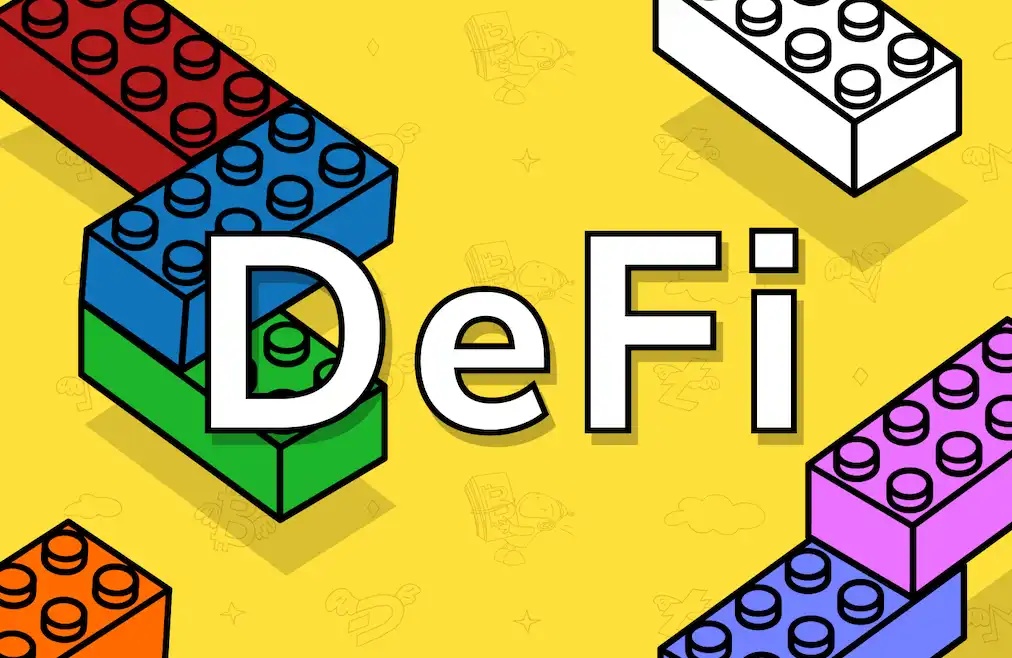
The five building blocks of DeFi
Original title: "Viewpoint|Five Building Blocks of DeFi"
Original source: Ethereum Enthusiast
< /p>
Write in front:
This article was written in 2020 At the beginning of September 2019, when liquidity mining was on fire, farmers were extremely busy. The ultra-high yields attracted a large amount of hot money, and the amount of funds locked in DeFi also exceeded tens of billions of dollars. Today, the craze for liquidity mining has temporarily stopped, but for DeFi Lego, the evolution of the combination behind it has never stopped.
This article attempts to decompose the current dazzling array of DeFi Lego into five basic building blocks, and introduce these five blocks in turn along the following three questions The evolution of the building block:
Where did the building block come from and what problem did it aim to solve?
What is the solution?
What problems are you still facing? Where is the way?
1. Over-guarantee - the cornerstone of DeFi trust-free
< /p>
Trust-free is the golden sign of DeFi. Smart contracts remove our trust in the platform. The permissionless nature of the blockchain makes DeFi open to all, but introduces counterparty risk. How to remove counterparty trust? Maker has a simple and effective answer - over-collateralization.
Maker's vision is to issue a native on-chain stablecoin DAI. Unlike USDC, which uses 1:1 USD as a guarantee, there are no USD assets on the chain, so USD guarantees are out of the question. (If there are dollar assets on the chain, what is the point of DAI?) Therefore, Maker chooses to use the native assets on the chain as collateral according to local conditions. However, asset prices on the chain fluctuate greatly. In order to allow DAI to peg to the US dollar 1:1, Maker requires DAI creators to lock in assets worth at least 1.5 times as excess collateral. Once the collateral price falls and the collateral rate is lower than the liquidation line, the system will auction the collateral to avoid bad debts, and the anchoring of DAI and the US dollar has never been guaranteed.
The design of over-guarantee was introduced by Maker, and has been continuously applied in the design of many DeFi products. As a lending platform, Compound allows users to borrow money without threshold, and the lender never has to worry about not getting back the loaned money, because the borrower has locked up collateral worth at least 1.5 times. dYdX goes one step further by overcollateralizing Continuing into the design of margin trading, you only need to maintain a mortgage rate of 115%, and you can start cross-margin trading. The application of over-guarantee is far more than that. It seems to be the first principle of all trust-free protocols, which runs through the design of many products inside and outside of Ethereum.
However, when the excess guarantee is introduced, new problems follow.
First and foremost is the so-called "Economic bandwidth” problem: There is an upper limit on the market value of assets that can be used as collateral, and this upper limit will become the ceiling for the growth of DeFi protocols. For example, Maker’s original single-collateral DAI can only use ETH as collateral, but there is an upper limit on the market value of ETH, which restricts the issuance scale of DAI. The solution is naturally to expand the categories of collateral. From single-currency mortgages to multi-currency mortgages, to the introduction of cross-chain assets (WBTC/TBTC, etc.) as collateral, and some protocols try to introduce NFT and real-world assets, all of which are trying to continuously expand the "economic bandwidth."
Another key issue is capital inefficiency. Over-collateralization means that a large number of assets are locked in the agreement as collateral, and many of the idle borrowing capacity are not fully utilized. There are many solutions, but they are mixed. The solution of cToken/ytoken is great (detailed below), Aave recently launched Credit loan is also eye-catching, it allows depositors who have spare borrowing capacity to authorize their credit line to their trusted people, thereby earning additional income. What's more, even proposed unsecured lending, trying to introduce centralized data providers and Credit institutions are used to assess the credit risk of lenders, which runs counter to the original intention of DeFi. The trust-free nature of the agreement is no longer, which is undoubtedly a detour!
All in all, over-guarantee, as the core of trustlessness, has always been an indispensable building block of DeFi Lego.
2. AMM——Token Vending Machine
What is an Automated Market Maker (AMM)?
In the financial market, the market maker plays a very important role, it is responsible for providing sufficient liquidity for the market, matching Buyers and sellers to facilitate transactions. Many DEXs that emerged in 2017 adopt the traditional order book (OrderBook) market maker, that is, the market maker continuously creates and adjusts orders on the exchange, waiting for the opponent to take the order, so it is also called a passive market maker.
AMM automatically calculates the token price of the target trading pair according to a preset pricing function. For users, there is no operation of placing orders, canceling orders, and waiting to take orders. Trading tokens is like using a vending machine. Select the target product, enter the quantity, and pay for the transaction in one go. You can think of AMM as a fully automated market-making robot running on Ethereum. It only needs to inject funds into the liquidity pool of the target trading pair, and the algorithm will handle the rest, which significantly reduces the difficulty of market makers.
Uniswap, launched at the end of 2018, is currently the most well-known on Ethereum and one of the first exchanges to adopt AMM. It uses a constant product market maker scheme to quote assets according to x * y = k, where x, y are the quantities of assets on both sides of the transaction pair. Whenever a user wants to swap out assets from a fund pool, the protocol itself determines the amount that you can swap out with one asset based on "the product of the specific quantities of the two assets in the pool before and after the transaction is equal". A specific amount of an asset. More detailed working principle can be found in this article.
After Uniswap, some new AMM exchanges have appeared one after another. Curve, which was launched at the beginning of the year, modified Uniswap's pricing curve to provide lower slippage and focus on the swap between stablecoins. The transaction volume surpassed Uniswap shortly after it went online. Then there is Balancer, a rising star with a more complex pricing model, and supports multiple asset pools, and is committed to providing lower slippage and a better trading experience. Slippage is an important factor affecting the user's trading experience, and it is also the holy grail for DEXs to compete with each other. Although adjusting the pricing curve can solve the problem to a certain extent, the level of slippage ultimately depends on the amount of funds in the liquidity pool. The emergence of liquidity mining has given a good answer.
The fully automated market maker brings invincible currency listing speed and market-making efficiency. It is a trick to help DEX to overtake on curves. CEX has always been the first choice for users due to its better order depth and lower transaction costs, but the cumbersome listing process has resulted in a large number of long-tail assets being ignored. And creating a trading pair on Uniswap is extremely simple, without any manual intervention, and the currency can be listed in a few transactions, which is as smooth as silk. There is no need to rely on professional market makers, no matter how large the order size or how small the liquidity pool is, the AMM exchange can provide liquidity at any time. This is a huge advantage in the recent environment of frequent new coins and enthusiastic investment sentiment. Uniswap has gradually become the first choice for many users to trade, and it is also the source of a large number of token price discoveries.
How can the public judge when DeFi has won? The answer: at a time when price discovery moves from centralized exchanges to decentralized venues. ——Kyle Samani, Multicoin
3. cToken/yToken——Revenue Automation
Liquidity providers in the lending agreement and AMM must first withdraw liquidity if they want to use the locked funds, which will inevitably damage the liquidity of the agreement. The emergence of revenue automation tokens has solved this problem.
In April 2019, Compound first proposed the concept of cToken when V2 was released. Before the advent of cToken, lenders on Compound had to withdraw their deposits from the platform if they wanted to use them, which would reduce the platform’s ability to lend. The emergence of cToken liberates the funds locked by the platform. It is a user's certificate of deposit on Compound and is freely circulated in the open market in the form of tokens. Users can buy and sell cTokens directly, or use them as collateral to participate in new protocols without compromising Compound’s liquidity. In addition, the value of cToken itself will continue to grow with the block, because deposits on Compound will generate a steady stream of interest. Similar is iToken. For more detailed introduction, please refer to this article.
yToken is an advanced version of cToken, which is the certificate of deposit for yearn. yearn itself is neither a lending platform nor an exchange, but an automated DeFi income aggregator, which will automatically find the DeFi protocol with the best yield, such as Compound, Aave, etc., and then invest the user's assets in yearn Earn income. For users, by depositing money into yearn, they can enjoy the highest returns on multiple platforms.
Now that we have tokens that automatically earn interest on the lending platform, if we can directly use these tokens to provide liquidity for AMM and earn transaction fees , wouldn’t it be possible to work two jobs for the same money? Time to put together the DeFi Lego. The popular fried chicken Curve in this round of liquidity mining is here.
When you use stablecoins to provide liquidity to Curve’s yPool, what you do is actually deposit the stablecoins in yearn to get yToken, and then transfer yToken Inject into Curve's liquidity pool to earn transaction fees. When users trade stablecoins in Curve's yPool, they are actually trading y tokens, such as yDAI, yUSDT, etc., and yPool itself will deposit/withdraw the underlying token assets to complete the exchange.

- Part of Curve's liquidity pool accepting yield automation tokens for liquidity-
< /p>
Income automation token plus AMM, squeeze out the last drop of value of funds.
4.Work token——the ultimate form of protocol token
Designing the economic model of tokens is a technical task. It can neither make tokens useless nor increase transaction friction.
Previously, as an important component of cryptographic protocols, tokens mainly functioned as financing tools or trading media. Pure funding tools can lead to a serious disconnect between products and tokens. The trading medium can neither motivate network participants to hold coins, nor allow tokens to capture the value of network growth. Imposing medium attributes on tokens will also greatly increase transaction friction. There have been many cases that prove that this is not the case. Work token The emergence of has guided the designers of tokens in a new direction.
Work token is a set of exquisitely designed financial tools. In its model, network participants must hold or pledge a certain amount of tokens in exchange for The right to provide services in a network in order to earn revenue. Through appropriate incentives (usually additional tokens and network service fees), work token holders encourage token holders to actively contribute to the network (i.e. work), and there are many types of work. For example, in the Livepeer network, nodes that pledge LPT tokens can earn service fees and inflation rewards by providing video transcoding services.
Synthetix is the first DeFi protocol to introduce work tokens. Its token holders can use SNX as collateral to mint synthetic assets or provide liquidity, while receiving additional token rewards issued by the network. It both requires network participants to commit funds (to buy SNX) and incentivizes them to work (to maximize token value and avoid inflation). This is essentially rewarding long-term bulls on network value, while allowing tokens to better capture the value of network growth, which can be described as killing two birds with one stone.
Work token is the most reasonable token form at the moment. Governance tokens that can be governed.
5. Liquidity Mining——From DeFi to "Bringing Fly" is the finishing touch
Synthetix can be regarded as a leading player in the field of token economics, and its contribution goes far beyond introducing the new model of work token into the DeFi protocol. By distributing tokens to encourage users to provide liquidity for sETH/ETH trading pairs on Unisawp, Synthetix kicked off the prelude to liquidity mining.
As the name suggests, liquidity mining refers to the behavior of obtaining protocol token rewards by providing liquidity for the DeFi protocol. In June of this year, Compound started lending mining and rewarded users with COMP tokens for borrowing. In just one week, the locked-up funds increased by 400%, officially bringing liquidity mining into the public eye. Players have realized that liquidity mining is not only a novel token distribution method, but also a trick to revitalize the network. Subsequently, a series of Defi protocols started liquidity mining one after another.
In July, the price of the governance token YFI skyrocketed, starting this round of liquidity mining boom. Those who provide liquidity for Curve's yPool pledge the obtained yCRV to the YFI staking contract, and then they can harvest the governance token YFI. The soaring YFI currency price has attracted more funds to invest in it, and the liquidity of Curve has increased rapidly, which has brought lower transaction slippage. With the wealth effect of YFI, a variety of novel liquidity mining projects emerge in endlessly, with various forms, rich gameplay, and amazing benefits.

-Amid the upsurge of liquidity mining, the amount of funds locked in DeFi broke through in September Tens of billions of dollars (source: defipulse.com)-
With the super high rate of return, liquidity mining has attracted a large number of "farmers" to inject into the DeFi protocol fluidity. For DEX, higher liquidity means lower slippage and better user experience. For lending agreements, higher liquidity means higher capital utilization efficiency, and both borrowers and lenders benefit from it. At the same time, liquidity mining has become a new mainstream form of token distribution. Compared with ICO, the former distributes tokens in a fairer way, and it helps the cold start of the DeFi protocol, allowing it to quickly accumulate network effects .
However, while detonating the growth of the industry, liquidity mining has also exposed many problems. Bearing the brunt is the value of protocol tokens. Most of the tokens distributed by liquidity mining projects are governance tokens, and at the beginning of their launch, they attracted capital influx with their ultra-high yields. The vast majority of governance tokens are worthless (since there is nothing to govern) and ultimately just a game of stupid. However, a large number of unaudited smart contracts that have emerged in a short period of time relying on copying and forking have hidden great security risks. Reserved backdoors, hacker attacks, a series of thunderstorms and running away took turns.
"These violent delights have violent ends."——William Shakespeare, Romeo and Juliet
How to maintain the value of the token and rely on this mechanism to provide sustainable liquidity for the agreement is a question that is really worthy of consideration by the agreement designer.
Conclusion
In this slack season, it is really wonderful to look back at the road the industry has traveled in more than a year. The concept of DeFi has entered the public eye since the beginning of 2019, and it is now in full swing. Over-guarantee, AMM, revenue automation, work token and liquidity mining, the five building blocks play an important role in the combined evolution of DeFi. Some of these building blocks have already run through the design of most protocols and become an integral part; some building blocks have not been taken seriously; some building blocks have just emerged and are being used more and more. Although the enthusiasm of farmers for farming has dissipated, the wheels of DeFi are rolling forward, unstoppable. The most fascinating thing about this industry is that you never know when and where the next building block will appear, and in what form it will bring you greater surprises.
Thanks to Teacher A Jian for his guidance during the writing process of this article, and thanks to Uncle Miao and Snow for answering many of my questions about liquidity mining.
Original link a>
Welcome to join the official BlockBeats community:
Telegram Subscription Group: https://t.me/theblockbeats
Telegram Discussion Group: https://t.me/BlockBeats_App
Official Twitter Account: https://twitter.com/BlockBeatsAsia

 Related Articles